Dynamics 365 F&O Model Types: Platform vs Application
Short answer
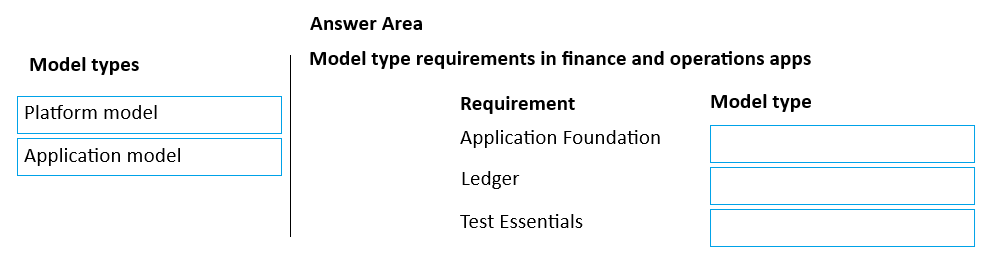
Application Foundation should be mapped to the Platform model. Ledger should be mapped to the Application model. Test Essentials should be mapped to the Platform model.
Question
You are creating custom functionality for Dynamics 365 Supply Chain Management.
You reference standard models in the custom model to use data types and classes in the customizations.
You need to select the model type to use for each customization.
Which model type should you select? To answer, move the appropriate model types to the correct requirements. You may use each model type once, more than once, or not at all. You may need to move the split bar between panes or scroll to view content.
NOTE: Each correct selection is worth one point.
Key Takeaways
The main trap is confusing 'Foundation' with 'Application'; however, Foundation models provide shared infrastructure for all apps, making them Platform models, whereas domain-specific modules like Ledger are Application models.
Learn how to classify Dynamics 365 Finance and Operations models into Platform or Application categories based on their scope and usage within the application stack architecture.
Common mistake: Learners often incorrectly classify Ledger as a Platform model because it is a core component. They fail to recognize that Platform models are those shared across *multiple* distinct applications (like Finance and Supply Chain), while Ledger is exclusive to Finance.
Expert Analysis
The question requires mapping specific Dynamics 365 Finance and Operations models to their correct classification within the application stack architecture. The core concept is distinguishing between Platform Models and Application Models. Platform models contain shared infrastructure, base classes, and common data types used across multiple applications. Application models contain business logic and data structures specific to a single application or industry vertical.
The Application Foundation model provides foundational services (such as security, user experience patterns, and base classes) that are shared by all finance and operations applications. Therefore, it is classified as a Platform model. Similarly, the Test Essentials model provides testing utilities and frameworks used across various customizations and standard apps, making it another Platform model.
In contrast, the Ledger model contains financial-specific entities, tables, and logic unique to the Finance application. It does not provide shared infrastructure for other apps but rather implements specific business functionality. Thus, the Ledger model is an Application model. This distinction is critical: if a model is part of the 'base' stack shared by many apps, it is a Platform model; if it is a specialized module, it is an Application model.
Comments in the source material correctly identify this pattern, noting that Microsoft’s documentation splits the stack into platform models (Application Platform, Application Foundation, Test Essentials) and application-specific models (Ledger, Retail, etc.). The key insight is recognizing that 'Foundation' and 'Essentials' imply cross-cutting concerns, while 'Ledger' implies domain-specific logic.
Exam Strategy
When asked to classify models, ask if the model provides shared infrastructure (security, UI patterns, testing) for multiple apps. If yes, it is a Platform model. If it contains specific business logic for one domain (Finance, Retail, SCM), it is an Application model. Memorize the three primary Platform models: Application Platform, Application Foundation, and Test Essentials.
Frequently Asked Questions
What defines a Platform model in Dynamics 365?
Is the Ledger model a Platform or Application model?
Discussion 2 contributions
Compiled from public community threads and reader submissions, lightly edited for clarity. Handles and vote tallies are shown as recorded, and comments reflect the views of individual contributors.
From public community threads 2
-
cbef765 👍 1Requirement Model type Application Foundation - Platform model Ledger - Application model Test Essentials - Platform model Why: Microsoft answers this almost word for word in the Application stack and server architecture article. It says the application stack is split into platform models and application-specific models, and that the platform models are Application Platform, Application Foundation and Test Essentials. It then lists Application Suite, Ledger, Retail and Case Management as examples of the many application-specific models.
-
jennylin1735 👍 1Application Foundation = Platform model Ledger = Application Model Test Essentials = Platform Model The application stack is divided into platform models and application-specific models. The platform models are Application Platform, Application Foundation, and Test Essentials. There are many application-specific models. Some examples are Application Suite, Ledger, Retail, and Case Management. https://learn.microsoft.com/en-us/dynamics365/fin-ops-core/dev-itpro/dev-tools/application-stack-server-architecture
Reader comments & corrections
No reader corrections yet — spotted an error or have a note? Share it below.
Related Analysis
Practice All MB-500 Questions
Access 115 questions with complete answers and detailed explanations.
View Full MB-500 Practice Test →