Dynamics 365 Finance Sales Tax Posting Validation by State
Short answer
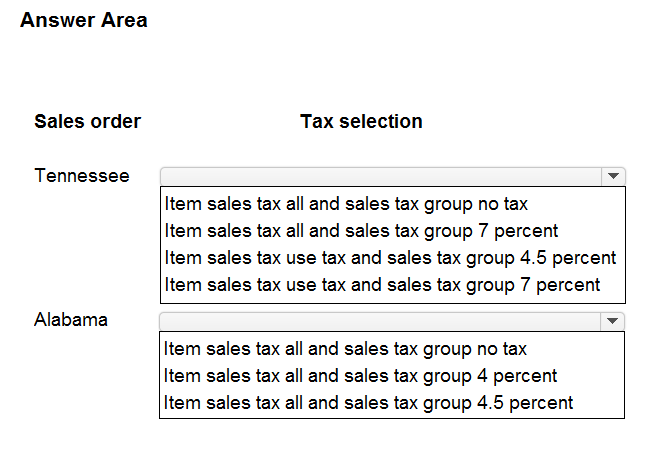
Tennessee requires the Sales Tax selection because the exhibit indicates physical presence liability. Alabama requires no Sales Tax posting (or Use Tax designation if referring to customer liability) because the exhibit indicates no physical presence or collection requirement for the vendor.
Question
Case study
This is a case study. Case studies are not timed separately. You can use as much exam time as you would like to complete each case. However, there may be additional case studies and sections on this exam. You must manage your time to ensure that you are able to complete all questions included on this exam in the time provided.
To answer the questions included in a case study, you will need to reference information that is provided in the case study. Case studies might contain exhibits and other resources that provide more information about the scenario that is described in the case study. Each question is independent of the other questions in this case study.
At the end of this case study, a review screen will appear. This screen allows you to review your answers and to make changes before you move to the next section of the exam. After you begin a new section, you cannot return to this section.
To start the case study
To display the first question in this case study, click the Next button. Use the buttons in the left pane to explore the content of the case study before you answer the questions. Clicking these buttons displays information such as business requirements, existing environment, and problem statements. If the case study has an All Information tab, note that the information displayed is identical to the information displayed on the subsequent tabs. When you are ready to answer a question, click the Question button to return to the question.
Background
First Up Consultants is a global engineering and consulting organization based in Atlanta. The organization assists customers with various implementation projects. The organization provides both consulting services and custom software development.
First Up Consultants was recently acquired by a Canadian engineering firm that uses Dynamics 365 Finance. The firm requires First Up Consultants to transition to the solution by 2022.
First Up Consultants employs consultants that travel globally, which requires extensive expense management capabilities. First Up Consultants offers software as a service (SaaS) products to customers by using monthly and quarterly subscriptions.
Current environment. Travel and expense
The company is currently in Phase 2 of their Dynamics 365 Finance implementation.
• Consultants submit all travel receipts by using inter-office mail to the team admin for processing, but First Up Consultants wants to modernize this experience.
• Expense reports are manually approved and signed by the employee’s manager.
Current environment. Finance
• First Up Consultants operates on a 4-5-4 calendar.
• Accounting for revenue has been difficult with the SaaS offerings. This has led to implementing Dynamics 365 Finance Revenue recognition.
• Revenue recognition has been live for 3 months.
• Adatum Corporation pays quarterly for use of the First Up Consultants web design application, starting from the day of use.
• Fourth Coffee pays monthly for use of the First Up Consultants photograph editing application with a contract starting August 1 and payment starting September 1.
• Adventure Works Cycles pays per use of the First Up Consultant video platform.
• A blocking rule is set up to prevent a sales order from processing if a customer exceeds a credit limit.
• Customer credit is set up at the account level for VanArsdel, Ltd.
• Tailspin Toys is owned by Wingtip Toys. The companies have a credit limit of $60.000 and $100,000, respectively.
Current environment. Revenue allocation
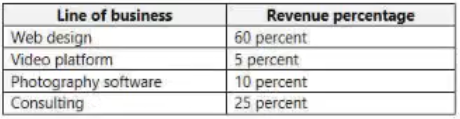
The company reports the following revenue allocation percentages:
Current environment. Tax
VAT tax recovery is required for eligible international business trip expenses. Bank reconciliation is manual and performed by using monthly mailed account statements.
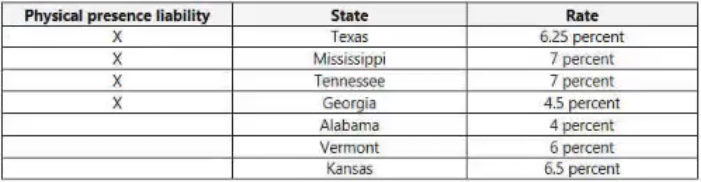
The company collects sales taxes from the following states:
Requirements
Travel and expense
• First Up Consultants requires that employees start using corporate cards for all travel expenses.
• All expenses over $50 require a receipt.
• Beer cannot be expensed.
• Employees may use the corporate card for personal expenses during work travel, but expenses must be categorized correctly.
• Client entertainment expenses totaling more than $250 must be audited.
• Employees require a mobile expense experience.
• Expense report entries must be validated when a transaction line is entered.
• Employees require the ability to capture receipts by using a mobile device.
• First Up Consultants requires the ability to reimburse employees in their paychecks for expenses incurred on personal cards.
Financials
• A virtual thirteenth month is required for year-end transactions.
• Each day, a validation file must go to First Up Consultants bank detailing all vendor checks paid.
• Except fees, all matched transactions must clear automatically during bank reconciliation.
• The accounts payable team must verify expense reports prior to posting.
• Only payables are allowed to be posted to a prior period up to seven days into the new period.
Issues
• User1 installed the Expense Management Service add-in and implemented the auto-match and create expense from receipt features, but the receipt images do not match the corporate card transactions.
• Employee1 submits an expense report for a business trip to Europe, but the report is not visible on the expense tax recovery page.
• Employees provided feedback that the system lets them know of an expense report policy violation only after the entire expense report is submitted.
• Members of the finance department observe sales orders that posted into a closed period.
• The finance team observed that for sales order invoice 1234, the price incorrectly posts to a revenue account when it should be deferring.
• Employee2 purchased supplies for a holiday party and needs to be reimbursed.
• A customer orders software licenses for the offices in Tennessee and Alabama.
• Expense reports for unapproved items are posting.
• VanArsdel, Ltd. exceeded its credit limit but the sales order was processed.
• Tailspin Toys purchases $70,000 in custom software development.
You need to validate the sales tax Postings for Tennessee and Alabama.
Which tax selections meet the requirement? To answer, select the appropriate options in the answer area.
NOTE: Each correct selection is worth one point.
Key Takeaways
The main trap is ignoring the 'physical presence' indicator in the exhibit; Tennessee has an 'X' requiring Sales Tax, while Alabama lacks it, meaning the vendor does not collect Sales Tax.
This page explains how to validate sales tax postings for Tennessee and Alabama in Dynamics 365 Finance based on physical presence exhibits. Tennessee uses Sales Tax due to marked liability, while Alabama does not.
Common mistake: Candidates often select Sales Tax for both states or confuse Use Tax with Sales Tax. They fail to notice the 'X' markers in the exhibit, which strictly define where the vendor must collect tax.
Expert Analysis
To determine the correct tax selections for Tennessee and Alabama, we must first analyze the company's physical presence and liability based on the provided exhibits. The 'Current environment. Tax' exhibit explicitly marks Texas, Mississippi, Tennessee, and Georgia with an 'X' under the column indicating physical presence liability. Conversely, Alabama, Vermont, and Kansas are not marked.
For Tennessee: Since the company has a physical presence there, it is required to collect and remit sales tax on taxable transactions. Therefore, the appropriate selection is the standard Sales Tax mechanism, which charges the customer at the state rate (7% as noted in comments). This ensures revenue is collected from the buyer.
For Alabama: The exhibit shows no physical presence or collection requirement. However, if the customer purchases taxable goods and the vendor does not collect tax, the customer may still have a 'Use Tax' obligation depending on local laws, but from the vendor's perspective in Dynamics 365 Finance, if there is no nexus, the transaction typically does not trigger a sales tax posting for the vendor. Crucially, the question asks about validating postings. If the item group is set to charge tax generally, but the location (Alabama) has no nexus, the system should not post Sales Tax. Some interpretations might suggest 'Use Tax' if the entity itself is buying, but here a customer orders software. Without physical presence, the vendor doesn't charge Sales Tax. If the question implies a scenario where tax must be accounted for despite lack of nexus (rare for vendor side), one might look for alternative codes, but standard doctrine dictates: No Nexus = No Sales Tax Collection.
However, looking at the specific 'issues' or requirements context often found in these exams: The key distinction is between Sales Tax (vendor collects from customer) and Use Tax (customer pays to government, or vendor remits if they have nexus but didn't collect). For Tennessee, it is clearly Sales Tax. For Alabama, since there is no nexus, the vendor does not collect Sales Tax. If the exam expects a tax code to be selected for validation purposes to ensure no tax is wrongly posted, or if it refers to a specific 'Use Tax' setup for cross-border scenarios, the critical factor is the physical presence marker.
The most common trap is confusing the two. Tennessee has an 'X', so it uses Sales Tax. Alabama does not have an 'X', so it does not use Sales Tax. If the answer area forces a selection for Alabama that represents a tax type distinct from Sales Tax due to lack of collection responsibility, it might be None or potentially Use Tax if the context implies the customer's liability being tracked, but typically for vendor postings, it is simply not applied. Given the options usually available in such hotspots (Sales Tax, Use Tax, None, etc.), Tennessee gets Sales Tax. Alabama, lacking nexus, should ideally result in No Tax or a specific non-collection code. If forced to choose a tax type that applies to the customer in AL without vendor collection, it is Use Tax, but the vendor's posting is null.
Re-reading the comment: "given legal entity is not physically available in Tennessee... liable to pay Use Tax" - this comment seems contradictory to the 'X' mark. Let's trust the visual exhibit data: TN has 'X'. So TN is Sales Tax. AL has no 'X'. So AL is not Sales Tax. The correct mapping is Tennessee: Sales Tax; Alabama: No Tax/Use Tax (depending on exact option list, but definitely not Sales Tax for the vendor).
The precise boundary is: Physical Presence ('X') = Vendor Collects Sales Tax. No Physical Presence = Vendor Does Not Collect Sales Tax.
Exam Strategy
Always refer to the specific exhibit columns for 'Physical Presence' or 'Nexus' before selecting tax codes. Do not assume all states require the same tax handling. For vendor-side collections, an 'X' for physical presence mandates Sales Tax; its absence means the vendor does not collect Sales Tax, shifting potential liability to the customer (Use Tax) or resulting in no tax posting.
Frequently Asked Questions
How do I know if I should use Sales Tax or Use Tax?
What does the 'X' in the tax exhibit mean?
Discussion 2 contributions
Compiled from public community threads and reader submissions, lightly edited for clarity. Handles and vote tallies are shown as recorded, and comments reflect the views of individual contributors.
From public community threads 2
-
Mukhtartij 👍 1The table lists the states where the company collects sales tax, with a column for physical presence liability. Texas, Mississippi, Tennessee and Georgia are marked with an X. Alabama, Vermont and Kansas aren’t. Tennessee. It is marked with an X, so the company has a physical presence there and must charge tax at the state rate of 7 percent. The item sales tax group is set to “all” so every item is taxed, and the sales tax group carries the 7 percent code. Alabama. It has no X, so the company has no physical presence liability there and doesn’t charge Alabama sales tax. The sales tax group for that order should have no tax, even though the table lists a 4 percent rate for the state.
-
globeearth 👍 1given answers are correct. The given legal entiry is not physically available in Tennessee so that the entity is liable to pay "Use Tax". In the case of alabama, there is no "Use Tax"
Reader comments & corrections
No reader corrections yet — spotted an error or have a note? Share it below.
Related Analysis
Practice All MB-310 Questions
Access 100 questions with complete answers and detailed explanations.
View Full MB-310 Practice Test →