GRE Tunnel Underlay TTL Decrement Calculation
Short answer
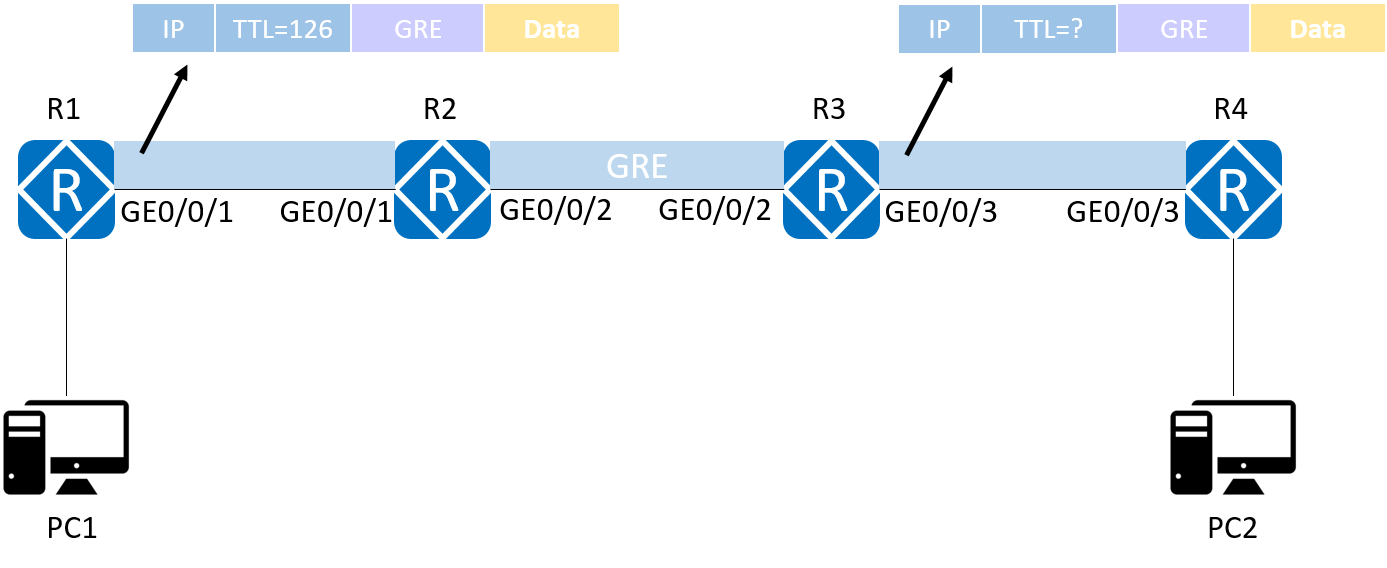
D The outer IP header TTL decrements at each underlay router hop; starting at 126, it becomes 125 after R2 and 124 after R3.
Question
Key Takeaways
The main trap is confusing the inner payload TTL with the outer transport TTL. The outer IP header is subject to normal IP decrement rules at each router hop in the underlay path.
This H12-891 question tests understanding of how TTL behaves in GRE tunnels. The correct answer is D (124), reflecting the decrement of the outer IP header's TTL at each underlay hop.
Common mistake: Choosing B (126) because some might believe the tunnel preserves the original TTL entirely without considering the separate outer IP header lifecycle. Choosing A (125) by miscounting the number of hops (forgetting R3 decrements it before sending out).
Expert Analysis
The question asks for the TTL of the packet leaving R3's GE0/0/3 interface, given that the initial TTL from PC1 is 126. The path involves a GRE tunnel between R1 and R4. We must trace the packet through the underlay network.
First, PC1 sends an IP packet with TTL=126 to R1 (GE0/0/1). When R1 receives this packet, it encapsulates it in a GRE header and adds an outer IP header to create the GRE tunnel packet. This outer IP header represents the transport across the underlay network. Crucially, when R1 creates this new outer IP header, it sets the TTL value. According to standard IP behavior, the originating router (R1) typically sets the initial TTL for the outer header. While the prompt states "TTL of the packet sent from GE0/0/1... is 126", this refers to the original inner packet. However, in GRE scenarios, the outer IP header's TTL is independent. Usually, if not explicitly configured otherwise (like ttl-share), the outer TTL starts at a default (often 255 or 64) or is set based on the inner TTL depending on implementation. But let's look at the options: 124, 125, 126, 127. These are close to 126. This implies the question assumes the outer TTL is derived from or equal to the inner TTL initially, or more likely, the question is testing the decrement process of the outer IP header as it traverses the underlay.
Let's re-read carefully: "The TTL of the packet sent from GE0/0/1 of R1 is 126." This phrasing is slightly ambiguous. Does it mean the inner packet's TTL is 126, or the encapsulated packet's outer TTL is 126? Given the options, if the outer TTL started at 126, we need to count hops.
Path: R1 -> R2 -> R3 -> R4.
- R1 encapsulates the packet. If the outer TTL is set to 126 (as implied by the context of the options being small integers near 126), then:
- Packet travels from R1 to R2. R2 decrements TTL by 1. TTL becomes 125.
- Packet travels from R2 to R3. R3 decrements TTL by 1. TTL becomes 124.
- Packet leaves R3 via GE0/0/3 towards R4. The TTL is now 124.
If the answer were B (126), it would imply no decrement, which is incorrect for IP routing. If A (125), it would imply only one hop. If C (127), it would imply increment, which doesn't happen. The most logical interpretation consistent with standard networking exam logic is that the outer IP header's TTL starts at 126 (or is treated as such for the sake of the problem's arithmetic) and decrements at each router hop in the underlay.
Hop 1: R1 to R2. R2 processes it. TTL 126 -> 125. Hop 2: R2 to R3. R3 processes it. TTL 125 -> 124. The packet exits R3 towards R4 with TTL 124.
Therefore, the TTL leaving R3 is 124.
Exam Strategy
When analyzing GRE or other tunneling questions, always distinguish between the inner payload headers and the outer tunnel headers. For TTL calculations, track the outer IP header specifically. Count every router hop in the underlay path that the packet traverses, decrementing the TTL by 1 for each hop. Do not assume the tunnel 'hides' the hops from the TTL perspective unless specific commands like ttl-share are mentioned.
Frequently Asked Questions
Does the inner packet's TTL change while inside the GRE tunnel?
Why does the outer TTL start at 126 in this problem?
Community Votes
67% of anonymous learners picked answer D. Votes are pick records left by other test-takers — they are not the verified answer.
Discussion 3 contributions
Compiled from public community threads and reader submissions, lightly edited for clarity. Handles and vote tallies are shown as recorded, and comments reflect the views of individual contributors.
From public community threads 3
-
bobhe5153 👍 2 Answered Dthe ttl in this question is before the gre header, the ttl will decrease each hop
-
megamind23 👍 1 Answered DOuter IP TTL decrements at each underlay hop (R2, R3), so 126 → 125 at R2 → 124 leaving R3 — the inner TTL is untouched between tunnel endpoints.
-
Erdal09 👍 1 Answered BAs I remember in GRE tunnels ttl remains same till tunnel out interface. So the answer might be 126
Reader comments & corrections
No reader corrections yet — spotted an error or have a note? Share it below.