BGP Route Reflector Cluster ID Purpose
Short answer
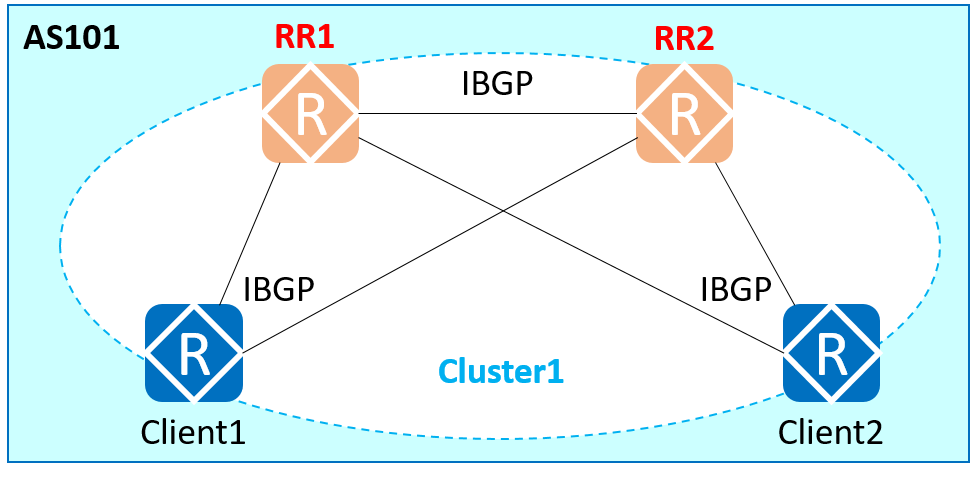
A Setting the same Cluster ID on redundant Route Reflectors ensures that they recognize each other's reflected updates as belonging to the same cluster, thereby preventing routing loops.
Question
Key Takeaways
The primary purpose of the Cluster ID is loop prevention; using the same ID for redundant RRs ensures they drop updates containing their own cluster ID, avoiding loops.
Learn why redundant BGP Route Reflectors share the same Cluster ID to prevent routing loops and maintain network stability.
Common mistake: Choosing D because users might think redundancy leads to more routes and thus memory issues, but the Cluster ID specifically addresses loop logic, not resource allocation.
Expert Analysis
The core principle governing Route Reflector (RR) operation in BGP is loop prevention. When a client sends an update to its RR, the RR reflects it back to other clients. To prevent these reflected updates from being re-reflected or causing loops when multiple RRs exist within the same cluster, BGP uses the Cluster ID attribute. The rule is strict: if a Route Reflector receives an update containing its own Cluster ID in the Cluster List, it must discard that update.
By configuring two RRs with the same Cluster ID, they effectively belong to the same logical entity for loop-detection purposes. If RR1 reflects a route and RR2 receives it, RR2 sees its own Cluster ID in the list and drops the route, preventing infinite looping. This ensures that even though there are two physical devices, they act as one logical reflector regarding loop avoidance.
While redundancy is achieved by having two RRs, the specific reason for setting their IDs to be identical is not memory management or optimal path selection, but rather to ensure consistent loop-prevention behavior across both devices. Without the same ID, each RR might treat updates from the other as valid new routes, leading to potential routing loops or excessive route processing. Therefore, matching the Cluster ID is essential for maintaining stability and preventing loops in a redundant RR setup.
Exam Strategy
When analyzing BGP reliability features, always distinguish between the mechanism (e.g., Cluster ID) and the goal (loop prevention vs. redundancy). Remember that identical Cluster IDs on multiple RRs make them logically one entity for loop detection, forcing them to discard reflected updates containing that ID.
Frequently Asked Questions
What happens if two RRs have different Cluster IDs?
Does using the same Cluster ID affect load balancing?
Community Votes
75% of anonymous learners picked answer A. Votes are pick records left by other test-takers — they are not the verified answer.
Discussion 5 contributions
Compiled from public community threads and reader submissions, lightly edited for clarity. Handles and vote tallies are shown as recorded, and comments reflect the views of individual contributors.
From public community threads 5
-
gorillaenhanced 👍 3 Answered CQuestion is not why do we use cluster ID (which is prevent loops), but rather why we use the same ID which is IMO to prevent memory insufficiency on the RR
-
sdbugs534 👍 1 Answered ABackup RR To ensure network reliability and prevent single-point failures, a cluster requires redundant RRs. An RR allows a BGP device to advertise the routes received from an IBGP peer to other IBGP peers. Therefore, routing loops may occur between RRs in the same cluster. To prevent this, all the RRs in the cluster must use the same cluster ID. https://support.huawei.com/enterprise/en/doc/EDOC1000178171/ba3d67a5/route-reflector
-
Toyyib 👍 1 Answered AThe primary goal of cluster-id is to prevent loop
-
7c3a129 👍 1 Answered Ato prevent loops
-
Fighter2k 👍 1Why not C?
Reader comments & corrections
No reader corrections yet — spotted an error or have a note? Share it below.