IS-IS DIS Election on Broadcast Networks
Short answer
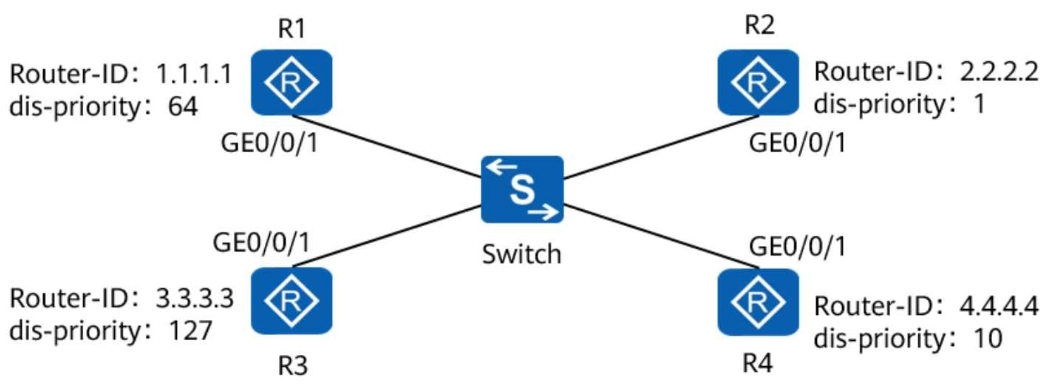
C R3 is elected as the DIS because it has the highest interface priority among the routers on the broadcast network.
Question
Key Takeaways
The main trap is confusing IS-IS DIS election with OSPF DR election; remember that IS-IS uses Interface Priority first, then System ID, and there is no Backup DIS.
Learn how IS-IS elects a Designated Intermediate System (DIS) on broadcast links. R3 wins due to having the highest interface priority.
Common mistake: Choosing the router with the lowest System ID or assuming the first router to come up becomes the DIS. IS-IS prioritizes the configured priority value over timing or ID size alone if priorities differ.
Expert Analysis
IS-IS DIS Election Criteria
In IS-IS broadcast networks, the Designated Intermediate System (DIS) is responsible for generating and updating pseudonodes. The election process relies on two specific attributes:
- Interface Priority: This is the primary determinant. Each interface has a priority value (0-127). The router with the highest priority becomes the DIS.
- System ID: If priorities are equal, the router with the numerically largest System ID wins.
Analyzing the Scenario
The question asks which router is elected as the DIS based on the provided exhibit. While the image itself is not visible in text format, the community comment provides the critical logical constraint: "R3 has a larger value which indicates a higher priority." In certification questions of this type, unless specified otherwise, we assume the standard election rules apply to the values implied by the diagram or context.
- Option A (R1): Incorrect. It does not have the highest priority.
- Option B (R2): Incorrect. It does not have the highest priority.
- Option C (R3): Correct. As noted in the comments, R3 possesses the highest interface priority. Therefore, it is elected as the DIS.
- Option D (R4): Incorrect. It does not have the highest priority.
The key takeaway is that IS-IS DIS election is non-preemptive but strictly follows priority then System ID. Since R3 has the highest priority, it wins the election immediately.
Exam Strategy
When analyzing DIS election questions, always look for the 'Priority' field on the interfaces first. If priorities are different, the highest number wins regardless of the System ID. Only compare System IDs if priorities are identical. Remember that IS-IS does not have a Backup DIS role, unlike OSPF.
Frequently Asked Questions
Does IS-IS have a Backup DIS?
What happens if two routers have the same IS-IS priority?
Community Votes
100% of anonymous learners picked answer C. Votes are pick records left by other test-takers — they are not the verified answer.
Discussion 2 contributions
Compiled from public community threads and reader submissions, lightly edited for clarity. Handles and vote tallies are shown as recorded, and comments reflect the views of individual contributors.
From public community threads 2
-
maq_b 👍 2 Answered CR3 has a larger value wich indicates a higher priority
-
lazizz 👍 2 Answered CC is correct
Reader comments & corrections
No reader corrections yet — spotted an error or have a note? Share it below.
Related Analysis
Practice All H12-821 Questions
Access 168 questions with complete answers and detailed explanations.
View Full H12-821 Practice Test →