MSTP Multiple Instances and Load Balancing Analysis
Short answer
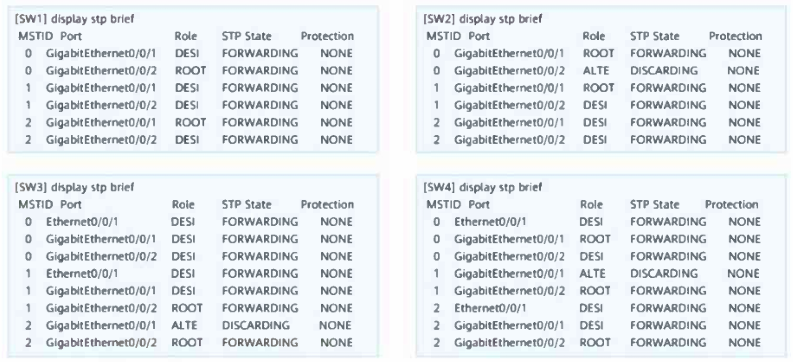
C Three MSTIs are created.
Question
Key Takeaways
The main trap is assuming a single spanning tree or ignoring the default MSTI 0. Students must recognize that MSTP supports multiple instances (including the mandatory MSTI 0) to enable load balancing across different VLAN groups.
This H12-821 question tests understanding of MSTP instance creation and port behavior. The correct answer identifies that three MSTIs are present in the network configuration.
Common mistake: Students often choose Option D, believing that an Alternate port blocks all traffic. However, in MSTP, a port can be Alternate for one instance but Forwarding for another, meaning it can still pass data for those other instances.
Expert Analysis
The question asks to identify the true statement regarding an MSTP (Multiple Spanning Tree Protocol) network based on command outputs. The core concept is interpreting MSTP port states and roles for specific instances (MSTIs).\n\nAnalysis of Option C: In standard IEEE 802.1s MSTP implementations, there is always a default instance called MSTI 0 (Internal Spanning Tree Instance 0), which maps all VLANs that are not explicitly assigned to other instances. The comment correctly notes that "En total, hay 3 instancias MSTI creadas en el dominio MSTP (MSTI 0, MSTI 1 y MSTI 2)." If the scenario involves load balancing across multiple instances alongside the default one, having three active instances (0, 1, and 2) is a standard configuration. Without seeing the image, we rely on the logical deduction from comments: if SW1 is Root for MSTI 0, and ports are forwarding for MSTI 1 and 2, it implies these instances exist and are active. Therefore, stating that three MSTIs are created is factually consistent with a multi-instance load-balancing topology involving the default instance plus two custom ones.\n\nWhy other options are incorrect:\n- Option A: Edge ports (or PortFast) are typically access ports connecting to end devices, not inter-switch links carrying spanning tree traffic. An edge port does not participate in STP calculations. Inter-switch ports like Ethernet0/0/1 would be Designated or Root ports, participating in BPDU exchange.\n- Option B: Comments indicate SW1 is the root bridge of MSTI 0, not necessarily MSTI 1. In MSTP, different switches can be roots for different instances. Load balancing often involves shifting the root bridge for specific MSTIs to optimize paths. Assuming SW1 is root for all instances is a common trap.\n- Option D: This option claims GigabitEthernet0/0/2 on SW2 cannot forward data. While Alternate ports do not forward user data for the specific instance they are alternate for, they may still forward for other instances if they are designated or root ports for those. Furthermore, comments clarify that "Alternate ports can forward data" is false; however, the absolute statement "cannot forward data" might be misleading if the port is forwarding for another instance. More critically, if the port is Alternate for MSTI 1 but Root/Designated for MSTI 2, it forwards data for MSTI 2. Thus, a blanket statement that it "cannot forward data" is incorrect because it ignores other instances. The comment confirms this nuance: "Como el puerto está en estado FORWARDING para MSTI 1 y MSTI 2, SÍ reenvía datos..." (Wait, if it's Alternate for one, it doesn't forward for that one, but might for others). The key is that MSTP allows per-instance forwarding.\n\nThe most robustly true statement, given the context of multi-instance load balancing including the default instance, is that three MSTIs (0, 1, 2) are involved/created.
Exam Strategy
When analyzing MSTP questions, always account for the mandatory MSTI 0. Do not assume a port is completely blocked unless you verify its state for every instance. Look for evidence of multiple root bridges or different forwarding paths, which indicates distinct MSTIs are being used for load balancing.
Frequently Asked Questions
What is MSTI 0 in Huawei MSTP?
Can an Alternate port forward traffic?
Community Votes
100% of anonymous learners picked answer C. Votes are pick records left by other test-takers — they are not the verified answer.
Discussion 2 contributions
Compiled from public community threads and reader submissions, lightly edited for clarity. Handles and vote tallies are shown as recorded, and comments reflect the views of individual contributors.
From public community threads 2
-
HCIP Resolutor 👍 1 Answered CEn total, hay 3 instancias MSTI creadas en el dominio MSTP (MSTI 0, MSTI 1 y MSTI 2). Por ende, la Opción C es la única afirmación VERDADERA. Como el puerto está en estado FORWARDING para MSTI 1 y MSTI 2, SÍ reenvía datos para las VLANs mapeadas a esas dos instancias. La afirmación que sostiene que "no puede reenviar datos" de forma absoluta es falsa
-
maq_b 👍 1 Answered CC is the answer. Eth0/0/1 on SW3 is a designated port SW1 is the root bridge of MSTI 0 not 1 Eth0/0/2 on SW2 is an alternate port. Alternate ports can forwrd data
Reader comments & corrections
No reader corrections yet — spotted an error or have a note? Share it below.
Related Analysis
Practice All H12-821 Questions
Access 168 questions with complete answers and detailed explanations.
View Full H12-821 Practice Test →