Why SWA Cannot Learn HOST A's MAC Address
Short answer
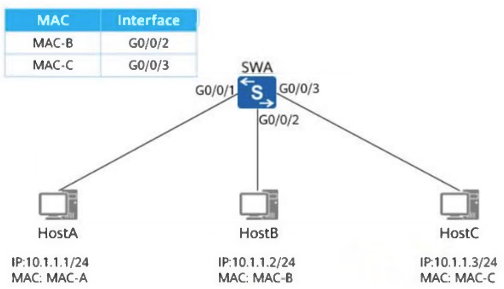
D Configuring G0/0/1 as an access interface cannot prevent SWA from learning HOST A's MAC address, since access ports learn MAC addresses normally.
Question
Key Takeaways
The question tests where MAC learning can be disabled — per VLAN, per interface, or by no traffic arriving — and traps learners into confusing an access port type with disabled learning.
This H12-811 switching question asks which listed reason cannot explain a missing MAC table entry. Configuring G0/0/1 as an access interface (D) never disables MAC learning, so it is the impossible cause.
Common mistake: Choosing C or believing an access port cannot learn MAC addresses: access ports learn source MACs exactly like trunk and hybrid ports, so option D is the impossible reason, not a real cause.
Expert Analysis
What the question is really asking The stem asks for the reason that is impossible — the only option that cannot explain why SWA fails to learn HOST A's MAC address. So three of the four options must be genuine, plausible causes, and one must be a non-cause.
Why option D is the impossible reason Configuring G0/0/1 as an access interface has no bearing on the MAC learning function. MAC address learning is performed by the switching engine on every Ethernet interface regardless of its link type — access, trunk and hybrid ports all learn the source MAC address of incoming data frames and write them into the MAC address table (subject to the VLAN's learning setting). Port type only decides tagging behaviour and which VLANs may be carried; it never disables learning. That is why D is the correct choice: it is the one stated reason that cannot account for the missing MAC entry.
Why A, B and C are all possible causes
Option A is possible because Huawei switches let you turn off MAC address learning for an entire VLAN (mac-address learning disable in VLAN view), so a frame from HOST A's VLAN would be forwarded but never learned. Option B is possible because the MAC table only learns from frames actually received — if HOST A never transmits, no source MAC is ever observed. Option C is possible because MAC learning can also be disabled per interface (mac-address learning disable in interface view), which stops G0/0/1 specifically from populating the table.
The trap Comments supporting D put it well: "configuring a port as an Access interface does NOT prevent MAC learning. Access ports learn MAC addresses normally — the port type (access, trunk, or hybrid) has no effect on the MAC learning function." The trap is confusing VLAN membership/tagging behaviour with the learning process itself, or reading the stem as "which reason is correct" instead of "which is impossible."
Official Reference
https://support.huawei.com/enterprise/en/doc/EDOC1100065050
This link opens the official vendor documentation in a new tab.
Exam Strategy
On "which is impossible" stems, flip the logic: eliminate every option that could genuinely stop MAC learning (disabled learning per VLAN or per interface, or no frames transmitted) and keep the one that only changes tagging or VLAN membership. Port type — access, trunk, hybrid — never toggles learning, so any option blaming the port type is usually the impossible one. Always read the polarity of the question before comparing options.
Frequently Asked Questions
Does configuring a switch port as an access interface disable MAC address learning?
What settings actually prevent SWA from learning a host MAC address?
How does the MAC address table get populated on a Huawei switch?
Community Votes
67% of anonymous learners picked answer D. Votes are pick records left by other test-takers — they are not the verified answer.
Discussion 3 contributions
Compiled from public community threads and reader submissions, lightly edited for clarity. Handles and vote tallies are shown as recorded, and comments reflect the views of individual contributors.
From public community threads 3
-
Fmoura17 👍 1 Answered DThe correct answer is D D. G0/0/1 is configured as an access interface ❌ (Impossible reason) This is the correct answer because configuring a port as an Access interface does NOT prevent MAC address learning. Access ports learn MAC addresses normally — the port type (access, trunk, or hybrid) has no effect on the MAC learning function. The switch will still learn Host A's MAC address from incoming frames on an access port.
-
e9b92a4 👍 1 Answered DAnswer: D Why D is impossible: Configuring G0/0/1 as an access interface does not prevent MAC learning. Access ports learn source MAC addresses from incoming frames just like trunk ports do.
-
agirgis2 👍 1 Answered Afollowing reasons is impossible B & C in the same vlan
Reader comments & corrections
No reader corrections yet — spotted an error or have a note? Share it below.