VLAN Tagging and Traffic Flow Direction in Campus Networks
Short answer
B The statement is false because LSW1 receives an untagged frame from R1, not a tagged frame from LSW2.
Question
Key Takeaways
The trap is confusing the direction of traffic flow and the point where VLAN tags are added. Tags are added by the egress switch on a trunk port, not received by the ingress switch from an access-connected device.
This question tests understanding of VLAN tagging behavior and traffic flow direction between routers and switches. The correct answer is B because LSW1 receives an untagged frame from the router, not a tagged one from the downstream switch.
Common mistake: Candidates often choose TRUE by focusing only on the fact that VLAN 10 traffic is involved, ignoring the critical detail that the frame arrives at LSW1 from the router (R1) via an access link, meaning it is untagged upon arrival.
Expert Analysis
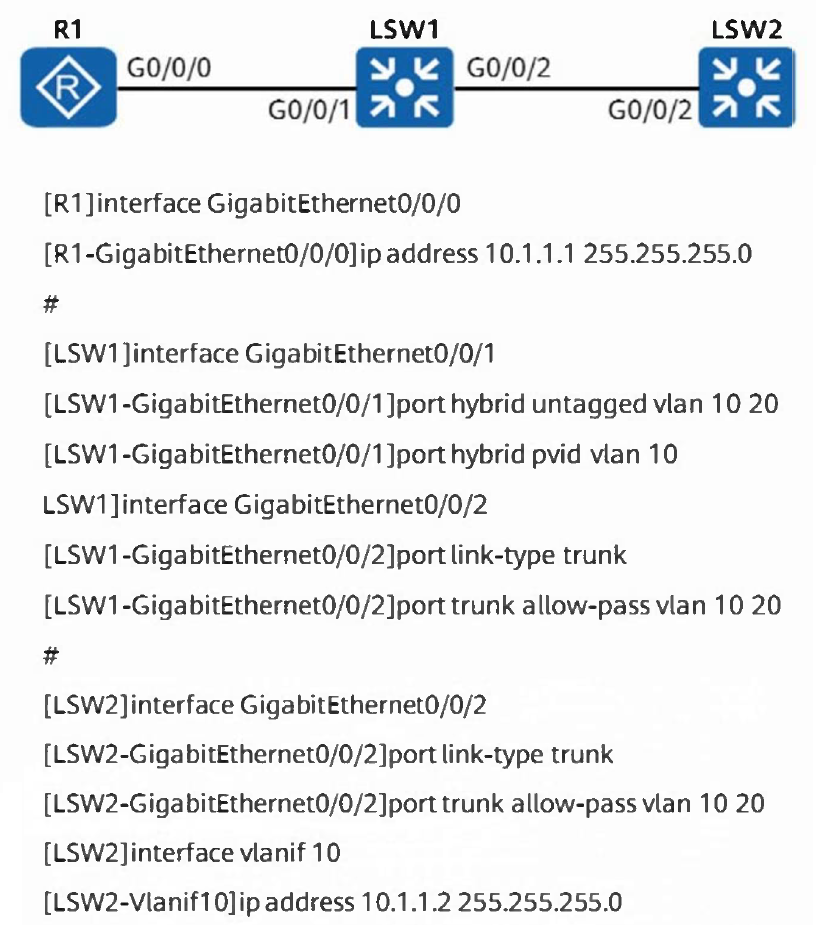
The scenario describes a ping initiated from Router R1 to the IP address 10.1.1.2, which resides on LSW2 in VLAN 10. To evaluate the statement 'LSW1 receives a tagged data frame from VLAN 10 on LSW2', we must trace the traffic flow and frame encapsulation.
Traffic Direction Analysis The comment correctly identifies that the traffic originates at R1. The path is R1 → LSW1 → LSW2. Therefore, any frame arriving at LSW1 comes from R1 (via its uplink interface), not from LSW2. The statement claims LSW1 receives a frame from LSW2, which contradicts the unidirectional nature of this specific packet's journey from source to destination. In networking questions, 'receives from X' implies X is the sender or the immediate upstream neighbor transmitting toward the receiver. Here, R1 is the upstream neighbor for LSW1.
Frame Encapsulation Analysis R1 is connected to LSW1 via an access port (G0/0/1) assigned to VLAN 10. When R1 sends the ICMP Echo Request, it encapsulates the IP packet in an Ethernet frame with a source MAC of R1 and a destination MAC of the default gateway (LSW1's VLAN 10 interface). Since the link between R1 and LSW1 is an access link, the frame arrives at LSW1 untagged. It is only after LSW1 processes the frame and forwards it out its trunk port towards LSW2 that the frame becomes tagged with VLAN 10. Thus, LSW1 does not receive a tagged frame; it receives an untagged frame.
Conclusion The statement fails on two counts: the directionality (LSW1 receives from R1, not LSW2) and the tagging status (LSW1 receives untagged, not tagged). Therefore, the statement is false.
Exam Strategy
Always identify the source of the traffic first. If a device sends a packet, the frames travel away from it. For devices connected via access ports, frames are always untagged when they arrive at the switch. Only frames traversing trunk links carry VLAN tags. Check both the direction ('from whom') and the encapsulation ('tagged vs untagged') to validate statements about frame reception.
Frequently Asked Questions
Why is the frame untagged when it reaches LSW1?
When does the VLAN tag get added?
Community Votes
67% of anonymous learners picked answer B. Votes are pick records left by other test-takers — they are not the verified answer.
Discussion 3 contributions
Compiled from public community threads and reader submissions, lightly edited for clarity. Handles and vote tallies are shown as recorded, and comments reflect the views of individual contributors.
From public community threads 3
-
Fmoura17 👍 1 Answered BB-FALSE Why FALSE? The question states that LSW1 receives a tagged VLAN 10 frame from LSW2 — but the traffic flow is in the opposite direction: The ping originates from R1, so the data flows R1 → LSW1 → LSW2, not from LSW2 to LSW1 It is LSW2 that receives the tagged VLAN 10 frame, not LSW1 LSW1 receives an untagged frame from R1 on G0/0/1, not a tagged frame from LSW2 The statement is false because the tagged VLAN 10 frame is received by LSW2 (not LSW1), and it comes from LSW1 (not from LSW2).
-
konyuz 👍 1 Answered AThe question is "LSW1 receives a tagged data frame from VLAN 10 on LSW2" that is true.
-
Heidorn 👍 1 Answered BNo ping, as the VLAN 10 was never created in the first place on both switches.
Reader comments & corrections
No reader corrections yet — spotted an error or have a note? Share it below.