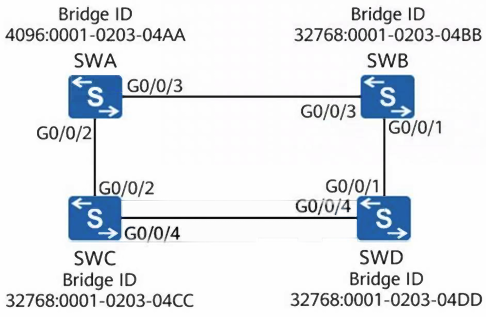
Root Path Cost inside a BPDU received on SWD G0/0/4
Short answer
B The configuration BPDU received on SWD's G0/0/4 carries the sender's root path cost of 200, before SWD adds its own 200 port cost.
Question
Key Takeaways
You must distinguish the sender's root path cost carried in the received BPDU from the receiver's root path cost computed after adding its own ingress port cost.
This STP question asks for the root path cost field inside the configuration BPDU arriving at SWD port G0/0/4. Because that field holds the transmitting bridge's cost, the value is 200 (option B), while 400 is SWD's own computed cost.
Common mistake: Choosing C (400): it is SWD's own root path cost after adding the 200 cost of G0/0/4, but the received BPDU frame still contains only the sender's value of 200.
Expert Analysis
The attractive wrong answer: C (400)
Option C is the choice that looks like the "real" STP calculation, and the arithmetic is trivially defensible: with every port path cost equal to 200, SWD ends up two hops from the root bridge, so SWD's own root path cost becomes 200 (learned from the neighbour) + 200 (its own G0/0/4 ingress cost) = 400. That number is genuinely SWD's root path cost once it adopts the path — so a candidate who answers 400 has done correct STP maths, just on the wrong quantity.
What the question pins down
The wording asks for the root path cost contained in the configuration BPDU received by G0/0/4. A configuration BPDU carries four key fields: root bridge ID, root path cost, sender bridge ID and port ID. The root path cost field always holds the root path cost of the bridge that transmits that BPDU — the sender's value — never the receiver's. The receiving bridge adds its own ingress port cost only after the frame arrives, when it recomputes its own RPC. That single timing distinction is where option C stops being correct.
Why the field reads 200
The sender of the BPDU into SWD's G0/0/4 is one hop from the root, so its own root path cost is a single port cost of 200, and it advertises RPC = 200. A comment on this item makes the same point from the other end: the bridge adjacent to the root receives a BPDU whose RPC field is 0 (the root's own value) and then computes 0 + 200 = 200 before sending onward. So the frame entering G0/0/4 carries 200, while 400 is what SWD will compute for itself. Option A is only seen in BPDUs originated by the root bridge itself, which is not the case here. The correct choice is therefore B (200), not C.
Exam Strategy
When an STP question asks for the cost in a received BPDU, answer with the sender's root path cost and never add the local port cost; only add it when the question asks for the receiving bridge's own root path cost. Read the preposition carefully — "contained in", "carried by" or "received" points to the frame's field, while "of SWD" or "computed by" points to the local total. Evaluate each option as a stage in the calculation: 0 is the root's own value, 200 is one hop, 400 is two hops, so pick the stage the wording names.
Frequently Asked Questions
Why is the root path cost in a received BPDU not the same as the receiving switch's root path cost?
When would the root path cost field in a BPDU be 0?
Does SWD's port G0/0/4 cost affect the BPDU it receives?
Community Votes
77% of anonymous learners picked answer B. Votes are pick records left by other test-takers — they are not the verified answer.
Discussion 1 contributions
Compiled from public community threads and reader submissions, lightly edited for clarity. Handles and vote tallies are shown as recorded, and comments reflect the views of individual contributors.
From public community threads 1
-
Rabbit414 👍 1 Answered Bpage 387 The question specifically asks for the value contained inside the received Configuration BPDU frame header itself, the correct value in the payload is 200. SWC receives the BPDU with RPC = 0 on port G0/0/2.SWC calculates its own total Root Path Cost by adding the incoming port's path cost (200): $0 + 200 = 200$.
Reader comments & corrections
No reader corrections yet — spotted an error or have a note? Share it below.