OSPF ABR Identification and Classification
Short answer
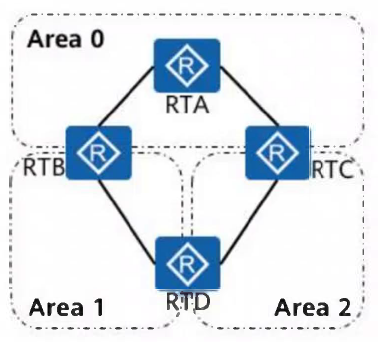
B The statement is false because RTD is an internal router, not an ABR, disproving the claim that all routers except RTA are ABRs.
Question
Key Takeaways
The main trap is assuming all routers in a multi-area topology are ABRs; you must verify that every router (except the specified exception) actually connects Area 0 to another area.
This question tests the identification of OSPF Area Border Routers (ABRs) based on interface area assignments. The correct answer is False (B) because RTD lacks connections to multiple areas.
Common mistake: Choosing True (A) by overlooking RTD's position. Candidates often assume that any router with multiple neighbors or links is an ABR, failing to check if those links belong to the same area.
Expert Analysis
An Area Border Router (ABR) in OSPF is defined as a router that has interfaces belonging to two or more distinct OSPF areas, including the backbone area (Area 0). To determine the validity of the statement, we must evaluate each router's interface placement relative to the areas shown in the network diagram.
The prompt states: "all routers on the network except RTA are ABRs." This implies that RTD, RTB, and RTC are all ABRs. However, according to the provided community insight, "RTD is not an ABR" because it does not have one interface in Area 0 and another in a different area. If RTD is fully contained within a single non-backbone area (e.g., Area 1) without connecting to Area 0, it functions as an Internal Router, not an ABR.
Since RTD is identified as not being an ABR, the universal claim that "all routers... except RTA are ABRs" is factually incorrect. The existence of at least one other internal router (RTD) invalidates the "all" quantifier. Therefore, the correct determination is FALSE.
Exam Strategy
When evaluating OSPF topology statements involving 'all' or 'none', always look for counter-examples among the routers listed. Specifically, identify Internal Routers (single area) versus ABRs (multiple areas, one being Area 0). Do not assume connectivity implies border status; verify the specific area IDs assigned to each physical interface.
Frequently Asked Questions
What defines an OSPF ABR?
Why is RTD not considered an ABR in this scenario?
Community Votes
100% of anonymous learners picked answer B. Votes are pick records left by other test-takers — they are not the verified answer.
Discussion 1 contributions
Compiled from public community threads and reader submissions, lightly edited for clarity. Handles and vote tallies are shown as recorded, and comments reflect the views of individual contributors.
From public community threads 1
-
arandarafa 👍 1 Answered Bto be a ABR you must have one interface in area 0 and other interface in other area RTD is not an ABR
Reader comments & corrections
No reader corrections yet — spotted an error or have a note? Share it below.