Impact of Mismatched Trunk PVIDs on VLAN Connectivity
Short answer
BC Host A and Host B can ping each other because the trunk PVID configuration ensures frames are sent untagged but retain their VLAN identity upon ingress to the remote switch.
Question
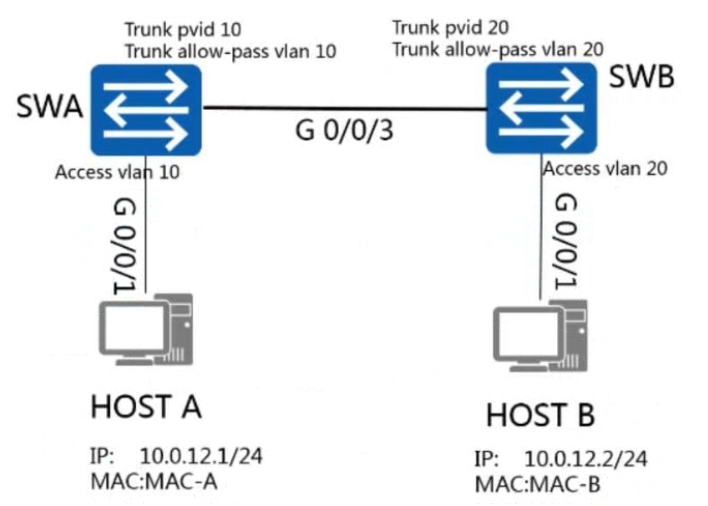
to VLAN 10 and VLAN 20 respectively. The ports through which the two switches are interconnected are trunk ports, and the PVIDs of the ports are 10 and 20, respectively. Which of the following statements are true? (Choose all that apply.)
Key Takeaways
Trunk ports send PVID traffic untagged; if both sides' PVIDs map to the same effective VLAN ID, connectivity is maintained despite the lack of tags.
Learn how configuring trunk port PVIDs to match host VLANs allows inter-VLAN communication over a trunk link by sending frames untagged yet preserving VLAN context.
Common mistake: Candidates often select 'A' or 'D', assuming different VLAN IDs inherently block communication or that trunk ports always tag every frame, ignoring the PVID exception.
Expert Analysis
The scenario involves two switches connected via a trunk link where the PVID (Port VLAN ID) on each side is configured to match the host's VLAN: Switch A’s trunk port has PVID 10, and Switch B’s trunk port has PVID 20. In Huawei/H3C switch architecture, a trunk port sends frames belonging to its own PVID as untagged frames while tagging all other permitted VLANs.
Therefore, when Host A (VLAN 10) sends traffic, Switch A identifies it as belonging to the trunk's PVID (10) and forwards it to the trunk port untagged. When this untagged frame arrives at Switch B, the receiving trunk port assigns it to its local PVID, which is also 10. Thus, the frame successfully traverses the link and reaches Host B. This confirms that Host A and Host B can ping each other, making Option B correct and Option A incorrect. Similarly, ARP requests are broadcast frames within the same VLAN context; since the VLAN identity is preserved across the link despite being untagged, ARP requests from Host A can be forwarded to Host B, making Option D incorrect.
Regarding the transmission format, because the PVID matches the source VLAN on both ends, the frames are indeed transmitted untagged between the switches. This makes Option C correct. The common trap is assuming trunk ports always tag frames; however, the PVID exception allows untagged transit for the default VLAN, effectively bridging the two hosts in this specific misconfiguration/setup.
Exam Strategy
Always check the PVID configuration on trunk links before assuming standard tagging behavior. Remember that the PVID determines which VLAN is sent untagged. If the PVID on one switch corresponds to the VLAN ID of the traffic, that traffic leaves untagged. On the receiving end, untagged traffic is assigned to the receiver's PVID. If the logical VLAN mapping aligns, connectivity persists regardless of the physical tag absence.
Frequently Asked Questions
Why are frames untagged between switches in this scenario?
Can hosts in different VLANs communicate without a router here?
Community Votes
30% of anonymous learners picked answer C. Votes are pick records left by other test-takers — they are not the verified answer.
Discussion 7 contributions
Compiled from public community threads and reader submissions, lightly edited for clarity. Handles and vote tallies are shown as recorded, and comments reflect the views of individual contributors.
From public community threads 7
-
konyuz 👍 1c is good due to PVID A standard trunk port's job is to forward traffic for multiple VLANs. It does this by adding a VLAN tag to frames as they leave a switch and checking for a tag on frames as they enter a switch. This is the normal behavior for tagged VLAN traffic. However, the PVID (Port VLAN ID) on a trunk port is different. It's the default VLAN for untagged traffic. When an untagged frame arrives at a trunk port, the switch assigns it the PVID. Similarly, when a tagged frame is leaving a trunk port, if its VLAN ID matches the PVID of that trunk port, the switch strips the tag before sending the frame.
-
Fmoura17 👍 1Answer: A, C, and D A. Host A and Host B belong to different VLANs and cannot ping each other. ✅ Host A is in VLAN 10, Host B is in VLAN 20 → different VLANs = cannot communicate without a router. C. Frames between switches are untagged. ✅ SWA trunk PVID = 10, so VLAN 10 frames are sent untagged. SWB trunk PVID = 20, so it expects untagged frames to belong to VLAN 20. But SWB only allows VLAN 20 → VLAN 10 frames from SWA are dropped by SWB. D. ARP requests from Host A cannot reach Host B. ✅ Since VLAN 10 and VLAN 20 are isolated, ARP from Host A cannot cross to Host B.
-
e7f304c 👍 1On a trunk port, frames are tagged with their respective VLAN IDs when crossing the switch-to-switch link. Only access ports send/receive untagged frames. B & C are false.
-
lkhjk 👍 1Correct Answer: ACD Arp cannot travel between broadcast domains VLANS without A GW or Router. D. ARP requests from host A cannot be forwarded to host B.
-
js293 👍 1PVID send packet without tag in one side and the other side dont know if is vlan 10 o 20. received packet in trunk must follow PVID to tag a packet.
Show 2 more comments
-
4c4da48 👍 1answer: BCD are right, A is against B
-
HCIA 👍 1In my opinion, only BC are correct.
Reader comments & corrections
No reader corrections yet — spotted an error or have a note? Share it below.