Basic NAT Many-to-Many Exhaustion Scenario
Short answer
B No public IP address is assigned to Host C, and Host C cannot access the public network.
Question
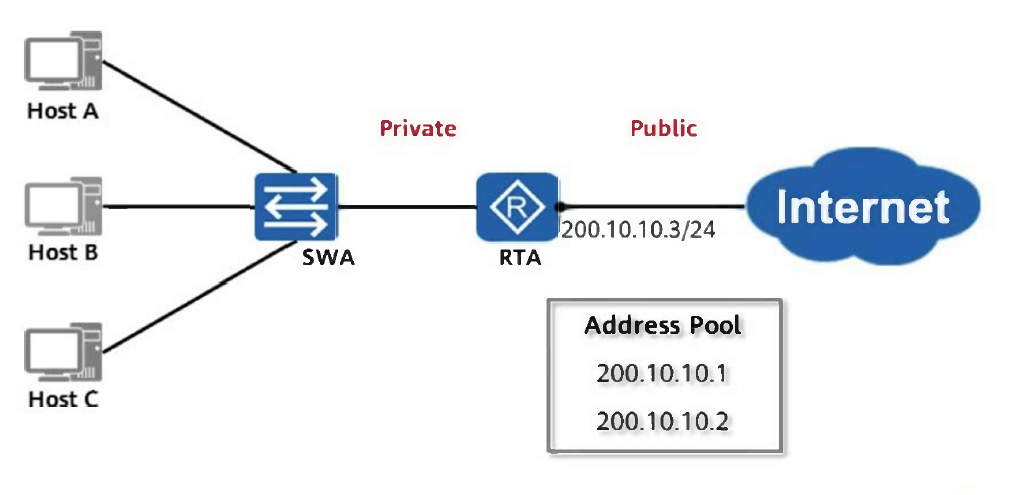
Key Takeaways
This question tests the strict one-to-one IP mapping requirement of Basic NAT versus the port-multiplexing capability of NAPT, highlighting that non-NAPT fails when the pool is empty.
In a many-to-many non-NAPT scenario with limited public IPs, once the address pool is exhausted by other hosts, additional hosts like Host C cannot access the public network because Basic NAT requires a one-to-one IP mapping.
Common mistake: Option A is commonly chosen because candidates assume the router will use Port Address Translation (PAT/NAPT) to share IPs via port numbers, ignoring the explicit 'non-NAPT' constraint in the question.
Expert Analysis
The core concept tested here is the distinction between Basic NAT (many-to-many) and NAPT (many-to-one). The question explicitly states that RTA uses "NAT" with a pool of two public IPs for "many-to-many non-NAPT address translation."
Basic NAT performs only Layer 3 translation, mapping private IP addresses to public IP addresses on a one-to-one basis. It does not manipulate transport-layer port numbers. Consequently, each host requiring external access must be assigned a unique public IP from the pool. Since Host A and Host B are already occupying the two available public IP addresses, the pool is exhausted. When Host C attempts to initiate a connection, there are no free public IPs left to map its private address. Therefore, Host C's traffic cannot be translated and will be dropped.
Let's evaluate the distractors:
- Option A suggests RTA performs NAT based on the source port number. This describes Port Address Translation (PAT), also known as NAPT or Overload. The question specifically excludes this by stating "non-NAPT." Thus, this option is incorrect because the router is not configured to multiplex connections based on ports.
- Option C implies time-sharing or turn-based allocation. Basic NAT does not work this way; if a slot is occupied, it is unavailable until the existing session terminates or times out. There is no queuing mechanism described in standard basic NAT behavior.
- Option D suggests assigning an interface address. While some configurations allow using the outside interface IP as part of the pool, the question specifies a configured address pool. Even if the interface IP were available, the prompt implies the pool is the sole source. More importantly, without explicit configuration mentioning the interface IP, we assume the pool is strictly the two listed addresses. However, the primary failure mode is the exhaustion of the defined pool.
The most attractive wrong answer is A, as many engineers conflate NAT and NAPT. In modern networks, PAT (NAPT) is far more common than Basic NAT due to IPv4 scarcity. Test-takers might instinctively choose A because they know "routers usually use ports to save IPs," but the specific constraint "non-NAPT" invalidates that assumption.
Official Reference
This link opens the official vendor documentation in a new tab.
Exam Strategy
Always check for specific keywords like 'non-NAPT', 'basic NAT', or 'one-to-one'. If these appear, do not assume Port Address Translation (PAT) is active. Verify if the address pool has sufficient entries for the requested hosts before concluding connectivity is possible.
Frequently Asked Questions
What is the difference between Basic NAT and NAPT?
Can Basic NAT reuse IP addresses after a session ends?
Community Votes
50% of anonymous learners picked answer B. Votes are pick records left by other test-takers — they are not the verified answer.
Discussion 2 contributions
Compiled from public community threads and reader submissions, lightly edited for clarity. Handles and vote tallies are shown as recorded, and comments reflect the views of individual contributors.
From public community threads 2
-
4243643 👍 1 Answered BNon-NAPT, also known as basic NAT, establishes a one-to-one mapping between a private IP address and a public IP address from the configured address pool. The pool has only two public addresses. Since Host A and Host B are already using these two addresses, the pool is exhausted. When Host C attempts to initiate a connection to the public network, the router (RTA) has no available public IP addresses to assign for the translation. Therefore, Host C's traffic will be dropped, and it will be unable to access the public network.
-
Heidorn 👍 1 Answered AA and B are true. While Hosts AB use the 2 public IPs host C cant access the public network, due to 1:1 format of static NAT
Reader comments & corrections
No reader corrections yet — spotted an error or have a note? Share it below.