How many database scoped credentials are required for Azure SQL elastic jobs?
You have an Azure subscription that contains the resources shown in the following table. You plan to use SQLDB11 as an elastic job database to run jobs on SQLDB11 and SQLDB22. What is the minimum number of database scoped credentials required for the elastic jobs? - 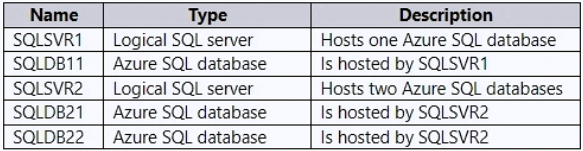
Community Insight
The exam tests whether you know that elastic jobs authenticate per logical server, not per database, so each distinct logical server hosting target databases requires its own database scoped credential.
Azure SQL elastic jobs use database scoped credentials stored in the job database to authenticate against target databases. When target databases reside on different logical SQL servers, a separate credential is required for each server.
Many candidates choose 1, assuming a single credential can cover all target databases regardless of which logical server they live on, overlooking that credentials are scoped to the logical server connection.
Community Discussion (3 comments)
Comments & Corrections
No comments yet — spotted an error or have a note? Share it below.
Expert Analysis
Why the Answer Is Correct
The correct answer is B (2). SQLDB11 resides on SQLSVR1 and SQLDB22 resides on SQLSVR2, which are two different logical SQL servers. Database scoped credentials used by elastic jobs authenticate against the logical server, so one credential is needed for SQLSVR1 and another for SQLSVR2. The credentials themselves are created inside the job database (SQLDB11), but each maps to a distinct target logical server.Why the Other Options Are Wrong
Option A (1) is wrong because a single credential cannot authenticate against two different logical servers; each logical server requires its own credential. Option C (3) is wrong because there is no third logical server or additional target group requiring a separate credential. Option D (4) is wrong because it incorrectly assumes a credential is needed per database or per server plus job database, which is not how elastic job authentication works.Community Comment Notes
Comment [1] correctly points learners to the official elastic jobs overview page that explains authentication via database scoped credentials created in the job database. Comment [2] clearly explains that because SQLDB11 and SQLDB22 are on different logical servers, two separate credentials are required, one per logical server. Comment [3] reinforces the same conclusion, confirming that different logical servers demand separate credentials.Official Reference
Exam Strategy
When an elastic job question mentions multiple target databases, first identify how many distinct logical servers host them. The number of required database scoped credentials equals the number of distinct logical servers, not the number of databases.
Related Analysis
Practice All DP-300 Questions
Access 105 questions with complete answers and detailed explanations.
View Full DP-300 Practice Test →