What is the first step to automate DB3 management using elastic jobs?
Case study - This is a case study. Case studies are not timed separately. You can use as much exam time as you would like to complete each case. However, there may be additional case studies and sections on this exam. You must manage your time to ensure that you are able to complete all questions included on this exam in the time provided. To answer the questions included in a case study, you will need to reference information that is provided in the case study. Case studies might contain exhibits and other resources that provide more information about the scenario that is described in the case study. Each question is independent of the other questions in this case study. At the end of this case study, a review screen will appear. This screen allows you to review your answers and to make changes before you move to the next section of the exam. After you begin a new section, you cannot return to this section. To start the case study - To display the first question in this case study, click the Next button. Use the buttons in the left pane to explore the content of the case study before you answer the questions. Clicking these buttons displays information such as business requirements, existing environment, and problem statements. If the case study has an All Information tab, note that the information displayed is identical to the information displayed on the subsequent tabs. When you are ready to answer a question, click the Question button to return to the question. Overview - ADatum Corporation is a financial services company that has a main office in New York City. Existing Environment. Licensing Agreement ADatum has a Microsoft Volume Licensing agreement that includes Software Assurance. Existing Environment. Network Infrastructure ADatum has an on-premises datacenter and an Azure subscription named Sub1. Sub1 contains a virtual network named Network1 in the East US Azure region. The datacenter is connected to Network1 by using a Site-to-Site (S2S) VPN. Existing Environment. Identity Environment The on-premises network contains an Active Directory Domain Services (AD DS) forest. The forest contains a single domain named corp.adatum.com. The corp.adatum.com domain syncs with a Microsoft Entra tenant named adatum.com. Existing Environment. Database Environment The datacenter contains the servers shown in the following table. DB1 and DB2 are used for transactional and analytical workloads by an application named App1. App1 runs on Microsoft Entra hybrid joined servers that run Windows Server 2022. App1 uses Kerberos authentication. DB3 stores compliance data used by two applications named App2 and App3. DB3 performance is monitored by using Extended Events sessions, with the event_file target set to a file share on a local disk of SVR3. Resource allocation for DB3 is managed by using Resource Governor. Requirements. Planned Changes - ADatum plans to implement the following changes: • Deploy an Azure SQL managed instance named Instance1 to Network1. • Migrate DB1 and DB2 to Instance1. • Migrate DB3 to Azure SQL Database. • Following the migration of DB1 and DB2, hand over database development to remote developers who use Microsoft Entra joined Windows 11 devices. • Following the migration of DB3, configure the database to be part of an auto-failover group. Requirements. Availability Requirements ADatum identifies the following post-migration availability requirements: • For DB1 and DB2, offload analytical workloads to a read-only database replica in the same Azure region. • Ensure that if a regional disaster occurs, DB1 and DB2 can be recovered from backups. • After the migration, App1 must maintain access to DB1 and DB2. • For DB3, manage potential performance issues caused by resource demand changes by App2 and App3. • Ensure that DB3 will still be accessible following a planned failover. • Ensure that DB3 can be restored if the logical server is deleted. • Minimize downtime during the migration of DB1 and DB2. Requirements. Security Requirements ADatum identifies the following security requirements for after the migration: • Ensure that only designated developers who use Microsoft Entra joined Windows 11 devices can access DB1 and DB2 remotely. • Ensure that all changes to DB3, including ones within individual transactions, are audited and recorded. Requirements. Management Requirements ADatum identifies the following post-migration management requirements: • Continue using Extended Events to monitor DB3. • In Azure SQL Database, automate the management of DB3 by using elastic jobs that have database-scoped credentials. Requirements. Business Requirements ADatum identifies the following business requirements: • Minimize costs whenever possible, without affecting other requirements. • Minimize administrative effort. You need to recommend a process to automate the management of DB3. The solution must meet the management requirements. What should be the first step of the process? - 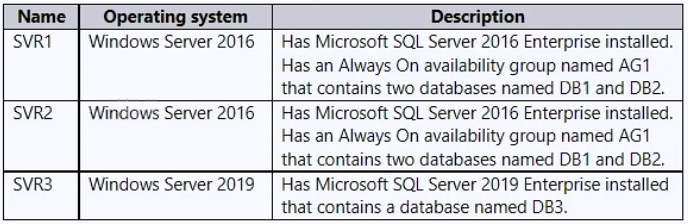
Community Votes
57% of anonymous learners picked answer C. Votes are pick records left by other test-takers — they are not the verified answer.
Community Insight
The exam tests understanding of elastic job automation prerequisites, specifically that database-scoped credentials must exist in the target database before creating elastic jobs, avoiding unnecessary infrastructure costs.
This question tests the initial step for automating Azure SQL Database management using elastic jobs with database-scoped credentials. Community consensus is split, but the correct first step is creating database-scoped credentials directly in DB3 to minimize costs and administrative effort.
Many candidates incorrectly choose option D (creating a separate database for database-scoped credentials) without recognizing that DB3 already exists and can host the credentials directly, leading to unnecessary costs and complexity.
Community Discussion (6 comments)
Comments & Corrections
No comments yet — spotted an error or have a note? Share it below.
Expert Analysis
Why the Answer Is Correct
Option C is correct because DB3 already exists in the environment, and the requirement specifically states to use elastic jobs with database-scoped credentials. According to Microsoft documentation, database-scoped credentials can be created directly in the target database that will be managed by elastic jobs. This approach minimizes costs by avoiding the creation of additional databases and reduces administrative effort as required by the business requirements. The credential creation is the foundational first step before elastic job agents can authenticate and execute automated management tasks.
Why the Other Options Are Wrong
Option A is incorrect because Microsoft Entra authentication is not required for elastic jobs using database-scoped credentials - the scenario specifically calls for database-scoped credentials as the authentication method. Option B is wrong because private endpoints relate to network connectivity and security, not the authentication prerequisites for elastic job automation. Option D is incorrect because it suggests creating a new database for credentials, which contradicts the cost minimization requirement and is unnecessary since DB3 already exists and can store the database-scoped credentials directly.
Community Comment Notes
The community shows significant debate with 57 votes for C and 43 for D. Comment [1] correctly identifies that elastic job agents can use database-scoped credentials for authentication. Comment [3] argues for D based on documentation stating credentials must be in the job database, but misses that DB3 itself can serve this purpose. Comment [4] provides the strongest reasoning for C, emphasizing the cost requirement ($30/month savings) and noting DB3 already exists. Comment [5] references documentation about creating job databases but doesn't address that this applies when setting up a dedicated job agent database, not when using existing databases with database-scoped credentials.
Official Reference
Exam Strategy
When answering Azure SQL management questions, always check if existing resources can fulfill requirements before creating new ones. Pay close attention to cost minimization requirements, as they often indicate you should use existing infrastructure rather than provisioning additional resources.
Related Analysis
Practice All DP-300 Questions
Access 105 questions with complete answers and detailed explanations.
View Full DP-300 Practice Test →