Deploying MLflow Models to Online Endpoints
Note: This question is part of a series of questions that present the same scenario. Each question in the series contains a unique solution that might meet the stated goals. Some question sets might have more than one correct solution, while others might not have a correct solution. After you answer a question in this section, you will NOT be able to return to it. As a result, these questions will not appear in the review screen. You have an Azure Machine Learning workspace named Workspace1. Workspace1 has a registered MLflow model named model1 with PyFunc flavor. You plan to deploy model1 to an online endpoint named endpoint1 without egress connectivity by using Azure Machine Learning Python SDK v2. You have the following code: You need to add a parameter to the ManagedOnlineDeployment object to ensure the model deploys successfully. Solution: Add the scoring_script parameter. Does the solution meet the goal? - 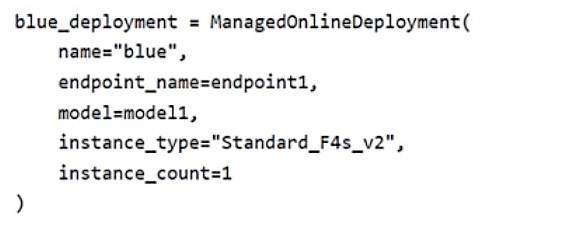
Community Votes
100% of anonymous learners picked answer B. Votes are pick records left by other test-takers — they are not the verified answer.
Community Insight
The question tests whether candidates understand that MLflow models can be deployed without custom scoring scripts or environments via native integration, contrary to traditional custom model deployments.
This question tests the deployment of MLflow models with PyFunc flavor to Azure ML online endpoints, specifically addressing scenarios without egress connectivity. The community consensus confirms that adding a scoring_script parameter is incorrect because MLflow models support no-code deployment.
Candidates often select 'Yes' assuming all deployments require explicit code configuration (scoring_script and environment), failing to recognize the specific capabilities of MLflow model packaging in Azure ML.
Community Discussion (4 comments)
Comments & Corrections
No comments yet — spotted an error or have a note? Share it below.
Expert Analysis
Why the Answer Is Correct
The solution does not meet the goal because MLflow models, particularly those with PyFunc flavor, are designed for 'no-code' deployment when packaged correctly. In Azure Machine Learning, you can deploy these models directly using themodel entity without specifying code_configuration (which includes scoring_script) or environment. This feature allows the platform to handle inference automatically based on the model's metadata.Why the Other Options Are Wrong
Selecting 'Yes' is incorrect because thescoring_script parameter is part of CodeConfiguration, which is required for custom Python models but redundant and potentially conflicting for MLflow models managed by the service. The prompt explicitly mentions deploying without egress connectivity, which implies using offline-capable packaging methods rather than external script dependencies that might fail if they try to reach out.Community Comment Notes
Comment [4] provides critical context by citing Microsoft Learn documentation, confirming that MLflow models do not require a scoring script or environment for online endpoint deployment. Comment [1] correctly identifies that the scoring script is irrelevant to the egress connectivity constraint, reinforcing that the proposed solution addresses the wrong problem.Official Reference
Exam Strategy
Recognize keywords like 'MLflow model' and 'PyFunc' as indicators for no-code deployment capabilities. When a question involves standard MLflow flavors, assume the native Azure ML infrastructure handles the scoring logic unless custom transformations are explicitly requested.