Which Azure Database Fits the Cosmos, 5-TB, and 30-TB Projects?
HOTSPOT
You have the following projects:
• Project1: A rapidly iterating cloud-based solution that integrates multiple Azure software as a service (SaaS) solutions
• Project2: The migration of a 5-TB on-premises database to Azure
• Project3: The migration of a 30-TB on-premises database to Azure
The projects have the requirements shown in the following table.
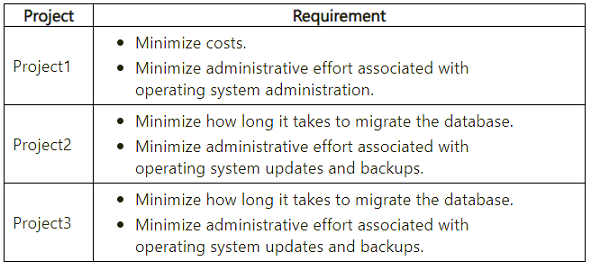 You need to recommend a database solution for the projects.
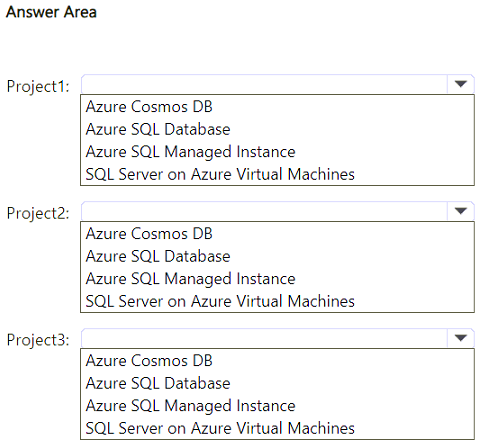
What should you include in the recommendation for each project? To answer, select the appropriate options in the answer area.
NOTE: Each correct selection is worth one point.
You need to recommend a database solution for the projects.
What should you include in the recommendation for each project? To answer, select the appropriate options in the answer area.
NOTE: Each correct selection is worth one point.
Community Insight
It tests whether you know the capability profile and, above all, the storage ceiling of each Azure database service — the trap is routing the 30-TB migration into Azure SQL Managed Instance, which caps at 16 TB (32 TB only for newer Business Critical premium-series hardware).
This AZ-305 hotspot asks you to map three projects — a rapidly iterating app that integrates several Azure SaaS services, a 5-TB on-premises migration, and a 30-TB on-premises migration — to the right Azure data service. The page settles each slot as Azure Cosmos DB, Azure SQL Managed Instance, and Azure SQL Database in the Hyperscale tier, with the 16-TB Managed Instance storage ceiling as the deciding constraint.
Treating Azure SQL Managed Instance as the automatic landing zone for every on-premises migration: its 16-TB ceiling rules out the 30-TB database, and the General Purpose/Business Critical tiers of Azure SQL Database cap at 4 TB, so the 5-TB project also needs a service that can physically hold it.
Community Discussion (2 comments)
Comments & Corrections
No comments yet — spotted an error or have a note? Share it below.
Expert Analysis
Why the Answer Is Correct
Project1 is a fast-iterating solution that consumes several Azure SaaS services, so the store must be schema-flexible, multi-model and globally distributable — that is Azure Cosmos DB, which exposes SQL, MongoDB, Cassandra, Gremlin and Table APIs and lets the data model change as the solution iterates. Project2 migrates a 5-TB on-premises database: Azure SQL Managed Instance accepts up to 16 TB per instance and offers near-100% SQL Server surface area (cross-database queries, SQL Agent, linked servers, Service Broker), which keeps the migration a lift-and-shift rather than a rewrite. Project3 is the same migration type at 30 TB, which is beyond the Managed Instance ceiling, so the only managed relational PaaS target that fits is Azure SQL Database with the Hyperscale service tier (up to 100 TB, fast snapshot-based scale and restore). The three selections therefore hinge on workload character for Project1 and on hard storage limits for Project2 and Project3.Why Other Candidate Answers Are Wrong
Sending Project3 to Azure SQL Managed Instance is the most common error — a 30-TB database cannot be restored into an instance capped at 16 TB, no matter how SQL Server-compatible it is. Recommending plain Azure SQL Database (General Purpose or Business Critical) also fails on size: those tiers cap at 4 TB per database, so even the 5-TB project does not fit, and only Hyperscale breaks that ceiling. Azure Cosmos DB is wrong for Project2 and Project3 because it is a non-relational, NoSQL engine with no SQL Server compatibility — the existing schemas, stored procedures and Agent jobs would have to be rewritten rather than migrated. SQL Server on Azure Virtual Machines could physically host 30 TB, but it is IaaS: patching, high availability and backups remain the customer's responsibility, so it is not the recommended managed target when Hyperscale satisfies the requirement.Community Comment Notes
Learners split on the two migration slots. One commenter (mesloth) maps Project2 to Azure SQL Database on the "5TB" keyword and Project3 to Azure SQL Managed Instance, while gpais answers the opposite way and points out that the "30-TB database exceeds the 16 TB" limit. gpais's size reasoning matches the documented Managed Instance resource limits, so the pair used here is Managed Instance for the 5-TB project and SQL Database (Hyperscale) for the 30-TB project. All commenters agree on Azure Cosmos DB for Project1 because it "integrates multiple SAAS" sources cheaply and read/write flexibly.Official Reference
Exam Strategy
In AZ-305 hotspot items, read the numeric limits before the feature lists, because a service's storage ceiling usually eliminates half the candidates. Size the workload character first (relational vs multi-model NoSQL) and then apply the ceilings — SQL Managed Instance 16 TB, Azure SQL Database General Purpose/Business Critical 4 TB, Hyperscale 100 TB. If a slot pairs SQL Server feature compatibility with a database under 16 TB, Managed Instance is the expected answer.
Frequently Asked Questions
Why can't the 30-TB database in Project3 be hosted on Azure SQL Managed Instance?
Managed Instance storage tops out at 16 TB per instance (32 TB only on newer Business Critical premium-series hardware), so a 30-TB database must go to Azure SQL Database Hyperscale, which scales to 100 TB.
Would the 5-TB database in Project2 fit in ordinary Azure SQL Database?
Not in General Purpose or Business Critical, which cap at 4 TB per database. It fits Azure SQL Managed Instance (16 TB) or the Hyperscale tier, so the choice depends on the project's SQL Server compatibility needs.
Why is Azure Cosmos DB recommended only for Project1 and not the migration projects?
Cosmos DB is a non-relational, multi-model NoSQL service for rapidly changing, globally distributed SaaS-integrated solutions; it cannot host SQL Server schemas, stored procedures or Agent jobs without rewriting them.
Related Analysis
Practice All AZ-305 Questions
Access 95 questions with complete answers and detailed explanations.
View Full AZ-305 Practice Test →