Which components handle AKS state, pub/sub, and traffic splitting?
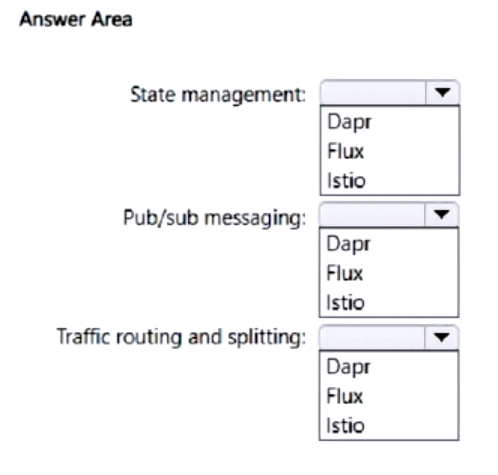
HOTSPOT
You plan to deploy multiple containerized microservice-based apps to Azure Kubernetes Service (AKS).
You need to recommend a solution that implements the following functions:
• State management
• Pub/sub messaging
• Traffic routing and splitting
The solution must minimize administrative effort.
What should you include in the recommendation for each function? To answer, select the appropriate options in the answer area.
NOTE: Each correct selection is worth one point.
Community Insight
The exam tests whether you can separate application-level building blocks (Dapr state and pub/sub) from network-level traffic control (Istio routing/splitting), and the trap is assuming one tool covers all three functions.
For containerized microservices on AKS, Dapr provides the state management and pub/sub building blocks, while Istio delivers traffic routing and splitting. This page confirms each selection and explains why an application runtime, not a service mesh, owns state and messaging.
Many learners pick Istio for all three slots because a service mesh 'manages microservices', but Istio exposes no application state or pub/sub API — state and messaging must come from Dapr's building blocks.
Community Discussion (3 comments)
Comments & Corrections
No comments yet — spotted an error or have a note? Share it below.
Expert Analysis
Why the Answer Is Correct
Dapr's state management building block gives microservices a standardized key-value API (save, get, delete) over backends such as Azure Cache for Redis or Azure Cosmos DB, so no service writes engine-specific state code and administrative effort stays low. Dapr's pub/sub building block likewise abstracts the broker (Azure Service Bus, Redis Streams, Kafka) behind a consistent publish/subscribe API with CloudEvents and at-least-once delivery. Traffic routing and splitting — canary, blue/green, weighted versions — is a layer-7 service-mesh concern handled by Istio's VirtualService and DestinationRule weight fields. Because AKS offers a managed Istio-based service mesh add-on, the routing requirement is met without operating your own control plane, satisfying the 'minimize administrative effort' constraint.Why Other Candidate Answers Are Wrong
Assigning Istio to state management or pub/sub messaging fails because a service mesh routes and secures traffic; it has no application state store API and no publish/subscribe abstraction, so each microservice would have to bind directly to a broker or database SDK. Assigning Dapr to traffic routing and splitting fails because Dapr's building blocks target application concerns (state, pub/sub, service invocation, secrets) and do not provide weighted layer-7 traffic distribution across service versions. GitOps tools such as Flux only reconcile deployment manifests and cannot hold state or split traffic, and event-driven autoscalers such as KEDA scale workloads but never route or persist anything. Mixing one tool across all three functions therefore breaks at least one requirement.Community Comment Notes
Ras1364 recorded exactly the same mapping — Dapr for state management, Dapr for pub/sub messaging, and Istio for traffic routing and splitting — which matches the vendor's body of knowledge for AKS microservices. Splash04 reasoned that state management and pub/sub should both be Dapr because "publish/subscribe is one of Dapr's core application-level building blocks", while Istio is "a service mesh designed for traffic management". gpais added that Dapr offers a "dedicated State Management building block" that works across backends like Redis or Cosmos DB, and pointed out that neither a GitOps deployment tool nor a service mesh handles application state. The consensus across these comments is consistent with the answer given here, and no comment proposes a viable alternative mapping.Official Reference
Exam Strategy
Map each hotspot row to a layer before you look at the dropdown choices: application state and messaging are runtime building blocks (Dapr), while routing, splitting and policy are mesh concerns (Istio). Watch for the 'minimize administrative effort' phrase, which signals managed add-ons such as the AKS Istio service mesh add-on rather than self-installed Helm charts.
Frequently Asked Questions
Why is Istio used for traffic routing and splitting instead of Dapr in this AKS scenario?
Istio's VirtualService and DestinationRule weight fields perform layer-7 canary and blue/green splitting, whereas Dapr building blocks cover state and pub/sub, not weighted traffic distribution.
Does the AKS Istio service mesh add-on reduce administrative effort for this design?
Yes. The Istio-based service mesh add-on is managed and upgraded by Azure, so you get traffic routing and splitting without running or patching your own Istio control plane.
Related Analysis
Practice All AZ-305 Questions
Access 95 questions with complete answers and detailed explanations.
View Full AZ-305 Practice Test →