Which Managed PostgreSQL Service Scales Transactional Writes with Row-Based Sharding?
HOTSPOT
You have an Azure subscription.
You plan to deploy a high-throughput transactional workload that will use PostgreSQL.
You need to recommend a managed solution for storing relational data. The solution must meet the following requirements:
• Support the horizontal scaling of transactional writes by using row-based sharding.
• Minimize administrative effort.
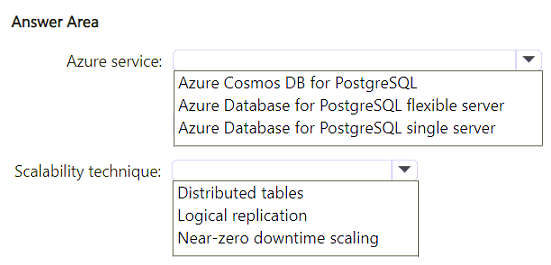
What should you include in the recommendation? To answer, select the appropriate options in the answer area.
NOTE: Each correct selection is worth one point.
Community Insight
The question tests whether you know that Citus distributed tables shard rows across worker nodes for horizontal write scaling in a managed PostgreSQL service, and the trap is selecting read replicas or table partitioning, which scale reads or stay inside one node.
This AZ-305 hotspot asks for a managed PostgreSQL solution that horizontally scales transactional writes through row-based sharding while minimizing administrative effort. The graded answer pairs Azure Cosmos DB for PostgreSQL (the managed Citus service) with the Distributed tables scalability technique.
Choosing Azure Database for PostgreSQL (single server or flexible server) with read replicas, or picking table partitioning as the scalability technique; replicas only offload reads, and partitioning never distributes rows across nodes.
Community Discussion (2 comments)
Comments & Corrections
No comments yet — spotted an error or have a note? Share it below.
Expert Analysis
Why the Answer Is Correct
The requirement pair "horizontal scaling of transactional writes" plus "row-based sharding" is the textbook definition of Citus distributed tables: rows of a distributed table are sharded across worker nodes while the coordinator routes reads and writes. Azure Cosmos DB for PostgreSQL is the managed Azure service built on Citus, so it satisfies PostgreSQL compatibility, horizontal write scale-out, and the "minimize administrative effort" constraint, since patching, scaling and high availability are handled by the platform. The second hotspot dropdown must therefore be Distributed tables rather than read replicas, partitioning or vertical scaling. Together, the two selections form a single coherent recommendation: a managed, Citus-based PostgreSQL service whose tables are distributed to scale transactional writes.Why Other Candidate Answers Are Wrong
Azure Database for PostgreSQL flexible server or single server with read replicas scales read workloads but leaves all writes on one primary node, so it fails the horizontal-write requirement. Plain table partitioning splits a large table into local partitions on the same server, which improves maintenance and pruning but does not shard rows across machines and never increases write throughput horizontally. Vertical scaling (bigger SKU) is not horizontal at all, and Azure SQL Managed Instance or Azure SQL Database are wrong engines because the workload explicitly uses PostgreSQL. Options such as geo-replication or sharding middleware you manage yourself also fail the "minimize administrative effort" test.Community Comment Notes
The highest-voted learner explanation, from gpais, reasons exactly this way: "Distributed tables shard rows across nodes, enabling horizontal scaling of transactional writes," and adds that Cosmos DB for PostgreSQL is managed, which reduces administrative effort. mesloth raised a practical caveat, noting that Azure Cosmos DB for PostgreSQL is "on retirement path" but still concluded that the given answer is correct for this item. That retirement note is worth knowing for the real world: Citus-style sharding now continues as an extension on Azure Database for PostgreSQL flexible server, so the underlying concept (distributed tables) remains the examinable idea even as the branding shifts.Official Reference
Exam Strategy
Scan the requirement list for the two decisive keywords: "row-based sharding" and "minimize administrative effort." Row-based sharding across nodes only comes from Citus distributed tables, and "managed" points at the PaaS offering rather than self-managed PostgreSQL on VMs. Set the scalability-technique dropdown to Distributed tables, not read replicas, because replicas never scale writes.
Frequently Asked Questions
Is Cosmos DB for PostgreSQL still the right AZ-305 hotspot answer even though it is retiring?
For this question's wording, yes: it is the managed Citus-based service whose distributed tables shard rows across nodes. Citus sharding now also runs as an extension on Azure Database for PostgreSQL flexible server.
Why are read replicas or table partitioning wrong for row-based sharding of transactional writes?
Read replicas only scale read traffic and partitions stay on one node's storage. Only Citus distributed tables place different row ranges on different worker nodes, scaling writes horizontally.
Related Analysis
Practice All AZ-305 Questions
Access 95 questions with complete answers and detailed explanations.
View Full AZ-305 Practice Test →