Which Entra provisioning method and endpoint handle App1 CSV users?
HOTSPOT
You have a Microsoft Entra tenant that uses Microsoft Entra Connect Sync to sync with an on-premises Active Directory Domain Services (AD DS) domain. The domain contains several member servers.
You have a custom human resources (HR) application named App1 that stores employee records.
You are designing a solution to automate the management of user accounts. The solution must meet the following requirements:
• When employees are added to App1, the user accounts of the employee1 must be provisioned to the AD DS domain and the Microsoft Entra tenant automatically.
• New employee records must be read from a CSV file that is exported from App1 daily.
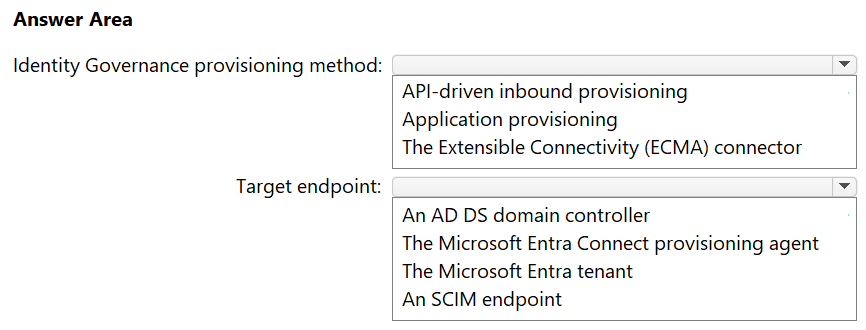
You need to recommend a Microsoft Entra Identity Governance provisioning method and a target endpoint for creating new user accounts.
What should you recommend? To answer, select the appropriate options in the answer area.
NOTE: Each correct selection is worth one point.
Community Insight
It tests whether you can distinguish API-driven inbound provisioning from HR connector-based provisioning and recognize AD DS as the target so Entra Connect Sync handles the cloud copy.
This AZ-305 hotspot asks you to choose an Entra Identity Governance provisioning method and target endpoint for a custom HR app that exports daily CSV files. The correct design uses API-driven inbound provisioning into AD DS, letting Microsoft Entra Connect Sync propagate new users to Microsoft Entra ID.
Many candidates pick HR-driven provisioning because App1 is an HR application, but App1 is custom and only supplies a CSV, so no native HR connector exists.
Community Discussion (1 comments)
Comments & Corrections
No comments yet — spotted an error or have a note? Share it below.
Expert Analysis
Why the Answer Is Correct
The design must take a daily CSV export from a custom HR application, so the provisioning source is file-based rather than a native HR connector. Microsoft Entra Identity Governance's API-driven inbound provisioning accepts bulk CSV uploads through its inbound provisioning API, which matches App1's export pattern. Because the requirement includes creating accounts in the on-premises AD DS domain, the target endpoint should be an AD DS domain controller; the existing Microsoft Entra Connect Sync then synchronizes those new AD DS users into the Microsoft Entra tenant. This gives one provisioning path for the CSV data and reuses the established hybrid identity sync for the cloud account.Why Other Candidate Answers Are Wrong
HR-driven provisioning is the obvious distractor because App1 is an HR application, but that method depends on a supported inbound HR connector such as Workday or SuccessFactors, and App1 is custom. Provisioning directly to Microsoft Entra ID would create cloud users but would not satisfy the requirement to create the user account in the on-premises AD DS domain. Targeting the Microsoft Entra Connect server itself is wrong because Entra Connect Sync is the synchronization engine, not the provisioning target where the AD DS user object is created. Manual CSV import or on-demand provisioning does not provide the automated daily ingest described.Community Comment Notes
The sole learner comment aligns with this design: gpais identifies "API-driven inbound provisioning" as the method and "An AD DS domain controller" as the endpoint. That comment also points to Microsoft's inbound provisioning API concepts article, which is the relevant official reference for the CSV bulk-upload pattern. The consensus here is therefore consistent with the requirement wording, not merely a vote count, because it maps the custom CSV source to the API-driven method and the on-premises AD DS target to Entra Connect Sync.Official Reference
Exam Strategy
Look for the data source shape: a daily CSV from a custom app points to API-driven inbound provisioning, not an HR connector. Then choose the on-premises AD DS endpoint so existing Microsoft Entra Connect Sync handles cloud provisioning.
Frequently Asked Questions
Why is an AD DS domain controller the target endpoint instead of Microsoft Entra ID?
Because creating the account in AD DS lets the existing Microsoft Entra Connect Sync handle the Entra tenant copy, while targeting Entra directly would not create the on-premises AD DS user.
Can HR-driven provisioning be used with App1's daily CSV export?
No. HR-driven provisioning needs a supported HR connector such as Workday or SuccessFactors; for a custom app's CSV, use API-driven inbound provisioning.
Related Analysis
Practice All AZ-305 Questions
Access 95 questions with complete answers and detailed explanations.
View Full AZ-305 Practice Test →