Which Azure Compute Fits Each App Service Web App?
DRAG DROP
You have an Azure subscription.
You are designing a deployment solution for the Azure App Service web apps shown in the following table.
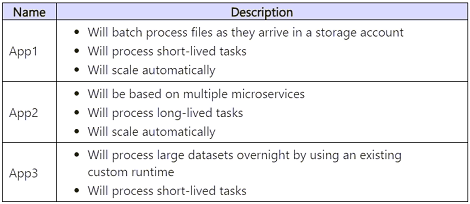 You need to recommend a compute solution for the apps.
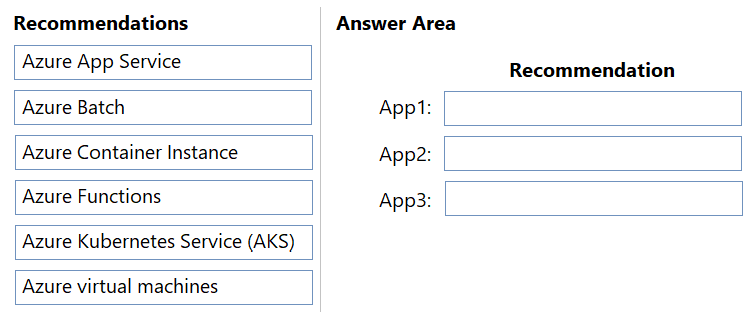
What should you include in the recommendation for each app? To answer, drag the appropriate recommendations to the correct apps. Each recommendation may be used once, more than once, or not at all. You may need to drag the split bar between panes or scroll to view content.
You need to recommend a compute solution for the apps.
What should you include in the recommendation for each app? To answer, drag the appropriate recommendations to the correct apps. Each recommendation may be used once, more than once, or not at all. You may need to drag the split bar between panes or scroll to view content.
Community Insight
The item tests whether you match a workload's operational pattern — event-driven, container-orchestrated, or massively parallel — to a compute service, and the trap is defaulting every web-facing app to plain App Service hosting plans or swapping Functions and Batch.
This drag-and-drop AZ-305 item asks you to map three Azure App Service web apps to the right compute platform — Azure Functions, Azure Kubernetes Service, or Azure Batch. The page confirms the mapping: App1 to Azure Functions, App2 to AKS, and App3 to Azure Batch, with the deciding evidence drawn from each app's workload pattern.
Learners often pick Azure Logic Apps or a scaled-out App Service plan for the event-driven app, and confuse Azure Batch with AKS for the compute-heavy app, because both 'run lots of work in parallel' and both feel like generic 'compute'.
Community Discussion (1 comments)
Comments & Corrections
No comments yet — spotted an error or have a note? Share it below.
Expert Analysis
Why the Answer Is Correct
The item forces one recommendation per app from the drag-item list, and each app's description contains a signature phrase that maps cleanly to one Azure compute service. App1 is described by its trigger behaviour — work is handled when messages/events arrive — which is exactly the Azure Functions consumption model: event-driven, scale-to-zero, per-execution billing, no cluster to manage. App2's description centres on a multi-service, container-based application that needs orchestration, service discovery and independent scaling, which is the Azure Kubernetes Service (AKS) scenario rather than a PaaS web host. App3's description centres on large volumes of compute-intensive work that must be queued and distributed across many machines without a permanently running cluster, which is precisely what Azure Batch provides through pools, jobs and tasks. Matching trigger model (Functions), orchestration model (AKS) and job-scheduling model (Batch) is the grading logic, not the fact that all three are called 'web apps' in the stem.
Why Other Candidate Answers Are Wrong
The common wrong pairings come from ignoring the workload verb in each row. Assigning the event-driven app to AKS or Batch introduces a cluster or pool plus job plumbing for something that only needs a function triggered per message, which is over-engineered and costlier at low volume. Assigning the containerised multi-service app to Azure Functions forces you into a single deployment unit and loses per-service scaling, sidecars and standard Kubernetes tooling. Assigning the compute-intensive app to AKS means you own node pools, autoscaling and job cleanup yourself, while assigning it to Functions hits execution-timeout and per-instance limits for long-running parallel workloads. Also incorrect is reusing the same recommendation for every app — the instructions allow reuse only where the evidence supports it, and the three descriptions deliberately diverge. Plain App Service plans are a trap because the stem already says these are App Service web apps and asks for a compute recommendation, not a hosting-plan SKU.
Community Comment Notes
mesloth's concise mapping aligns exactly with this analysis, keying App1 to Azure Functions on the phrase "as they arrive" and then listing AKS for App2 and Azure Batch for App3. That keyword-driven reading is the right way to attack this item: the exhibits are dense, so scan for the trigger/scaling language rather than the app name. The comment is a single vote, so it is supporting evidence rather than proof — but it converges with the vendor's own service descriptions for event-driven, container-orchestrated and job-scheduled workloads.
Official Reference
Exam Strategy
Read each table row for its trigger and scaling language first ("as they arrive", microservices/containers, large parallel compute) before looking at the drag items, then eliminate. If a row says nothing about orchestration or job scheduling, it almost never maps to AKS or Batch.
Frequently Asked Questions
Why is Azure Functions chosen for the app that processes requests as they arrive instead of AKS?
Functions is event-driven and scales per trigger with no cluster to operate, which matches the arrival-based workload. AKS adds orchestration overhead the app's description never asks for.
How do I tell Azure Batch and AKS apart for the compute-intensive App Service app?
Batch schedules jobs and tasks across managed pools for large parallel compute with no long-running cluster. AKS is for hosting containerized services you continuously operate.
Related Analysis
Practice All AZ-305 Questions
Access 95 questions with complete answers and detailed explanations.
View Full AZ-305 Practice Test →