Azure Functions Hosting Plan and Redundancy Selection
Short answer
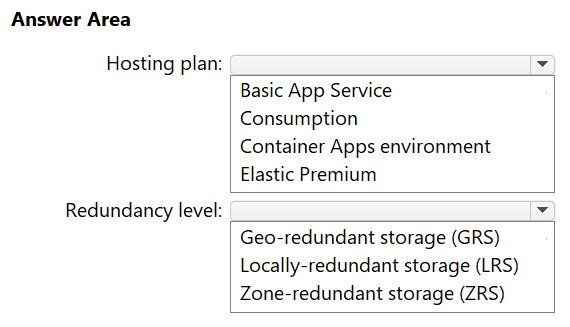
Hosting plan: Elastic Premium. Redundancy level: Zone-redundant.
Question
You have an Azure subscription.
You need to recommend a deployment solution for an Azure function that will host a custom API. The solution must meet the following requirements:
• Minimize latency associated with launching the API.
• Support on-demand scaling out to 90 instances.
• Support availability zones.
• Minimize costs.
Which hosting plan and redundancy level should you include in the recommendation? To answer, select the appropriate options in the answer area.
NOTE: Each correct selection is worth one point.
Key Takeaways
The question tests the specific capabilities of Azure Functions plans; Elastic Premium is unique in supporting both pre-warming (for latency) and availability zones.
To meet requirements for low latency, on-demand scaling, and availability zones in Azure Functions, recommend the Elastic Premium hosting plan with Zone-redundant configuration.
Common mistake: Selecting the Consumption plan because it is cost-effective or choosing standard redundancy instead of zone-redundant, failing to recognize that 'support availability zones' mandates a zone-redundant deployment.
Expert Analysis
The correct hosting plan is Elastic Premium. This is the only Azure Functions plan that supports availability zones and provides pre-warmed instances to minimize cold start latency. The Consumption plan does not support availability zones, and the App Service Plan (PremiumV3) does not offer pre-warming for functions in the same way, nor is it typically optimized for serverless cost structures compared to Elastic Premium for this specific scale.
For redundancy, you must select Zone-redundant. Since the requirement explicitly states "Support availability zones," the deployment must be zone-redundant to ensure high availability across multiple zones. Standard redundancy would imply a single zone, which contradicts the requirement.
The comment correctly identifies that Elastic Premium provides pre-warmed instances, addressing the latency requirement. It also notes the scaling capability up to 100 instances, which meets the 90-instance requirement. The key insight is that Elastic Premium is the bridge between serverless flexibility and enterprise-grade availability features like zones.
Official Reference
- https://learn.microsoft.com/en-us/azure/azure-functions/functions-scale#elastic-premium-plan
- https://learn.microsoft.com/en-us/azure/azure-functions/functions-app-settings
These links open the official vendor documentation in a new tab.
Exam Strategy
When asked about Azure Functions requirements involving availability zones and low latency, immediately eliminate Consumption and Basic plans. Focus on Elastic Premium as the sole option supporting zones and pre-warming. Always pair 'availability zones' with 'zone-redundant' redundancy settings.
Frequently Asked Questions
Why can't I use the Consumption plan for availability zones?
What is the benefit of pre-warmed instances in Elastic Premium?
Discussion 1 contributions
Compiled from public community threads and reader submissions, lightly edited for clarity. Handles and vote tallies are shown as recorded, and comments reflect the views of individual contributors.
From public community threads 1
-
gpais 👍 11. Hosting plan: • Selection: Elastic Premium • Reasoning: • Minimize launch latency: The requirement to minimize latency when launching the API means you must avoid "cold starts." The Elastic Premium plan provides pre-warmed instances that are always ready to respond immediately. • Scale and AZ Support: It comfortably scales up to 100 instances (meeting the 90-instance scale-out requirement) and natively supports Availability Zones while being more cost-effective for dynamic on-demand scaling than a full Container Apps or large dedicated App Service environment. • Why Consumption is incorrect: Consumption suffers from cold start latency, which violates the first requirement. • Why Basic App Service is incorrect: The Basic plan does not scale out to 90 instances and does not support Availability Zones.
Reader comments & corrections
No reader corrections yet — spotted an error or have a note? Share it below.
Related Analysis
Practice All AZ-305 Questions
Access 95 questions with complete answers and detailed explanations.
View Full AZ-305 Practice Test →