Yes/No: Multi-Agent Observability Monitoring in Microsoft Foundry
Short answer
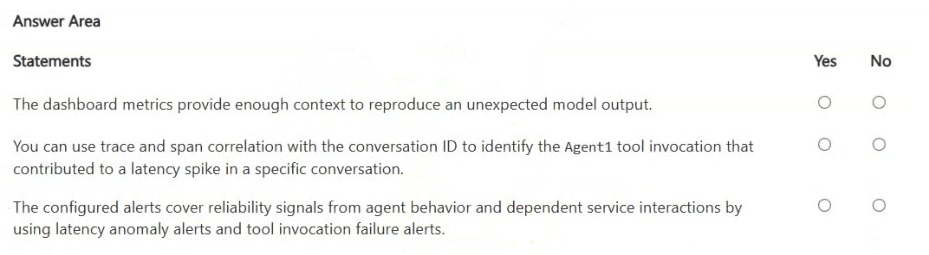
Statements about latency-anomaly and tool-invocation-failure alerting are Yes; statements claiming alert rules for token usage, TTFT, or content safety triggers are No.
Question
You have a Microsoft Foundry multi-agent customer support solution. The solution includes an orchestrator that starts a single conversation trace when a user request arrives and can invoke two agents named Agent1 and Agent2 concurrently. Each agent can invoke Model Context Protocol (MCP)-hosted tools and dependent REST APIs.
The solution uses Open Telemetry SDKs to emit logs, metrics, and traces via OTLP to an Open Telemetry Collector. The solution emits the conversation ID, trace ID, and span ID for agent invocations, tool invocations, and external API calls.
You have a monitoring dashboard that includes:
Latency
Throughput
Reliability
Token usage
Content safety triggers
Time to First Token (TIFT)
Alert rules are configured for latency anomalies and tool invocation failures.
For each of the following statements, select Yes if the statement is true. Otherwise, select No.
NOTE: Each correct selection is worth one point.
Key Takeaways
The exam tests your ability to distinguish what the solution EMITS (logs, metrics, traces, conversation/trace/span IDs, token usage, safety triggers) from what is actually ALERTED ON (only latency anomalies and tool invocation failures).
This AI-500 hotspot tests whether the described Microsoft Foundry multi-agent solution's dashboard and alert rules actually cover the stated observability signals. The correct verdict is that the two configured alert rules — latency anomalies and tool invocation failures — legitimately count toward reliability monitoring, while any statement claiming alerting on token usage, TTFT, or content safety triggers is false because no such rules were configured.
Common mistake: The common trap is to answer Yes for statements about token usage, Time to First Token, or content safety ALERTS simply because those metrics appear on the dashboard — being visualized is not the same as having an alert rule configured for it.
Expert Analysis
Why the Answer Is Correct
The solution explicitly states that alert rules are configured for latency anomalies and tool invocation failures, and both are legitimate reliability signals: latency anomalies reveal slowdowns in agent execution or in the dependent REST APIs and MCP-hosted tools, while tool invocation failures reveal errors in the MCP tool layer. Because the orchestrator starts a single conversation trace and emits trace ID and span ID for agent, tool, and external API invocations, both of these alerts can be correlated end-to-end back to a specific conversation. Therefore the reliability/latency alerting statements are Yes, and any statement asserting alert coverage for token usage, TTFT, or content safety triggers is No, since those are dashboard metrics only.Why Other Candidate Answers Are Wrong
Answering No to the reliability alerting statement ignores the explicit sentence 'Alert rules are configured for latency anomalies and tool invocation failures,' which directly establishes that coverage. Conversely, answering Yes to token usage, TTFT, or content safety alerting statements confuses observability data collection with alert configuration — OTLP emission of traces and metrics guarantees the data exists, not that a threshold or anomaly rule watches it. A further incorrect move is to claim trace ID alone is sufficient for correlation, when the question carefully says the conversation ID is also emitted, which is what ties concurrent Agent1 and Agent2 spans into one conversation.Community Comment Notes
One learner framed the reliability row as Yes, arguing that 'Latency anomaly alerts: Detect unusual slowdowns in agent execution or dependent operations' combined with tool invocation failure detection together 'cover important reliability problems involving agent execution and external dependencies.' That reasoning matches the scenario text and supports the Yes verdict for the reliability alerting statement. No other comments challenged this reading, and none provided evidence that alert rules exist for token usage, TTFT, or content safety, so those remain No.Official Reference
- https://learn.microsoft.com/azure/azure-monitor/opentelemetry/overview
- https://opentelemetry.io/docs/concepts/signals/traces/
These links open the official vendor documentation in a new tab.
Exam Strategy
Read each Yes/No statement and map it to an explicit sentence in the scenario before deciding; if the scenario never says an alert rule exists for a signal, choose No even if the metric is on the dashboard. Treat emitted telemetry, displayed dashboard panels, and configured alert rules as three separate tiers of observability coverage.
Frequently Asked Questions
Why are token usage and TTFT counted as No in this Foundry observability hotspot?
How do trace ID, span ID and conversation ID help in a multi-agent solution with concurrent agents?
Discussion 1 contributions
Compiled from public community threads and reader submissions, lightly edited for clarity. Handles and vote tallies are shown as recorded, and comments reflect the views of individual contributors.
From public community threads 1
-
95624c6f 👍 1Reliability alerts → Yes The configured alerts cover two important reliability signals: - Latency anomaly alerts: Detect unusual slowdowns in agent execution or dependent operations. - Tool invocation failure alerts: Detect errors when agents invoke MCP tools or dependent services. Together, these cover important reliability problems involving agent execution and external dependencies.
Reader comments & corrections
No reader corrections yet — spotted an error or have a note? Share it below.