Which Identity Access Configs for Foundry Agent Tools?
Short answer
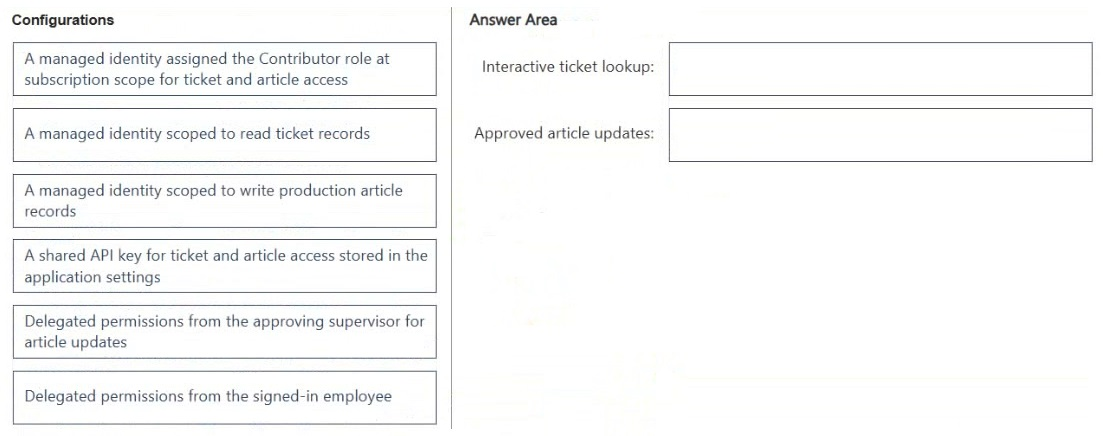
Ticket search: delegated Entra On-Behalf-Of permissions using the signed-in employee's token. Article updates: app-only managed identity permissions scoped only to the production repository.
Question
You have a Microsoft Foundry helpdesk triage agent. Employees sign in to the agent by using Microsoft Entra. The agent can invoke the following tools:
A ticket search tool that enforces the existing per-employee authorization model
A knowledge article tool that writes to a separate production article repository
You need to recommend an identity-based access configuration for the following execution contexts:
Ensure that interactive ticket searches enforce per-employee authorization.
Constrain approved article updates to the production article repository.
The solution must meet the following requirements:
Prevent the use of embedded secrets
Follow the principle of least privilege
Which access configurations should you recommend? To answer, drag the appropriate configurations to the correct execution contexts. Each configuration may be used once, more than once, or not at all. You may need to drag the split bar between panes or scroll to view content.
NOTE: Each correct selection is worth one point.
Key Takeaways
The exam tests delegated vs. app-only Entra permission models for two tool contexts; the trap is picking a single identity for both or allowing an embedded secret instead of a managed identity.
This Microsoft Foundry AI-500 drag-drop asks which Entra identity-based access configuration fits each helpdesk agent execution context. Interactive ticket search needs delegated On-Behalf-Of permissions from the signed-in employee, while approved article writes need app-only permissions scoped to the production repository.
Common mistake: Learners apply app-only (client credentials) access to the ticket search tool, which silently strips the per-employee authorization the tool depends on, or they grant the article writer broad repository-wide rights instead of scoping it to the production article repository alone.
Expert Analysis
Why the Answer Is Correct
The interactive ticket search must preserve the existing per-employee authorization model, which only works when the agent calls the tool with the signed-in employee's identity via Microsoft Entra On-Behalf-Of (OBO) delegated permissions. The article update path has no user in the loop, so it should use app-only access (managed identity or service principal) restricted by a permission scope or role that reaches only the production article repository. Both contexts satisfy the no-embedded-secrets rule because tokens come from Entra (OBO exchange or managed identity), and both satisfy least privilege because each identity receives only the rights its context requires. Assigning each configuration to its matching execution context is therefore the correct drag-drop mapping.Why Other Candidate Answers Are Wrong
Granting app-only access to the ticket search tool would let the agent query tickets outside any employee's entitlement, breaking the per-employee authorization the tool enforces and violating least privilege. Conversely, forcing delegated OBO onto the article writer is wrong because approved updates are a background, service-level operation with no signed-in user to delegate from. A shared secret or API key pasted into tool configuration is explicitly disallowed by the requirement to prevent embedded secrets, and it also weakens auditability of who performed a write. Granting the article identity rights beyond the production repository (such as write access to the whole knowledge store) exceeds least privilege even if it technically works.Community Comment Notes
The community response agrees with the delegated mapping, explaining that "The agent must access tickets on behalf of the currently signed-in employee" and naming On-Behalf-Of authentication as the mechanism. That comment also framed the second context as approved article updates handled by a separate app-only identity, which aligns with the least-privilege and no-secrets requirements. No commenter challenged the split between the two contexts, so the vote record supports rather than contradicts this verdict.Official Reference
https://learn.microsoft.com/en-us/entra/identity-platform/v2-oauth2-on-behalf-of-flow
This link opens the official vendor documentation in a new tab.
Exam Strategy
When a drag-drop splits contexts between an interactive (user-present) call and a background (service) call, pair the user-present call with delegated/OBO permissions and the service call with app-only managed identity — then re-check that no option introduces a stored secret.
Frequently Asked Questions
Why does interactive ticket search need On-Behalf-Of delegated permissions?
How do these configs avoid embedded secrets while staying least-privilege?
Discussion 1 contributions
Compiled from public community threads and reader submissions, lightly edited for clarity. Handles and vote tallies are shown as recorded, and comments reflect the views of individual contributors.
From public community threads 1
-
95624c6f 👍 11. Interactive ticket lookup → Delegated permissions from the signed-in employee "A ticket search tool that enforces the existing per-employee authorization model." The agent must access tickets on behalf of the currently signed-in employee, preserving that employee's permissions. This is typically achieved through Microsoft Entra On-Behalf-Of (OBO) authentication. 2. Approved article updates → Managed identity scoped to write production article records "A knowledge article tool that writes to a separate production article repository." Unlike ticket searches, article updates should use a dedicated workload identity with narrowly scoped permissions.
Reader comments & corrections
No reader corrections yet — spotted an error or have a note? Share it below.