Microsoft 365 Anti-Spam Policy Priority Resolution
Short answer
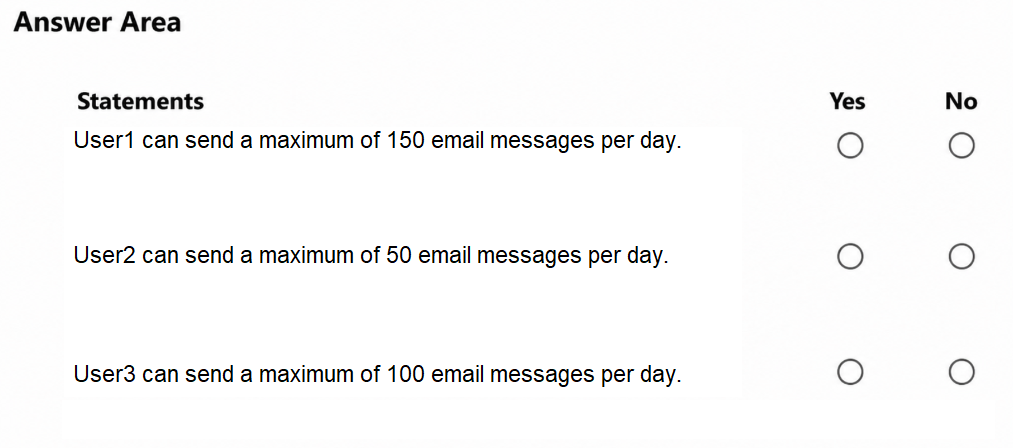
User1: Yes; User2: No; User3: Yes
Question
You have a Microsoft 365 E5 subscription that contains the users shown in the following table.
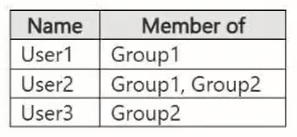
The subscription has the following two anti-spam policies:
Name: AntiSpam1
Priority: 0
Include these users, groups and domains
Users: User3
Groups: Group1
Exclude these users, groups and domains
Groups: Group2
Message limits
Set a daily message limit: 100
Name: AntiSpam2
Priority: 1
Include these users, groups and domains
Users: User1
Groups: Group2
Exclude these users, groups and domains
Users: User3
Message limits
Set a daily message limit: 50
For each of the following statements, select Yes if the statement is true. Otherwise, select No.
NOTE: Each correct selection is worth one point.
Key Takeaways
Tests understanding that lower priority numbers indicate higher precedence, meaning the first matching policy overrides all subsequent ones for the same recipient.
Determines the correct application of Microsoft 365 anti-spam policies by analyzing priority levels and inclusion lists to establish accurate daily message limits for specific users.
Common mistake: Learners often assume that if a user is excluded from a high-priority policy, they fall through to the next one, or they confuse 'excluded' status with 'not included'. For User3, mistakenly applying AntiSpam2 due to the exclusion rule leads to an incorrect answer.
Expert Analysis
The core principle governing Microsoft 365 anti-spam policy application is priority-based evaluation. Policies are processed in ascending order of their priority value, with a lower number indicating a higher precedence. The system evaluates the highest-priority policy first and applies its settings to the recipients; subsequent policies with lower priorities (higher numbers) are ignored for those same recipients unless there is no overlap.
In this scenario, AntiSpam1 has a Priority of 0, while AntiSpam2 has a Priority of 1. Therefore, AntiSpam1 takes precedence over AntiSpam2. We must evaluate each user against these policies based on inclusion and exclusion rules:
- User1: This user is included in AntiSpam2 (Priority 1) but is not mentioned in AntiSpam1 (Priority 0). Since AntiSpam1 does not explicitly include or exclude User1, it does not apply. AntiSpam2 then applies because User1 is in its 'Include' list. The daily message limit is 50. Thus, the statement that User1 can send up to 50 messages is True.
- User2: This user is not included in AntiSpam1 nor AntiSpam2. No specific anti-spam policy with message limits applies to User2. The statement claiming a limit of 100 is False.
- User3: This user is included in AntiSpam1 (Priority 0) and excluded from AntiSpam2 (Priority 1). Because AntiSpam1 has the higher priority (0), it is evaluated first. Since User3 is in the 'Include' list of AntiSpam1, this policy applies. The fact that User3 is excluded in the lower-priority AntiSpam2 is irrelevant because the higher-priority policy already matched. The daily message limit set by AntiSpam1 is 100. Thus, the statement that User3 can send up to 100 messages is True.
The comments correctly identify that AntiSpam1's Priority 0 supersedes AntiSpam2's Priority 1 for User3, leading to the 100-message limit.
Exam Strategy
When facing policy conflict questions, always sort policies by priority value (ascending). Apply the first policy that explicitly includes the target entity. Do not consider exclusions in lower-priority policies if the target was already positively matched by a higher-priority policy. If a target is not included in any policy, default rules apply.
Frequently Asked Questions
Why does User3 follow AntiSpam1 instead of AntiSpam2?
What happens if a user is not included in any anti-spam policy?
Discussion 1 contributions
Compiled from public community threads and reader submissions, lightly edited for clarity. Handles and vote tallies are shown as recorded, and comments reflect the views of individual contributors.
From public community threads 1
-
s.i.r.24 👍 1Yes, User3 can send up to 100 messages per day, assuming AntiSpam1 applies. Let's look at the policies: - AntiSpam1 (Priority 0): User3 is explicitly included. Daily limit = 100. - AntiSpam2 (Priority 1): User3 is explicitly excluded. Daily limit = 50. Because AntiSpam1 has the higher priority (0), User3 is covered by AntiSpam1.
Reader comments & corrections
No reader corrections yet — spotted an error or have a note? Share it below.