Agent 365 action cards for compliance gaps
Short answer
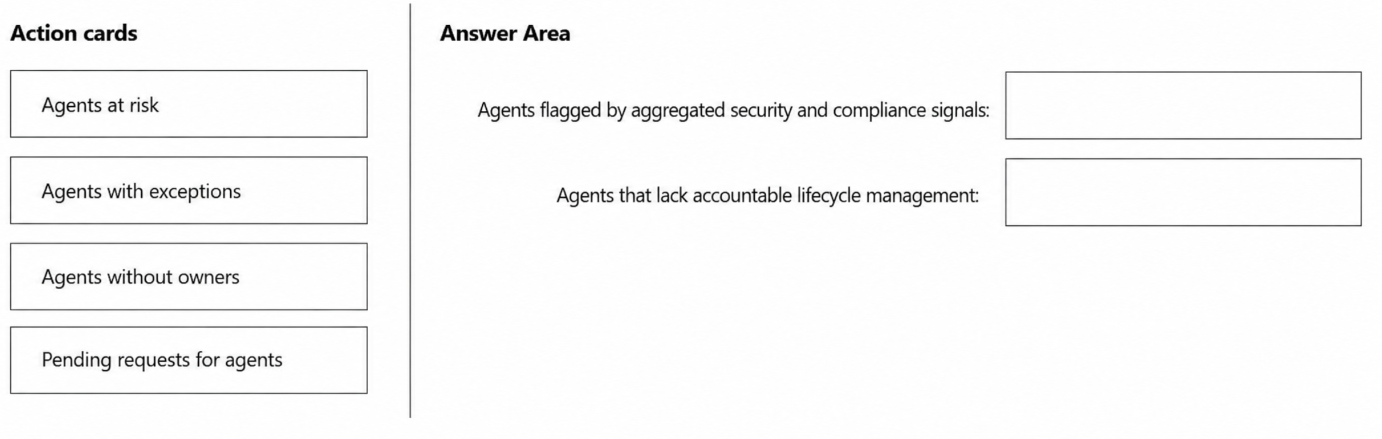
Map "Agents flagged by aggregated security and compliance signals" to the Agents at risk action card, and "Agents that lack accountable lifecycle management" to the Agents without owners action card.
Question
You have a Microsoft 365 subscription.
The following agent compliance gaps are identified in Microsoft Agent 365:
Agents flagged by aggregated security and compliance signals
Agents that lack accountable lifecycle management
You need to resolve the gaps.
Which action card should you use for each gap? To answer, drag the appropriate action cards to the correct gaps. Each action card may be used once, more than once, or not at all. You may need to drag the split bar between panes or scroll to view content.
NOTE: Each correct selection is worth one point.
Key Takeaways
The test is whether you distinguish an aggregated risk-signal gap (Agents at risk) from an accountability/lifecycle gap (Agents without owners); the trap is swapping the two cards because both sound governance-related.
This Microsoft Agent 365 drag-and-drop maps two compliance gaps to their action cards: agents flagged by aggregated security and compliance signals resolve with Agents at risk, while agents lacking accountable lifecycle management resolve with Agents without owners.
Common mistake: Pairing the aggregated-signal gap with Agents without owners and the lifecycle gap with Agents at risk. Ownership cards cannot triage security signals, and risk cards cannot assign accountable owners, so both gaps remain open.
Expert Analysis
What the question is really testing This is a Microsoft Agent 365 governance scenario with two distinct compliance gaps, each needing its own action card. The first gap describes agents "flagged by aggregated security and compliance signals" — the keyword is aggregated: many signals from security, compliance and risk surfaces rolled into one triage view. The second gap describes agents that "lack accountable lifecycle management" — that is an ownership and accountability question, not a risk question.
The correct mapping The gap for agents flagged by aggregated security and compliance signals is resolved with the Agents at risk action card. The gap for agents lacking accountable lifecycle management is resolved with the Agents without owners action card.
Why the adjacent choice fails The trap here is treating "risk" and "ownership" as interchangeable. Agents at risk aggregates risk alerts, DLP triggers, and security/compliance signals so administrators can investigate and remediate flagged agents — it does not assign accountability. Agents without owners surfaces agents with no designated owner and drives the lifecycle step of assigning one. Swapping them leaves both gaps unaddressed: a risk-triage card cannot create an owner, and an ownership card cannot process a security signal.
The change that would flip the answer If the second gap were worded as "agents with pending risk alerts from Defender and Purview," both gaps would route to Agents at risk. If the first gap were "agents with no designated owner in their lifecycle record," it would route to Agents without owners. The gap wording, not the card wording, decides the match.
Operational consequence of getting it wrong Mis-mapping these cards means flagged agents stay uninvestigated while unowned agents keep drifting through the lifecycle with no accountability — the two gaps persist in parallel. In the exam, read each gap's operative noun first (signals vs. lifecycle/ownership), then match it to the card that addresses that exact noun.
Exam Strategy
For drag-and-drop governance questions, underline the operative noun in each gap — "signals" points to a triage/risk card, "lifecycle" or "owners" points to an accountability card — then match noun to card before dragging. Check whether any card could plausibly serve both gaps; if one card only addresses one noun, keep them separate. After matching, reread each gap to confirm the card's own scope resolves it end to end, since partial matches earn nothing.
Frequently Asked Questions
Why does Agents at risk fit the aggregated security and compliance signals gap?
Why does Agents without owners fit the lifecycle management gap?
Can one action card resolve both Agent 365 compliance gaps?
Discussion 1 contributions
Compiled from public community threads and reader submissions, lightly edited for clarity. Handles and vote tallies are shown as recorded, and comments reflect the views of individual contributors.
From public community threads 1
-
linux_admin 👍 1Agents at risk Agents without owners Explanation: Agents at risk is correct for "Agents flagged by aggregated security and compliance signals" because in Microsoft Agent 365, the Agents at risk action card aggregates risk alerts, data loss prevention (DLP) triggers, and security signals from Microsoft Defender and Microsoft Purview, enabling administrators to investigate and remediate high-risk agents. Agents without owners is correct for "Agents that lack accountable lifecycle management" because the Agents without owners action card identifies orphaned or abandoned agents that lack assigned technical owners or business sponsors responsible for reviewing, approving, and managing their operational lifecycle. Other options: - Agents with exceptions is used to track agents that deviate from standard policy templates, baseline configurations, or approved permission sets. - Pending requests for agents displays newly submitted custom agents or connectors awaiting administrator review and approval before they can be published to the organization catalog.
Reader comments & corrections
No reader corrections yet — spotted an error or have a note? Share it below.