Prepare Agent Flow in Copilot Studio
DRAG DROP
A company is preparing an agent flow so that it can be invoked by an agent during conversations.
The agent flow must meet the following requirements:
The agent must be able to trigger the flow.
The agent flow must be verified.
You need to prepare an agent flow so that it can be used by the agent.
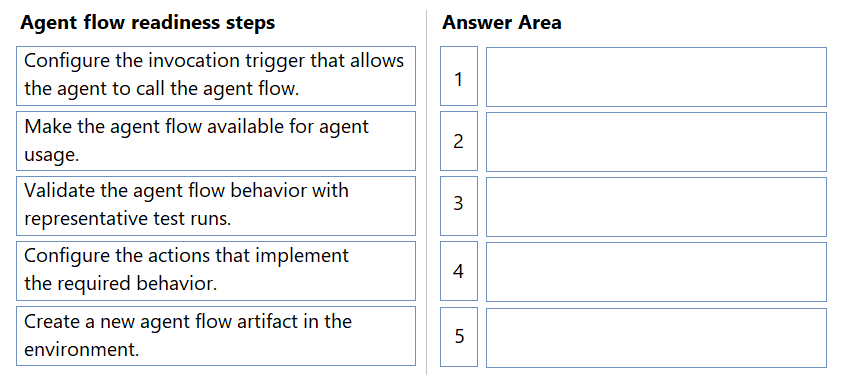
In which order should you perform the actions to prepare the agent flow? To answer, move all actions from the list of actions to the answer area and arrange them in the correct order.
Community Insight
The common trap is configuring actions before triggers or skipping validation steps; the correct order ensures the flow is defined, tested, and published sequentially.
This question tests the correct sequence for preparing an agent flow in Microsoft Copilot Studio. The page establishes that you must first create the artifact, then configure triggers and actions, validate behavior, and finally make it available.
Learners often try to configure actions before setting up the invocation trigger, which prevents the flow from being correctly linked to the agent's conversation context.
Community Discussion (3 comments)
Comments & Corrections
No comments yet — spotted an error or have a note? Share it below.
Expert Analysis
Why the Answer Is Correct
The correct sequence follows the logical lifecycle of building a functional Power Automate flow within Copilot Studio. First, you must create the new agent flow artifact in the environment. Second, you configure the invocation trigger so the agent knows how to call this specific flow. Third, you configure the actions (logic) that implement the required behavior. Fourth, you validate the behavior with representative test runs to ensure it works as expected. Finally, you make the agent flow available for agent usage by publishing or binding it.Why Other Candidate Answers Are Wrong
Reordering these steps breaks the dependency chain. For example, you cannot configure the invocation trigger without the flow artifact existing. You cannot validate the flow if the actions haven't been configured yet. Making the flow available before validation risks deploying broken logic to production agents.Community Comment Notes
As Snoopy70 noted, checking the official Microsoft Learn documentation confirms the order: Create -> Configure Trigger -> Configure Actions -> Validate -> Make Available. Another user, harshagracy, provided a clear breakdown matching this exact sequence, emphasizing the importance of validation before availability.Official Reference
Exam Strategy
Memorize the 'Create-Configure-Validate-Publish' pattern for all agent flow questions. Always check if a step involves 'validation' or 'testing'—it usually comes after configuration but before making something 'available' or 'published'.
Frequently Asked Questions
Why do I need to validate the agent flow before making it available?
Validation ensures the flow executes correctly with sample data and handles errors gracefully. Skipping this step can lead to failures when the actual agent invokes the flow during conversations.
Can I configure actions before the invocation trigger?
No. The invocation trigger defines how the agent calls the flow. While you might technically build actions in isolation, the standard preparation sequence requires defining the entry point (trigger) before finalizing the internal logic (actions).