Dynamics 365 Contact Center ALM Deployment Sequence
Short answer
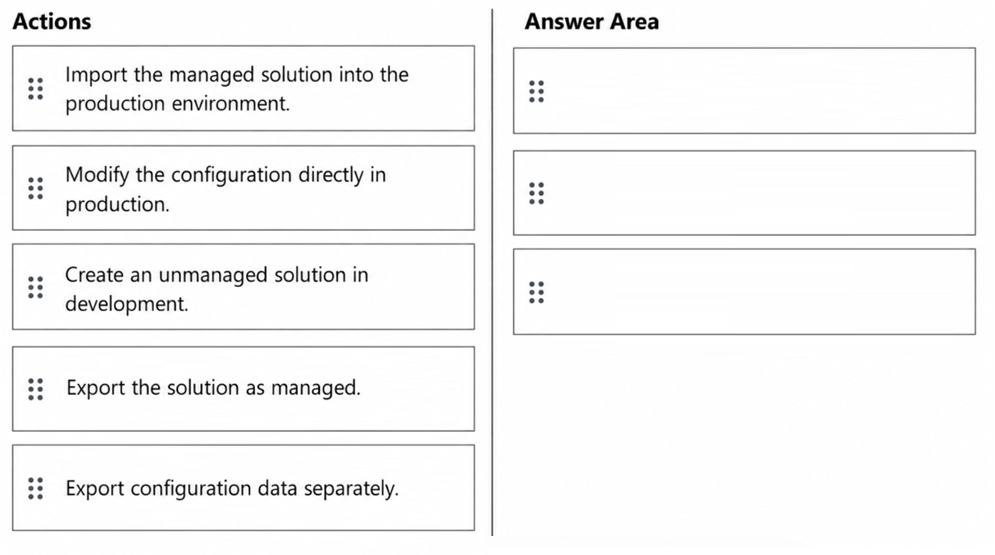
Create a solution, export the solution as managed, and then import the solution into the destination environment.
Question
This is a case study. Case studies are not timed separately from other exam sections. You can use as much exam time as you would like to complete each case study. However, there might be additional case studies or other exam sections. Manage your time to ensure that you can complete all the exam sections in the time provided. Pay attention to the Exam Progress at the top of the screen so you have sufficient time to complete any exam sections that follow this case study.
To answer the case study questions, you will need to reference information that is provided in the case. Case studies and associated questions might contain exhibits or other resources that provide more information about the scenario described in the case. Information provided in an individual question does not apply to the other questions in the case study.
A Review Screen will appear at the end of this case study. From the Review Screen, you can review and change your answers before you move to the next exam section. After you leave this case study, you will NOT be able to return to it.
To start the case study.
To display the first question in this case study, select the "Next" button. To the left of the question, a menu provides links to information such as business requirements, the existing environment, and problem statements. Please read through all this information before answering any questions. When you are ready to answer a question, select the "Question" button to return to the question.
Background
Fabrikam, Inc. is a mid-sized global company that provides outsourced customer support services for retail and telecommunications clients. The company operates multiple regional contact centers. Fabrikam, Inc. is transitioning to a unified cloud-based platform by implementing Microsoft Dynamics 365 Contact Center.
The goal is to improve customer satisfaction, reduce average handling time, and increase workforce productivity while enabling AI-assisted customer interactions.
Fabrikam, Inc. has an established Microsoft ecosystem, including Microsoft Azure and Microsoft Power Platform. The company requires that all implementations follow best practices for scalability, maintainability, and governance, while aligning with internal governance and security standards.
Current environment
Contact Center infrastructure
• Fabrikam, Inc. currently uses an outdated on-premises telephony system that does NOT integrate with modern CRM systems.
• The company is migrating to Dynamics 365 Contact Center to support voice-based interactions.
• Azure resources are centrally managed by the IT team.
• Azure Application Insights is provisioned but not yet connected to any contact center workload.
• Microsoft Entra ID is used for identity and access management.
Application lifecycle management (ALM)
• The company maintains separate development, test, and production environments in Microsoft Dataverse.
• Solutions are deployed as managed or unmanaged depending on the environment.
• Configuration data must be moved between environments without manual recreation.
• The IT team requires repeatable and governed deployment processes.
Users and roles
• Customer service representatives (CSRs) handle inbound customer calls.
• Supervisors monitor performance and manage workforce scheduling.
• Administrators configure and maintain the system.
• Roles are defined for CSRs, supervisors, and administrators, but permissions are not consistently enforced.
• Access must be restricted based on user responsibilities to enforce least privilege.
Business requirements
Voice channel
• Customers must be able to contact customer support through an inbound voice channel.
• Incoming calls must be routed to available CSRs based on predefined criteria.
• Customer input must be collected through an automated interaction before routing.
• Some inquiries must be resolved without involving a human representative.
• When escalation is required, CSRs must receive relevant information collected earlier in the interaction.
Workforce management (WFM)
• Supervisors must define shifts and assign schedules for CSRs.
• CSRs must receive interactions during their scheduled shifts only.
• Some shifts must allow for times that do NOT accept phone calls.
• WFM capabilities must be enabled within the contact center solution.
AI and automation
• The solution must support AI-driven capabilities to handle frequently asked customer questions.
• The system must support generative AI for natural, conversational interactions.
• When an issue cannot be resolved automatically, escalation paths must be defined.
Routing and work assignment
• Customer interactions must be managed through a structured process to ensure consistent handling.
• Information collected during the voice agent interactions must be available to CSRs.
• CSRs must be assigned to handle interactions based on their expertise.
Analytics and monitoring
• The company must monitor conversation performance and identify and troubleshoot issues affecting customer experience.
• The solution must provide detailed diagnostic information to support troubleshooting across the interaction lifecycle.
• Supervisors must be able to analyze interaction quality and identify trends and bottlenecks.
Technical requirements
Voice channel configuration
• Dynamics 365 Contact Center must be used to support voice-based customer interactions.
• The solution must support inbound calling through configured phone numbers.
• Voice interactions must be routed in a way that follows best practices for scalability and consistent performance.
IVR and voice agents
• IVR flows must support both naturally spoken input and keypad input.
• Voice agents must be configured by using Copilot Studio.• AI agents must be able to retrieve customer data from backend systems when needed.
Security and access
• Access must be restricted based on user responsibilities and follow the principle of least privilege.
• CSRs must access records relevant to only the interactions they handle.
• Supervisors must have visibility into CSR performance and schedules.
• Administrators must have full access to configure and manage the solution.
ALM and deployment
• Production deployments must use managed solutions.
• Configuration data must be moved between environments by using supported tools and without manual recreation.
• Deployment processes should be automated to ensure consistency and reliability.
Issues
• The current system lacks integration between voice interactions and CRM systems.• CSRs receive calls outside of their scheduled shifts.• Fabrikam, Inc. has no consistent process for deploying configurations across environments.• AI capabilities are underused, resulting in increased interaction volumes.• Some customers interact from a noisy environment, which makes it difficult for CSRs and agents to serve them efficiently.• Supervisors lack visibility into detailed conversation diagnostics.• Access permissions are not consistently aligned with user responsibilities, causing access inconsistencies.
You need to deploy configuration changes across environments based on the technical requirements.
Which three actions should you perform in sequence? To answer, move the appropriate actions from the list of actions to the answer area and arrange them in the correct order.
Key Takeaways
The main trap is forgetting to select 'Managed' during export when deploying to production, or attempting to move configurations without bundling them in a solution first.
Learn the correct three-step ALM sequence for deploying configuration changes in Dynamics 365 Contact Center: create a solution, export it as managed, and import it to the target environment.
Common mistake: Learners often try to import directly or export as unmanaged. Importing without creating a solution first is impossible, and exporting as unmanaged violates the requirement for managed production deployments.
Expert Analysis
The scenario requires moving configuration data between environments (Development, Test, Production) without manual recreation, adhering to ALM best practices. The key constraint is that production deployments must use managed solutions.
The correct sequence for Application Lifecycle Management (ALM) in Dynamics 365 is:
- Create a solution: All customizations and configurations must be bundled into a Solution component. This ensures they can be moved as a unit.
- Export the solution as Managed: Since the destination includes Production, and the requirement specifies 'Production deployments must use managed solutions,' you must export the solution with the 'Managed' checkbox selected. Exporting as Unmanaged allows overwriting but prevents the source environment from being updated by future imports of this solution; Managed packages prevent accidental modification of components in the target environment.
- Import the solution into the destination environment: Once exported, the managed solution package is imported into the target environment (e.g., from Dev to Test, or Test to Prod). This applies the configuration changes.
The comment correctly identifies this logic: "The correct actions are: create a solution, export managed, and import to destination." This aligns with Microsoft's official ALM guidance for Dynamics 365.
Exam Strategy
Always look for keywords like 'production', 'managed', and 'configuration data'. For ALM questions involving multiple environments, remember the standard flow: Package (Solution) -> Export (Managed for Prod) -> Import. Do not skip the creation step.
Frequently Asked Questions
Why must I export as managed for production?
Can I move individual settings without a solution?
Discussion 1 contributions
Compiled from public community threads and reader submissions, lightly edited for clarity. Handles and vote tallies are shown as recorded, and comments reflect the views of individual contributors.
From public community threads 1
-
lastcert 👍 1Question doesn't mention data, only configuration. The correct actions are: create a solution, export managed, and import to destination.
Reader comments & corrections
No reader corrections yet — spotted an error or have a note? Share it below.
Related Analysis
Practice All AB-250 Questions
Access 106 questions with complete answers and detailed explanations.
View Full AB-250 Practice Test →