OSPF External Route Selection: E1 vs E2 Metric Comparison
Refer to the exhibit. The network 10.10.0.0/16 has been redistributed to OSPF processes and the best path to the destination from R1 has been chosen as R1-R2-R3. A failure occurred on the link between R2 and R3, and the path was changed to R1-R4-R5-R3 What happens when the link between R2 and R3 is restored? - 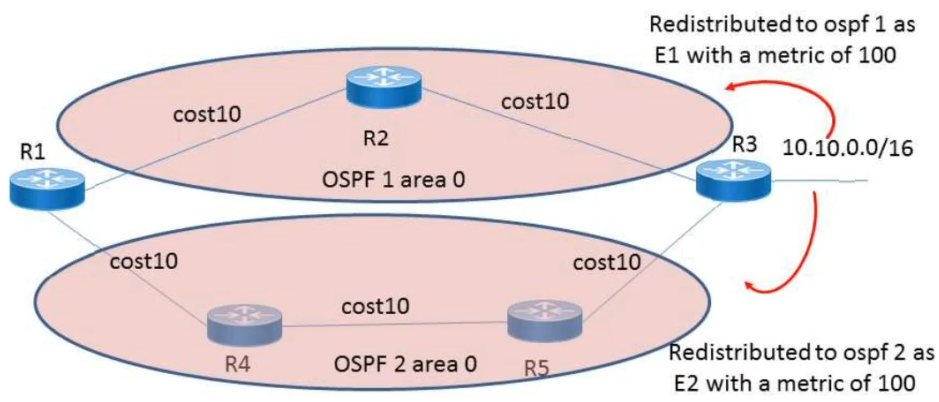
Community Votes
76% of anonymous learners picked answer B. Votes are pick records left by other test-takers — they are not the verified answer.
Community Insight
The core concept tested is the OSPF external route preference hierarchy; the common trap is assuming the lower metric path wins, ignoring the type precedence rule.
This question examines OSPF external route selection logic, specifically the tie-breaking rules between External Type 1 (E1) and External Type 2 (E2) routes. It establishes that E1 routes are always preferred over E2 routes regardless of metric magnitude.
Most learners choose C or D, mistakenly believing that metrics from different OSPF processes cannot be compared or that historical best paths persist without recalculation.
Community Discussion (8 comments)
Comments & Corrections
No comments yet — spotted an error or have a note? Share it below.
Expert Analysis
Why the Answer Is Correct
The correct answer is B because OSPF has a strict hierarchy for selecting among multiple external routes to the same destination. When a router receives both an E1 and an E2 route for the same network, it will always prefer the E1 route, even if the E2 route has a significantly lower cost. This behavior occurs because E1 routes accumulate internal AS costs plus the external cost, making them generally more representative of the true distance, whereas E2 routes only use the external cost. Therefore, when the link restores and R1-R2-R3 becomes available again, if it is advertised as an E1 route while the backup path remains E2, R1 will select the E1 path.Why the Other Options Are Wrong
Option A is incorrect because OSPF does not simply pick the lowest metric across all types; type takes precedence over metric in this specific comparison. Option C is incorrect because while OSPF processes maintain separate LSDBs, the router's routing decision process compares valid candidates from all configured processes (assuming equal Administrative Distance), and type is a primary discriminator. Option D is incorrect because OSPF is a dynamic protocol that recalculates paths based on current topology and metrics; it does not revert to previous paths out of loyalty or history.Community Comment Notes
Community comments largely support the E1 preference logic. As blurain noted, "Intra-Area... External Type 1... would still be selected over the E2 route." Another user, Weltbuerger, pointed out that intra-area is preferred over inter-area which is preferred over external, but emphasized that within external types, the type itself is the key differentiator here. Kalulosu correctly identified that E1 includes internal cost, reinforcing why it might be chosen, though the primary reason is the type preference rule.Official Reference
Exam Strategy
When analyzing OSPF external routes, always check the Type (E1/E2) before comparing Metrics. Remember the hierarchy: Intra > Inter > External E1 > External E2. If types differ, the lower type number wins regardless of cost.
Frequently Asked Questions
Why doesn't the lower metric path win?
OSPF prioritizes route type over metric for external routes. E1 is always preferred over E2, even if E2 has a much lower cost.
Do OSPF processes compare metrics?
Yes, if they have the same Administrative Distance. The router compares the best candidate from each process using standard tie-breakers like Type, then Metric.