AnswerCorrect answer: A — Under asymmetric IRB (egress does L2 only) inter-VNI routing happens at ingress using Layer 2 VNI mappings for each VLAN, with VLAN 100 mapped to L2 VNI 2020.
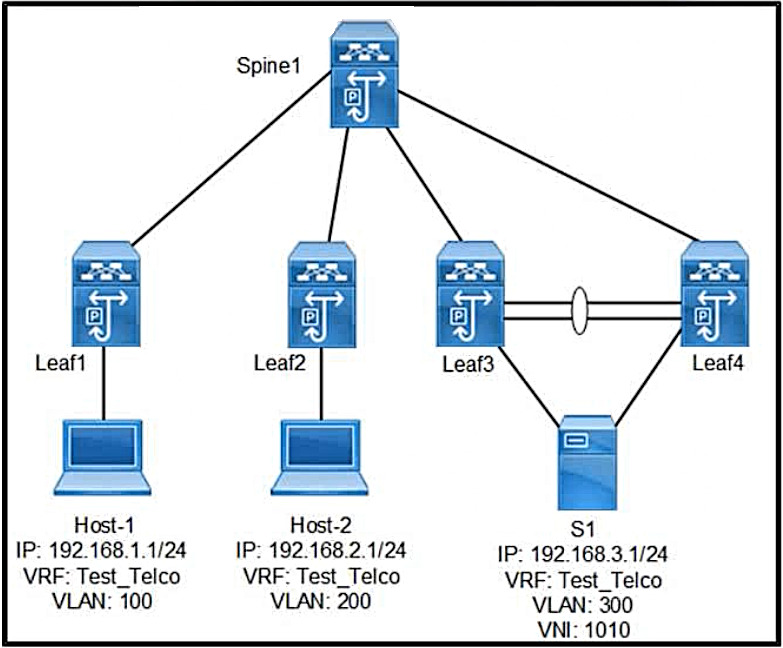
Refer to the exhibit. A VXLAN data center fabric consists of three hosts mapped to different VLANs. Ingress VTEPs perform Layer 2 bridging and Layer 3 routing. Egress VTEPs only perform a Layer 2 bridging lookup. Which VNI values must be set to allow inter-VNI communication? -
VLAN 100 to Layer 2 VNI 2020 - Correct Answer
VLAN 100 to Layer 2 VNI 2020 -
VLAN 100 to Layer 2 VNI 2020 -
VLAN 100 to Layer 2 VNI 1010 -
Community Votes
A
67%
B
33%
67% of anonymous learners picked answer A.
Votes are pick records left by other test-takers — they are not the verified answer.
Community Insight
Asymmetric IRB performs all routing at the ingress VTEP using SVIs and bridges into the destination L2 VNI; egress does only an L2 lookup, so distinct L2 VNIs per VLAN suffice and an L3 VNI is not used.
When ingress VTEPs route and egress VTEPs only bridge (asymmetric IRB), inter-VNI communication needs Layer 2 VNI mappings for each VLAN at the ingress; no L3 VNI is required.
Assuming a symmetric-IRB L3 VNI is needed, or reusing an already-assigned L2 VNI for a second VLAN, which collides and breaks fabric isolation.
Community Discussion (6 comments)
Manu_75👍 1Selected: B
"Egress VTEP only perform L2 lookup" == Asymmetric IRB == no L3VNI Different VLANs should be mapped to different VNIs so routing happens on ingress => B
bizzar7774👍 2Selected: A
In VXLAN, for Layer3 routing, a VRF must be bound to a Layer3 VNI. This makes A or C possible valid choises. In the diagram we see that vlan 300 is very likely bound to Layer2 VNI 1010. So this means that answer C is not correct because if VNI 1010 is a Layer2 VNI, we must use a different VNI ID for Layer3 routing. This lets A likely to be the correct answer.
sebamegot👍 1
A or B?
Mrtvi👍 2Selected: A
For a inter-vni communication we must define a L3 VNI.
ed27👍 1Selected: B
We need Layer 2 VNI mappings for VLAN 100 and VLAN 200
elper👍 1
What does inter-VNI communication even mean? Should it be inter-SVI?
Comments & Corrections
No comments yet — spotted an error or have a note? Share it below.
Log in to comment, report an error, or add a note about this question.
Expert Analysis
Why the Answer Is Correct
The exhibit states ingress VTEPs perform L2 bridging and L3 routing while egress VTEPs perform only an L2 lookup. That is the definition of asymmetric IRB: the ingress VTEP routes between subnets using SVIs and then bridges into the destination L2 VNI, so no L3 VNI is required. Inter-VNI (inter-VLAN) communication therefore needs a Layer 2 VNI mapping for each involved VLAN — VLAN 100 to L2 VNI 2020 and VLAN 200 to a distinct L2 VNI — with routing done entirely at the ingress.
Why the Other Options Are Wrong
Options that reuse an already-assigned L2 VNI (for example mapping VLAN 200 to 1010, which the diagram binds to VLAN 300) would collide and break isolation. Because egress only does L2 lookups, any solution requiring an L3 VNI (symmetric IRB) does not match the described behavior.
Community Comment Notes
Votes A 67 / B 33. bizzar7774 argues A: an L3 VNI would be needed only in symmetric IRB, and 1010 is already the L2 VNI for VLAN 300, so it cannot be reused. Manu_75 argues B on the asymmetric-IRB "no L3 VNI" point, but the decisive factor is assigning distinct L2 VNIs to the two VLANs.