How Does CoPP Handle ACL Match Results?
Refer to the exhibit. Which result is achieved by the CoPP configuration? - 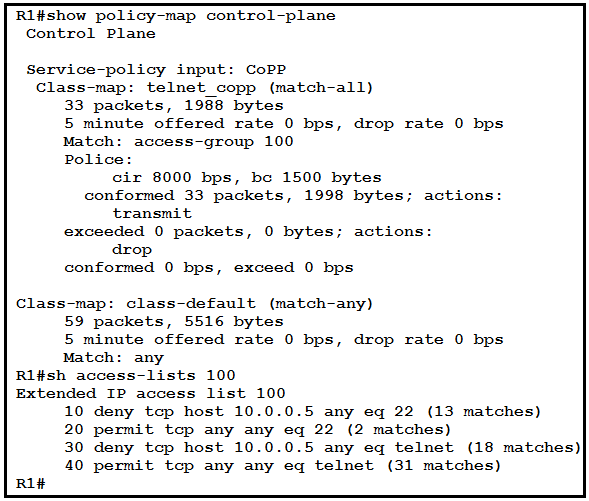
Community Votes
79% of anonymous learners picked answer D. Votes are pick records left by other test-takers — they are not the verified answer.
Community Insight
The question traps candidates who apply traditional firewall logic, whereas CoPP fundamentally treats all ACL matches as classification tags for subsequent policing actions.
This question tests the fundamental difference between ACL filtering and CoPP traffic classification. Candidates must recognize that CoPP uses ACLs solely to identify traffic for policing, meaning both permit and deny entries allow traffic to proceed to the rate limiter.
Candidates frequently choose A or C, incorrectly assuming ACL deny statements drop packets in CoPP or over-focusing on the CIR value. They miss the core concept that CoPP ACLs never filter traffic; they only route it to the policer.
Community Discussion (10 comments)
Comments & Corrections
No comments yet — spotted an error or have a note? Share it below.
Expert Analysis
CoPP Classification vs. Standard Filtering
In traditional networking, an ACL acts as a filter:permit allows traffic, and deny drops it. However, Control Plane Policing (CoPP) operates differently. When you configure a class-map to match an ACL, Cisco IOS uses the ACL strictly for traffic classification, not filtering. Every packet that matches any entry in the referenced ACL—whether the statement is permit or deny—is captured by the class-map and handed off to the policy-map's policer.Why Option D is Correct
Traffic matching entry 10 of ACL 100 is successfully classified into the CoPP class-map. Because CoPP ACLs do not discard packets, the traffic is allowed to pass through the classification stage and enter the policing engine. While the policer may drop packets that exceed the configured Committed Information Rate (CIR), the ACL itself never blocks them. The exam prioritizes this classification-over-filtering principle, making D the most accurate reflection of the architectural behavior.Why Other Options Fail
- Option A incorrectly applies standard ACL filtering logic, assuming a
denystatement in the ACL would drop the traffic before policing. - Option B misattributes the behavior to
class-default, which only catches traffic that fails to match any explicitly defined class maps. - Option C focuses heavily on the CIR limitation, but the phrasing obscures the primary learning objective. The exam tests whether you know the ACL doesn't drop the traffic, not the specifics of rate-limiting mechanics.
Official Reference
Exam Strategy
When reviewing CoPP questions, immediately identify whether the ACL is being used for filtering or classification. Remember that in Control Plane Protection, every ACL entry serves only to categorize traffic for the policer; never assume an ACL 'deny' statement will drop packets in this context. Focus on the policy-map's policing action rather than the ACL's permit/deny keywords.
Related Analysis
Practice All 350-401 Questions
Access 218 questions with complete answers and detailed explanations.
View Full 350-401 Practice Test →