How to resolve an EtherChannel PAgP misconfiguration issue?
Refer to the exhibit. After unsuccessfully configuring an EtherChannel link, an engineer enables debugging. Which action will resolve the issue? - 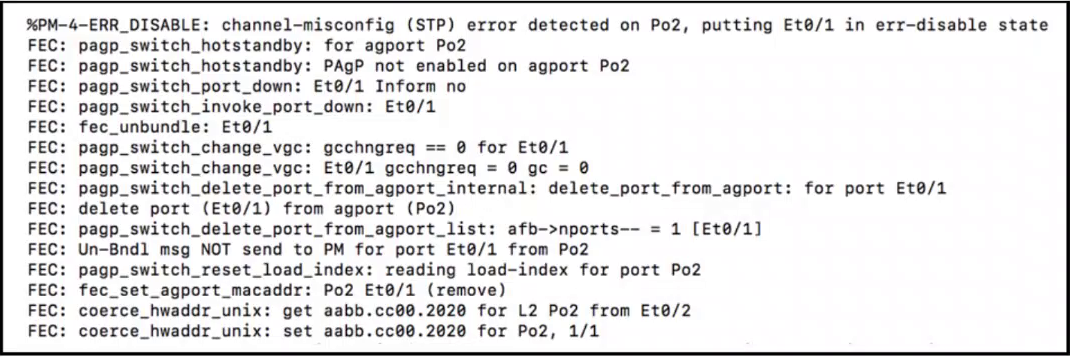
Community Votes
100% of anonymous learners picked answer A. Votes are pick records left by other test-takers — they are not the verified answer.
Community Insight
The exam tests your ability to map EtherChannel debug log keywords (PAgP vs. LACP) to the correct negotiation modes, with the common trap being selecting LACP modes (active/passive) when PAgP is in use.
This question tests the ability to identify and resolve an EtherChannel negotiation failure caused by a PAgP mode mismatch. Community consensus confirms that recognizing PAgP keywords in debug output is essential to selecting the correct mode (desirable or auto).
Candidates often choose 'active' or 'passive' mode, which are LACP modes, not realizing the debug output explicitly references PAgP, which only supports 'desirable' and 'auto' modes.
Community Discussion (6 comments)
Comments & Corrections
No comments yet — spotted an error or have a note? Share it below.
Expert Analysis
Why the Answer Is Correct
The debug output in the exhibit references PAgP (Port Aggregation Protocol), which is Cisco's proprietary EtherChannel negotiation protocol. PAgP only supports two negotiation modes: desirable and auto. Since the channel is failing to form, the member ports are likely set to 'auto' on both sides, preventing negotiation. Changing one side to 'desirable' will initiate PAgP negotiation and resolve the issue. Option A is the only valid PAgP mode listed.Why the Other Options Are Wrong
Option B ('on') is a static EtherChannel mode that disables negotiation entirely and would not resolve a PAgP mismatch—it would simply force the channel without protocol checks. Options C ('active') and D ('passive') are LACP (IEEE 802.3ad) modes, not PAgP modes; configuring them would switch the protocol entirely and is inconsistent with the debug output indicating PAgP is in use.Community Comment Notes
Comment [1] correctly identifies that the PAgP keyword in the log eliminates LACP and static options, narrowing the choice to 'desirable'. Comment [2] reinforces that PAgP only operates in 'auto' and 'desirable' modes. Comment [3] provides a helpful cheat sheet: PAgP → desirable/auto, LACP → active/passive, Static → on.Official Reference
Exam Strategy
When you see EtherChannel debug output, immediately identify the protocol keyword (PAgP, LACP, or none). Map the protocol to its valid modes—PAgP uses desirable/auto, LACP uses active/passive, and static uses on—before evaluating the answer options.
Related Analysis
Practice All 350-401 Questions
Access 218 questions with complete answers and detailed explanations.
View Full 350-401 Practice Test →