WLC Configuration to Increase Wi-Fi Throughput
Refer to the exhibit.
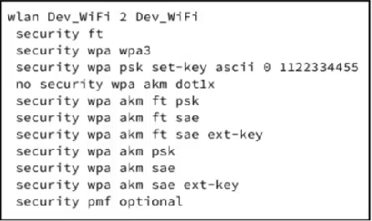 A startup company has recently moved to new offices and performed a full network refresh. The application development team requested a high-speed reliable wireless network to use for testing real-time applications. Although, the wireless network is Wi-Fi 7 enabled, the wireless clients are connecting using lower speeds.
Which configuration must be applied on the WLC to increase throughput?
A. security wpa3 akm sae ext-key
B. security wpa wpa2 ciphers gcmp256
C. security wpa wpa2 wpa3 aes512
D. security wpa wpa2 wpa3 tkip512
Community Insight
The exam tests knowledge of efficient encryption protocols, specifically identifying GCMP-256 as the optimal choice for high-throughput modern Wi-Fi standards compared to legacy or computationally heavy alternatives.
This question addresses how to configure a Cisco Wireless LAN Controller (WLC) to maximize throughput for high-speed Wi-Fi 7 clients by selecting the appropriate encryption cipher suite.
Candidates often select AES-CCMP or TKIP because they are more familiar from older Wi-Fi standards, failing to recognize that GCMP-256 is required to unlock the full performance potential of Wi-Fi 6/7 hardware.
Community Discussion (1 comments)
Comments & Corrections
No comments yet — spotted an error or have a note? Share it below.
Expert Analysis
Why the Answer Is Correct
The correct configuration issecurity wpa wpa2 ciphers gcmp256. GCMP (Galois/Counter Mode Protocol) with a 256-bit key is the recommended encryption standard for high-throughput environments, including Wi-Fi 6 and Wi-Fi 7 deployments. It offers stronger security than AES-CCMP while being significantly less computationally intensive, allowing the wireless controllers and access points to handle multi-gigabit speeds without becoming bottlenecked by encryption overhead.Why Other Candidate Answers Are Wrong
Options involvingtkip512 are incorrect because TKIP is a legacy protocol associated with WEP replacement and does not support high throughput; furthermore, 'tkip512' is not a valid standard cipher specification. Options specifying aes512 are invalid because standard AES-CCMP uses 128-bit keys, and there is no common 'AES-512' cipher in standard Wi-Fi security profiles. The option security wpa wpa2 wpa3 aes512 is also incorrect due to the non-standard key length and the inefficiency of AES compared to GCMP for pure throughput optimization in this context.Community Comment Notes
Community consensus strongly supports the selection of GCMP-256, noting that it is the efficient encryption cipher necessary for Wi-Fi 6E and Wi-Fi 7 devices to achieve their rated speeds. As one commenter noted, 'GCMP... provides stronger security than AES-CCMP while being computationally lighter,' which directly explains why lower speeds were experienced when less efficient ciphers were likely active or default.Exam Strategy
When troubleshooting slow speeds on modern Wi-Fi networks, always check the encryption cipher first. Ensure that GCMP-256 is enabled if the client devices and APs support it, as this is the primary driver for maximizing throughput in Wi-Fi 6 and 7 environments.
Frequently Asked Questions
Why does GCMP-256 improve speed over AES?
GCMP-256 is computationally lighter than AES-CCMP, reducing the CPU load on the controller and APs, which allows them to process packets faster and sustain higher throughput.
Is TKIP suitable for Wi-Fi 7 testing?
No, TKIP is a legacy security protocol with significant performance limitations and should never be used for high-speed Wi-Fi 7 applications.