What Is the Correct Firepower 4100 Multi-Instance HA Configuration Order?
DRAG DROP
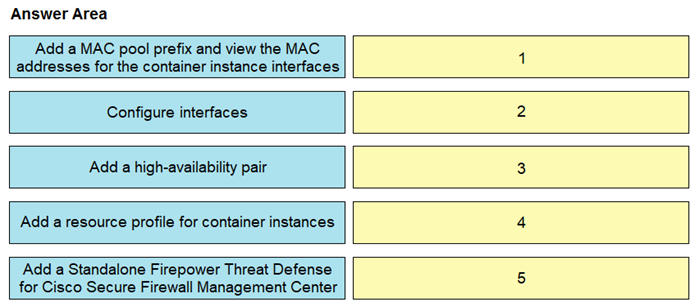
A network engineer is deploying a Cisco Firepower 4100 appliance and must configure a multi-instance environment for high availability. Drag and drop the actions from the left into sequence on the right for this configuration.
Community Insight
Tests whether you know the exact FXOS task order for multi-instance HA on a Firepower 4100; the trap is assuming interface configuration happens before the container instance exists, or skipping the resource profile and MAC pool prerequisites.
Multi-instance deployment on a Firepower 4100 chassis is an ordered FXOS workflow, and the drag-and-drop answer follows that order from interface pre-configuration through resource profiles to the final high availability pair. This page confirms the verified sequence, the reasoning behind each step, and where learner answers usually diverge.
Dragging Configure Interfaces before Add a Standalone Threat Defense because interface setup feels like a prerequisite, and dropping Pre-configure Interfaces as if it were a duplicate step; both break the dependency chain the chassis enforces.
Community Discussion (2 comments)
Comments & Corrections
No comments yet — spotted an error or have a note? Share it below.
Expert Analysis
Why the Answer Is Correct
Multi-instance deployment on a Firepower 4100 is a dependency chain executed in FXOS Chassis Manager: nothing can be deployed until the chassis interfaces and the CPU/memory buckets exist. Pre-configuring interfaces (physical ports, Ether Channels and their settings) therefore comes first, followed by one resource profile per container instance, then the optional MAC pool prefix that guarantees each instance interface receives a unique virtual MAC. Only after those building blocks are in place do you add the standalone threat defense, because a container instance must exist before its interfaces can be assigned, which is precisely what the Configure Interfaces step accomplishes. Adding the high availability pair is always last, since both peers must already exist with identical interface assignments before the pairing can be completed in FMC.Why Other Candidate Answers Are Wrong
Swapping Configure Interfaces ahead of Add a Standalone Threat Defense is the most attractive wrong ordering: at chassis level you can only pre-configure physical interface settings beforehand, while assigning interfaces to an instance requires the instance to be deployed. Placing Add a High Availability Pair anywhere but the end is equally invalid, because HA pairing is a relationship between two already-deployed, fully configured container instances. Deploying an instance before its resource profile is defined leaves the container with no reserved CPU/RAM and forces a redeploy, and setting the MAC pool prefix after interfaces are assigned leaves those interfaces with default MAC addresses. Finally, collapsing Pre-configure Interfaces and Configure Interfaces into one step loses the two distinct phases: chassis preparation versus instance-level interface assignment.Community Comment Notes
The most-liked comment (six votes) gives a compact five-step list starting with Add Resource Profile and pointing at Cisco's multi-instance documentation, and it simply omits the Pre-configure Interfaces phase. A second learner (one vote) supplies a longer list that opens with "Pre-configure Interfaces" and explicitly argues that "Add a Standalone Instance" before "Configure Interfaces," which matches the vendor dependency order used here. Both learners agree on the endpoints of the chain: resource profiles and the MAC pool prefix happen before deployment, and Add High Availability Pair is the closing step. The divergence is only about where interface work sits, and the vendor's sequence settles that by splitting it into pre-configuration (before) and assignment (after).Exam Strategy
Build the sequence from dependencies rather than from the wording of the tiles: anything the chassis needs before an instance exists (interface pre-configuration, resource profiles, MAC pool prefix) goes first, anything that acts on an existing instance (interface assignment) goes next, and HA pairing is always last. The optional MAC pool prefix keeps its fixed position in the order even though it is optional.
Frequently Asked Questions
Does the MAC pool prefix have to be set before deploying the container instance?
It is optional, but configuring it before deployment ensures each container instance interface receives a unique virtual MAC address instead of a default one.
Why can't Configure Interfaces come before adding the standalone threat defense?
Assigning interfaces targets an existing container instance in FXOS, so the instance must be deployed first; only chassis-level interface pre-configuration can happen earlier.