SD-WAN High Availability Components for Global Design
Refer to the exhibit.
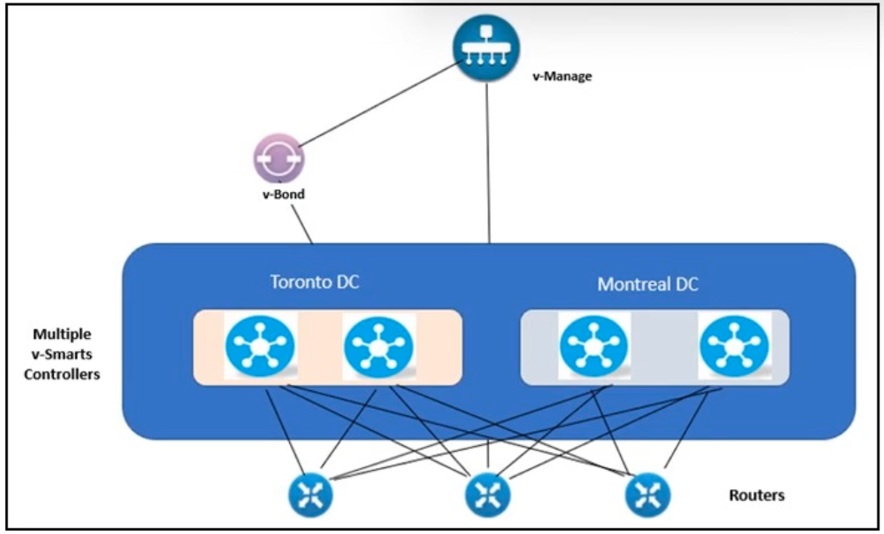 A network architect is designing a high-availability Cisco Catalyst SD-WAN solution for a global organization with offices in Canada, the United States, and Europe.
Which two components must be configured? (Choose two.)
Community Insight
The exam tests the distinction between local redundancy (like multiple control connections) and architectural resilience (geographically dispersed controllers), where the latter is essential for true global HA.
This question examines the critical components required to ensure high availability in a global Cisco Catalyst SD-WAN deployment, specifically focusing on control plane resilience and controller placement.
Many learners select 'multiple control connections' because it sounds redundant, but this typically refers to the path from an edge device to a single logical controller group or active/standby pair, which does not protect against regional outages of the entire controller infrastructure.
Community Discussion (1 comments)
Comments & Corrections
No comments yet — spotted an error or have a note? Share it below.
Expert Analysis
Why the Answer Is Correct
To achieve true high availability in a global organization, the design must prevent a single point of failure across regions. Configuring geographically dispersed SD-WAN Controllers (Option E) ensures that if one region's control infrastructure goes down, other regions can still manage their edges. Additionally, configuring multiple control connections (Option A) is often cited as a requirement for robust connectivity to these controllers, ensuring that edge devices maintain reachability even if individual links fail, though the primary architectural driver for global HA is the controller distribution.Why the Other Options Are Wrong
Single control connection (Option D) creates a single point of failure and is explicitly anti-thesis to high availability. While SD-WAN Manager redundancy (Option B) is important for management plane availability, the Control Plane (Controllers) is more critical for immediate operational continuity and policy enforcement. SD-WAN Validator redundancy (Option C) relates to license validation; while important, it is not the primary component for network connectivity and control plane high availability compared to the controllers themselves.Community Comment Notes
Community consensus strongly supports options C and E, with users noting that validator redundancy is part of the broader HA strategy for the control plane components. As one commenter noted, "C and E are the correct answers," highlighting the importance of both validation and controller distribution for a resilient setup.Exam Strategy
When designing for high availability, always look for 'dispersed' or 'redundant' infrastructure at the core service layer (Controllers) first. Local link redundancy is secondary to the availability of the control plane itself.
Frequently Asked Questions
Why is SD-WAN Validator redundancy included in HA?
Validator redundancy ensures that if the primary license validation server fails, the secondary server can continue to validate licenses, preventing potential service interruptions or policy denials.
Does single control connection provide any HA?
No, a single control connection represents a single point of failure. High availability requires multiple paths or redundant components to ensure continuous operation during failures.