Single-Homed Full Mesh Gives HA Without Extra WAN Links
Refer to the exhibit. Due to budget constraints, a customer decided to purchase WAN routers with one LAN and one WAN interface per device. There is a requirement to connect the three sites to ensure high availability without buying additional WAN links. Which design deployment must the customer choose? - 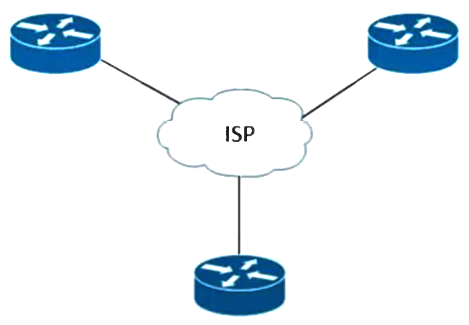
Community Votes
56% of anonymous learners picked answer B. Votes are pick records left by other test-takers — they are not the verified answer.
Community Insight
One WAN interface per device = single-homed. A full mesh over the WAN transport provides backup paths logically; dual-homed (A/D) would need extra WAN links the budget forbids.
Each router has only one WAN interface, so the sites are single-homed to the WAN service. Running a full mesh over that service provides any-to-any connectivity and logical path diversity, delivering high availability without purchasing additional WAN links (which dual-homing would require).
Picking C (hub-and-spoke): it has a single point of failure at the hub and less path diversity than a full mesh; the requirement for HA with backup paths points to full mesh (B), not hub-and-spoke.
Community Discussion (4 comments)
Comments & Corrections
No comments yet — spotted an error or have a note? Share it below.
Expert Analysis
Why the Answer Is Correct
B is correct. The one WAN interface per device means each site is single-homed to the provider. A full mesh over the WAN service yields any-to-any reachability and logical path diversity, so high availability is achieved without procuring extra WAN links.Why the Other Options Are Wrong
A and D (dual-homed) require additional WAN links, which the budget constraint rules out. C (hub-and-spoke) creates a hub single point of failure and less path diversity than the full mesh the HA requirement implies.Community Comment Notes
The vote is B (56) vs C (44). The top comment notes one WAN link means single-homed, and with no defined hub a full mesh adds no extra cost while meeting HA.Related Analysis
Practice All 300-420 Questions
Access 150 questions with complete answers and detailed explanations.
View Full 300-420 Practice Test →