Sizing the IPv4 Plan: /23 Server Room, No Overlap
Refer to the exhibit. An architect is designing an IPv4 plan using the 172.16.0.0/16. The design must maximize the number of subnets while meeting these requirements: • 500 hosts within the server room • 100 hosts at the remote site • 25 hosts at the access site Which plan must the architect choose? - 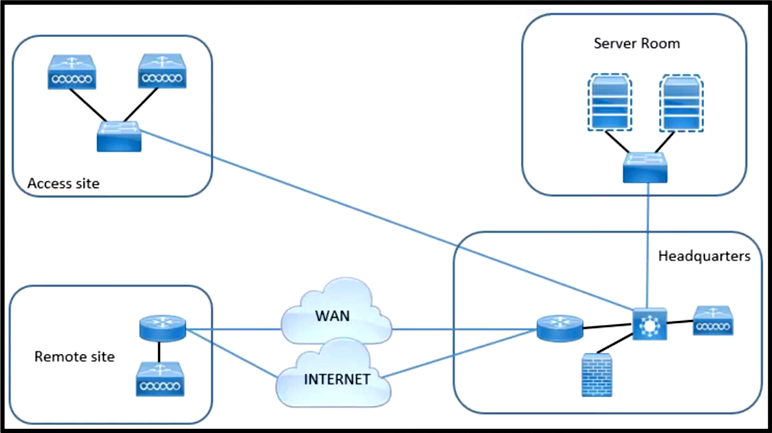
Community Votes
100% of anonymous learners picked answer B. Votes are pick records left by other test-takers — they are not the verified answer.
Community Insight
Pick the smallest prefix that holds the host count: 500 to /23, 100 to /25, 25 to /27. Then verify no overlap. B is the only option that satisfies all three without overlap.
For 172.16.0.0/16, the 500-host server room needs a /23 (512 addresses), the 100-host remote site a /25 (128), and the 25-host access site a /27 (32). Option B allocates these without overlap, meeting capacity while maximizing the number of available subnets.
Picking A (server /21) or D (server /22): those waste addresses and/or overlap the remote/access sites; C under-sizes the remote site (not enough hosts for 100). Only B fits all and stays contiguous.
Community Discussion (4 comments)
Comments & Corrections
No comments yet — spotted an error or have a note? Share it below.
Expert Analysis
Why the Answer Is Correct
B is correct. The server room needs 500 hosts, so a /23 (512 addresses) is the right size; B also sizes the remote site (100 hosts) and access site (25 hosts) without overlapping, maximizing usable subnets within 172.16.0.0/16.Why the Other Options Are Wrong
A (/21 server) and D (/22 server) waste addresses and overlap the remote/access allocations. C uses a /23 for the server but under-sizes the remote site, leaving it unable to hold 100 hosts. Only B meets every requirement.Community Comment Notes
The vote is B (100). Commenters confirm /23 gives 512 for the server room, /25 for the remote site, and /27 for the access site, with no overlap.Related Analysis
Practice All 300-420 Questions
Access 150 questions with complete answers and detailed explanations.
View Full 300-420 Practice Test →