Metro Ethernet vs SD-WAN Description Matching
Short answer
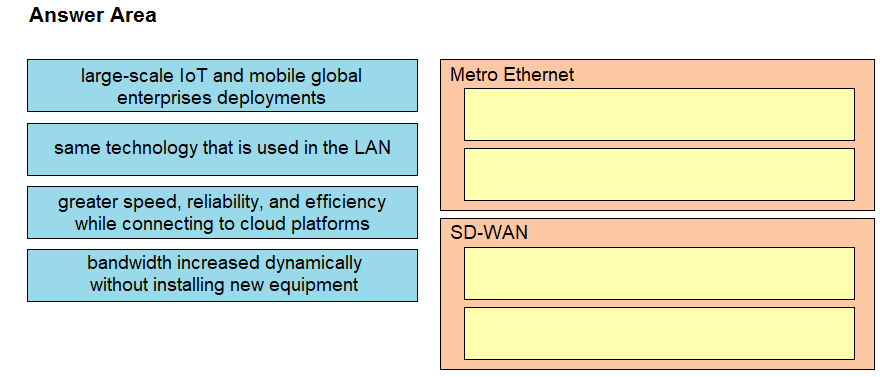
Metro Ethernet: same technology used in the LAN; bandwidth increased dynamically without installing new equipment. SD-WAN: large-scale IoT and mobile global enterprise deployments; greater speed, reliability, and efficiency while connecting to cloud platforms.
Question
Drag and drop the descriptions from the left onto the categories they apply to on the right.
Key Takeaways
The item tests whether you can distinguish a provider Ethernet service from an SD-WAN overlay, especially by the LAN-technology and dynamic-bandwidth clues.
This 300-420 drag-drop asks you to match Metro Ethernet and SD-WAN descriptions. Metro Ethernet covers LAN-consistent Ethernet and dynamic bandwidth, while SD-WAN covers global IoT/mobile scale and efficient cloud connectivity.
Common mistake: A common error is assigning “same technology that is used in the LAN” to SD-WAN because SD-WAN carries LAN traffic; that clue describes Metro Ethernet's Ethernet service, not the overlay.
Expert Analysis
What the categories are testing
The drag drop asks you to separate a Layer 2 metro transport service from an overlay WAN architecture. The descriptions are not interchangeable: Metro Ethernet is a carrier-delivered Ethernet service, while SD-WAN is a policy-driven overlay that can use multiple transports to connect branches, data centers, and cloud platforms. Qualifiers such as “same technology” and “without installing new equipment” point to a service characteristic, not to an SD-WAN feature.
Metro Ethernet mapping
Metro Ethernet belongs with “Same technology that is used in the LAN” and “Bandwidth increased dynamically without installing new equipment.” Ethernet is the LAN framing, and Metro Ethernet extends that Ethernet service across a provider metropolitan network; increasing subscribed bandwidth is a service change rather than a new customer-premises platform. A recurring correction in the comments points to the ENSLD source and assigns exactly these two descriptions to Metro Ethernet.
SD-WAN mapping
SD-WAN belongs with “Large-scale IoT and mobile global enterprise deployments” and “Greater speed, reliability, and efficiency while connecting to cloud platforms.” SD-WAN’s overlay, centralized policy, and transport independence suit many distributed devices and cloud-bound traffic. The Cisco blog reference in the comments supports monitoring cloud-native applications and IoT devices through vManage. That does not justify assigning LAN technology or dynamic bandwidth provisioning to SD-WAN.
Why the distractors fail
If “same technology used in the LAN” is assigned to SD-WAN, the architecture is being confused with Ethernet transport. If “bandwidth increased dynamically without installing new equipment” is assigned to SD-WAN, it mistakes provider service provisioning for SD-WAN’s use of multiple links. The correct mapping is therefore Metro Ethernet to the LAN-consistency and dynamic-bandwidth descriptions, and SD-WAN to the global IoT/mobile and cloud-efficiency descriptions.
Official Reference
https://blogs.cisco.com/networking/cisco-sd-wan-the-crossroads-of-enterprise-and-iot
This link opens the official vendor documentation in a new tab.
Exam Strategy
For matching items like this, classify each phrase by whether it describes a transport service or an overlay architecture before placing it. Look for ownership clues: provider Ethernet features such as LAN framing and subscribed bandwidth belong to Metro Ethernet, while multi-transport policy, cloud paths, and large-scale distributed endpoints belong to SD-WAN. Do not let a phrase that merely mentions cloud or devices force an overlay answer; test it against the category's defining mechanism.
Frequently Asked Questions
Why is “same technology that is used in the LAN” matched with Metro Ethernet rather than SD-WAN?
Which SD-WAN characteristics match the global IoT and cloud descriptions?
Does dynamic bandwidth without new equipment belong to SD-WAN?
Discussion 6 contributions
Compiled from public community threads and reader submissions, lightly edited for clarity. Handles and vote tallies are shown as recorded, and comments reflect the views of individual contributors.
From public community threads 6
-
Soggyt74 👍 15Per the ENSLD 300-420 book, page 278-279... Metro Ethernet should be "same technology that is used in the LAN" and "bandwidth increased dynamically without installing new equipment".
-
EADG 👍 5Metro Ethernet is Ethernet, typically delivered over fibre to get the range needed for metropolitan areas. Ethernet=LAN technology. SD-WAN characteristics in the answer above are accurate. Answer as shown is correct.
-
_MaGIC_13 👍 1Reposting from LearnMachine. Shown Solution is wrong. Should be as follows: Metro Ethernet - Same technology that is used in the LAN - Bandwidth increased dynamically without installing new equipment SD-WAN - Large-scale IoT and mobile global enterprise deployments - Greater speed, reliability, and efficiency while connecting to cloud platforms
-
chivastaba 👍 1SD-WAN : large-scale IoT and mobile global enterprises deployments Through the vManage dashboard, you can monitor cloud-native applications and employee devices alongside the IoT devices in your network so that you never miss a beat. https://blogs.cisco.com/networking/cisco-sd-wan-the-crossroads-of-enterprise-and-iot
-
G_Singh12 👍 1Metro Ethernet - Same technology that is used in the LAN - Bandwidth increased dynamically without installing new equipment SD-WAN - Large-scale IoT and mobile global enterprise deployments - Greater speed, reliability, and efficiency while connecting to cloud platforms
Show 1 more comment
-
ted_ba 👍 1In METRO ETH same technology that is used in the lan - wrong - this belong to SDWAN I think have to be "greate speed ...cloud platforms"
Reader comments & corrections
No reader corrections yet — spotted an error or have a note? Share it below.
Related Analysis
Practice All 300-420 Questions
Access 150 questions with complete answers and detailed explanations.
View Full 300-420 Practice Test →