IPv6 Migration Over IPv4-Only Layer 2 Infrastructure Using ISATAP
Short answer
A The engineer must deploy ISATAP to encapsulate IPv6 traffic within IPv4 packets, allowing the edge routers to peer across the IPv4-only Layer 2 DWDM infrastructure.
Question
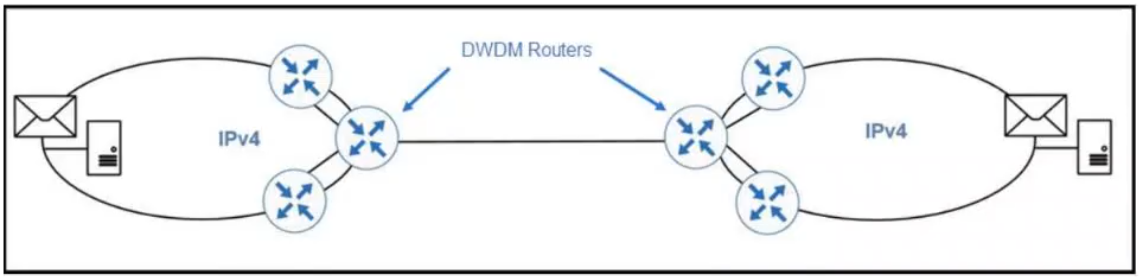
Refer to the exhibit. An engineer is planning an IPv4 to IPv6 migration solution for a customer. The routers in the network can support IPv4 and IPv6, except for the DWDM routers. The DWDM routers provide a Layer 2 link in which the routers peer directly with each other across a DWDM circuit. The circuit also provides connectivity between the mail servers. Which IPv6 migration technique must the engineer deploy?
Key Takeaways
The trap is assuming dual-stack suffices; however, since the intermediate DWDM routers are Layer 2 only and lack IPv6 support, a tunneling protocol like ISATAP is required to carry IPv6 traffic transparently.
This question examines IPv6 migration strategies when traversing an IPv4-only Layer 2 DWDM backbone. The correct solution is ISATAP, which enables IPv6 connectivity by encapsulating IPv6 packets in IPv4 headers.
Common mistake: Many candidates choose Dual-Stack (B) believing that since endpoints support IPv6, no special migration is needed. This ignores the fact that the intermediate transit link (DWDM) cannot process IPv6 headers, requiring encapsulation via ISATAP.
Expert Analysis
The core of this question lies in the network topology constraints: routers support IPv4/IPv6, but the intermediate DWDM infrastructure is strictly Layer 2 and does not support IPv6. The goal is to enable end-to-end IPv6 connectivity.
Why Dual-Stack (B) sounds right but fails: Dual-stack involves running both IPv4 and IPv6 on all devices. Since the DWDM routers are Layer 2 switches (or optical layer devices) that do not run an IP stack for IPv6, they cannot participate in dual-stack routing. While endpoints could be dual-stack, the 'migration technique' required to traverse the non-IPv6-aware link must handle the encapsulation or translation. If the answer were simply 'dual-stack,' it would ignore the specific constraint of the DWDM link's inability to route IPv6 packets natively across the site without a tunneling mechanism if the path were routed. However, because the link is Layer 2, we need a technology that works over a switched infrastructure.
Why ISATAP (A) is the correct choice: ISATAP (Intra-Site Automatic Tunnel Addressing Protocol) is specifically designed to provide IPv6 connectivity across an existing IPv4-only infrastructure, particularly over Layer 3 IPv4 networks, but it can also operate over Layer 2 IPv4 infrastructures by treating the IPv4 network as a virtual NBMA (Non-Broadcast Multi-Access) link. It encapsulates IPv6 packets inside IPv4 datagrams. In this scenario, the edge routers (which support IPv6) can establish ISATAP tunnels with each other. The intermediate DWDM routers simply forward the encapsulated IPv4 packets at Layer 2, oblivious to the IPv6 payload. This allows the IPv6 sites to communicate through the IPv4-only DWDM cloud.
Why other options are incorrect:
- 6to4 (C): Requires the use of a specific prefix (2002::/16) and relies on anycast relay routers. It is typically used for connecting isolated IPv6 islands over an IPv4 Internet, not necessarily for intra-site Layer 2 transport where ISATAP is more appropriate for automatic tunneling within a site.
- 6rd (D): Border Relay delegation is a service provider mechanism to assign IPv6 prefixes to customers over an IPv4 infrastructure. It requires the customer edge device to have IPv6 capabilities and often implies a different architectural setup than a simple peer-to-peer router migration across a DWDM link.
The key insight is that ISATAP is the standard Cisco-recommended technique for enabling IPv6 communication between sites connected by an IPv4-only infrastructure, whether that infrastructure is routed or switched (Layer 2), as long as the edge devices can form the tunnel.
Exam Strategy
When analyzing migration questions, always check the capabilities of every device in the path. If an intermediate device lacks IPv6 support, 'Dual-Stack' is automatically insufficient for end-to-end connectivity unless a tunnel or transition mechanism is explicitly mentioned. Look for keywords like 'Layer 2', 'IPv4-only infrastructure', or 'non-IP aware' to trigger selection of tunneling protocols like ISATAP or GRE.
Frequently Asked Questions
Why not use 6to4 instead of ISATAP?
Can DWDM routers ever support IPv6 directly?
Community Votes
50% of anonymous learners picked answer B. Votes are pick records left by other test-takers — they are not the verified answer.
Discussion 12 contributions
Compiled from public community threads and reader submissions, lightly edited for clarity. Handles and vote tallies are shown as recorded, and comments reflect the views of individual contributors.
From public community threads 12
-
sv1986 👍 3 Answered BI believe the answer is B. The question indicates that routers supporting both IPv4 and IPv6 can peer directly with each other over a DWDM circuit. This means they are capable of handling IPv6 in addition to IPv4. Therefore, we can configure IPv6 on routers and mail servers to enable their connection without needing to use any tunneling technologies.
-
cerifyme85 👍 3 Answered BGuys, my apologies, this dual-stack.. link between them is layer 2.. so layer3 ip/ipv6 stack not needed
-
electro165 👍 2 Answered ASince the DWDM routers don't support IPv6 and provide a Layer 2 link, the appropriate IPv6 migration technique to deploy in this scenario is: A. ISATAP (Intra-Site Automatic Tunnel Addressing Protocol) ISATAP is used to provide IPv6 connectivity across an IPv4-only infrastructure, allowing IPv6 packets to be encapsulated within IPv4 packets. It's typically used within a site or organization to facilitate IPv6 communication. Since the DWDM routers provide a Layer 2 link and don't support IPv6 directly, ISATAP can be used to enable IPv6 connectivity between the routers across the DWDM circuit, even though the DWDM routers themselves are not IPv6-capable.
-
dgonzalezexamtopics 👍 2What about 6rd? It allows SP Provides unicast IPv6 service to customers over IPv4. DWDM routers does NOT support IPv6, but I understand that IPv4 yes. Consequently, u can build an IPv6 in IPv4 tunnel. And BR interfaces has one in IPv6, IPv4 and another one as virtual. There are 3 interfaces. Could it be? I am not sure, dual stack for me is when coexisting IPv6 and IPv4, are you considering cerifyme85 that DWDM will have Ipv4 adresses and will have to coexist with IPv6 nets?
-
cerifyme85 👍 2Also with 6rd one would need to enable ipv6 routing on the dwdm routers, to do the tunneling.. but the DWDM routers cannot do ipv6.. not sure if I am missing anyhting on this one
Show 7 more comments
-
dgonzalezexamtopics 👍 2this is the final answer? I ask it because the last date is set with month and weeks, not the accurated day lol
-
cerifyme85 👍 2 Answered ASorry I will go for ISATAP A.. as we do not need to configure IPv6 on DWDM router
-
dgonzalezexamtopics 👍 1https://www.cisco.com/c/en/us/td/docs/optical/15000r10_0/dwdm/network_config/guide/b_ons_network_configuration-R11/b_ons_network_configuration-R11_chapter_01101.html IPv6 compatibility section: it says that is possible with NAT-PT and an GNE/ENE router, and it is not an option here. So, could it be ISATAP
-
cerifyme85 👍 1Not sure as well. the question said the full end-end migration. It did not say just provider DWDM link.. if they had specified the link for migration, then I would confidently say one of the tunneling protocols. still confused on this one.
-
Adaletherkesicin 👍 1I think isatap is best answer for this question. We don't need to 6to4 translation because DWDM routers working on the layer 2. So we can choose the A
-
G_Singh12 👍 1 Answered BTunneling mechanisms like ISATAP (A), 6to4 (C), and 6rd (D) are only used to encapsulate IPv6 over an intermediate Layer 3 IPv4-only routed path
-
cerifyme85 👍 1 Answered Cit says does dwdm does not support dual-stack so answer cannot be dual stack. I am going for tunelling 6to4..C
Reader comments & corrections
No reader corrections yet — spotted an error or have a note? Share it below.
Related Analysis
Practice All 300-420 Questions
Access 150 questions with complete answers and detailed explanations.
View Full 300-420 Practice Test →