Is BFD Required for Sub-Second Fiber-Break Convergence?
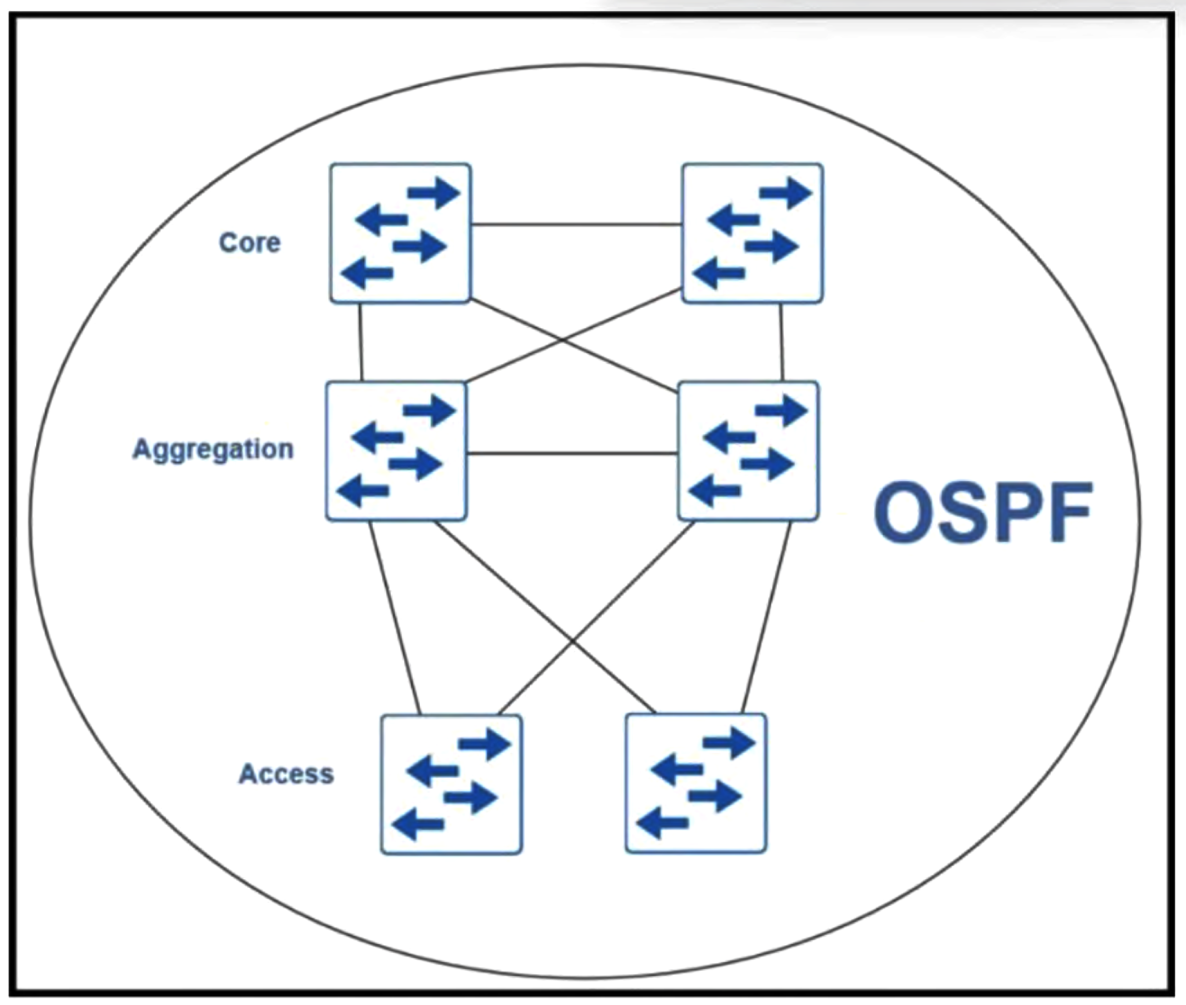 Refer to the exhibit. An architect is designing a Layer 3 routed network using point-to-point fiber links between the topology layers. BFD is supported on the software that runs within the infrastructure. Is BFD required within the design to provide sub-second convergence in the event of a fiber breakage?
Community Insight
The question tests whether you can distinguish physical failure detection (carrier loss on a fiber break) from logical/indirect failure detection where BFD actually adds value; the trap is assuming BFD is always needed for fast convergence.
In a Layer 3 design built with point-to-point fiber between topology layers, a fiber cut is a physical-layer event that the interface itself reports as loss of carrier, triggering an immediate OSPF interface-down reaction and SPF recalculation. This page establishes that BFD is therefore not required to achieve sub-second convergence in this scenario, making option A the correct choice.
Option D is the most tempting wrong answer: learners recall that BFD's default timers are too slow for sub-second detection and conclude BFD must be tuned, but they miss that on a fiber break BFD is unnecessary in the first place because the hardware already signals the failure instantly.
Community Discussion (3 comments)
Comments & Corrections
No comments yet — spotted an error or have a note? Share it below.
Expert Analysis
Why the Answer Is Correct
A fiber break severs light transmission, so the receiving interface immediately loses signal and the link is placed in down state, which is a physical/hardware failure-detection mechanism. Cisco's BFD guidance states that such hardware mechanisms can already detect failures quickly, so OSPF is driven by the interface-down event and runs its SPF calculation at once rather than waiting for hello or dead timers. Because the topology layers are connected by point-to-point fiber with the failure visible at Layer 1, sub-second convergence is achieved without any BFD configuration, so A is correct. BFD's real value appears when no such physical indication exists, for example a failure beyond the directly connected link where the interface stays up.Why the Other Options Are Wrong
Option C is wrong because BFD never "automatically" provides anything — sessions must be configured under the OSPF process/interface, and even then its default timers are not sub-second. Option D describes a true fact about BFD defaults but answers the wrong question: tuning BFD would only matter for failures that do not drop carrier, not for a fiber breakage that already produces an instant interface-down signal. Option B is wrong because retuning OSPF hello and dead intervals is exactly the slow, CPU-expensive mechanism BFD exists to avoid, and it is still unnecessary when carrier loss is detected in hardware.Community Comment Notes
drinu89 argued that a fiber break is a physical-layer failure and that the interface detects loss of carrier immediately, noting that Cisco's BFD white paper says "physical/hardware failure-detection mechanisms can detect failures quickly". e14efdb reinforced the same line of reasoning, stating that "BFD is not being used for physical issues but logical issues" and that OSPF recalculates SPF on interface-down. By contrast, _MaGIC_13 selected D solely because "BFD does not support sub-second convergence w/ it's default timers", which is accurate about BFD but does not justify needing BFD for a fiber break at all.Exam Strategy
Ask yourself what the failure physically looks like before reaching for BFD: if the event drops carrier and forces an interface-down, OSPF already converges sub-second. Reserve BFD for scenarios where the local interface stays up, such as failures beyond the directly connected link or non-physical (logical) failures.
Frequently Asked Questions
Why isn't BFD needed when a fiber link is cut?
A cut fiber causes loss of light, which the interface hardware reports as carrier loss and an immediate interface-down. OSPF reacts to that event right away, so BFD adds nothing.
When is BFD actually required in an OSPF design?
Use BFD when the local interface stays up despite a remote failure, such as a failure beyond the directly connected link or a logical/indirect failure that hardware cannot signal.
Do BFD default timers provide sub-second detection?
No. BFD's default minimum-interval and multiplier values are too slow for sub-second detection, which is why tuning is discussed for cases where BFD is genuinely needed.
Related Analysis
Practice All 300-420 Questions
Access 150 questions with complete answers and detailed explanations.
View Full 300-420 Practice Test →