Preventing Routing Loops in EIGRP-RIPv1 Redistribution
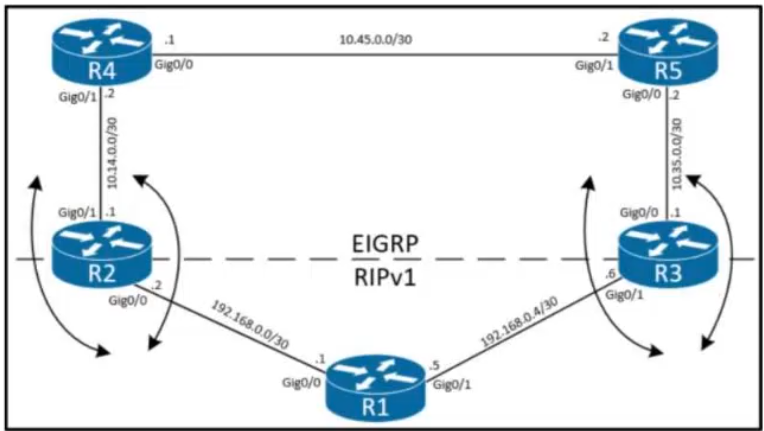 Refer to the exhibit. An engineer is designing a redistribution solution for a customer. The customer recently acquired another company and decided to Integrate the new network running RIPv1 with the company's existing network. Which redistribution technique must the engineer select to ensure the multipoint two-way redistribution does not cause routing loops?
Community Insight
The core trap is misidentifying which protocol's learned routes cause the loop; the solution requires blocking RIP-learned routes from being re-advertised back into RIP via the EIGRP process.
This question addresses the critical design consideration of preventing routing loops during two-way redistribution between EIGRP and RIPv1. It establishes that filtering learned routes at the redistribution boundary is the primary defense against route feedback.
Many candidates incorrectly select Option A, believing they should filter incoming RIP routes within EIGRP to prevent them from entering the network. However, this fails to stop the routes that have already been redistributed into EIGRP from looping back into RIP.
Community Discussion (11 comments)
Comments & Corrections
No comments yet — spotted an error or have a note? Share it below.
Expert Analysis
Why the Answer Is Correct
To prevent routing loops in a two-way redistribution scenario, you must avoid 'route feedback,' where a route learned from Protocol B and injected into Protocol A is subsequently advertised back into Protocol B. In this specific topology, R2 and R3 act as Distribution/Border routers redistributing between EIGRP and RIPv1. The most effective technique is to apply a distribute-list outbound under the EIGRP process (on R2/R3) that denies prefixes learned from RIPv1. This ensures that when R2/R3 redistribute routes into EIGRP, they do not include the RIP-learned subnets, thus preventing those subnets from ever reaching the RIP domain again.Why the Other Options Are Wrong
Option A filters inbound on EIGRP, which prevents EIGRP from learning RIP routes, but it does nothing to stop the redistribution of those same routes out of EIGRP if they were somehow present or if the logic is misunderstood; more importantly, standard practice dictates controlling what leaves the redistribution point. Option B applies an inbound filter on RIPv1, which would prevent RIPv1 from learning EIGRP routes, potentially causing connectivity loss rather than just preventing loops. Option D applies an outbound filter on RIPv1, which is less precise for controlling the EIGRP-to-RIP feedback loop compared to controlling the EIGRP advertisement side.Community Comment Notes
Community consensus is split, with many users favoring Option A based on a misunderstanding of 'inbound' vs 'outbound' relative to the redistribution action. As user 314_pi noted, some assume filtering inbound is sufficient. However, expert analysis confirms that controlling the export of the redistributed routes (outbound from EIGRP) is the correct mechanism to ensure clean separation. User CiscoNinja correctly identifies that filtering out on EIGRP prevents the 'feedback' loop.Exam Strategy
When designing redistribution, always ask: 'What routes are leaving this router?' Apply distribute-lists outbound on the source protocol to exclude routes learned from the destination protocol. This prevents the 'ping-pong' effect of route feedback.
Frequently Asked Questions
Why not filter inbound on EIGRP?
Filtering inbound on EIGRP prevents EIGRP from learning RIP routes, but doesn't control what EIGRP advertises out. To stop loops, you must stop EIGRP from advertising RIP-learned routes back into the RIP domain.
Does RIPv1 classful behavior affect this?
Yes, RIPv1 is classful, but the principle of avoiding route feedback remains. Filtering outbound on EIGRP ensures only native EIGRP routes are sent to RIP, keeping the domains separate.
Related Analysis
Practice All 300-420 Questions
Access 150 questions with complete answers and detailed explanations.
View Full 300-420 Practice Test →