Which Address Families Isolate Two Companies on a Shared Core?
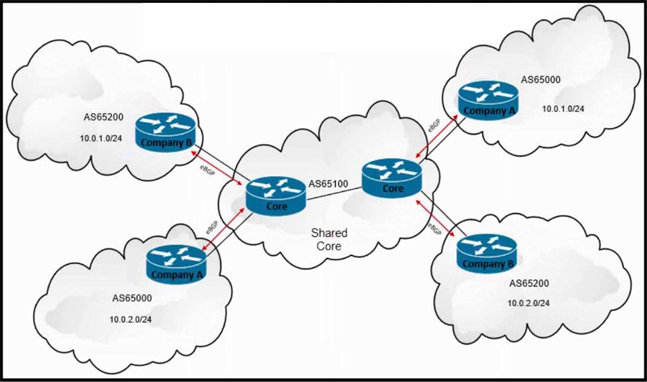 Refer to the exhibit. Company A acquired Company B, and the companies want to use the same shared core. However, the companies must not learn each other's prefixes. Which two address family solutions meet these requirements? (Choose two.)
Community Insight
The question tests BGP/MPLS address-family selection for route isolation, and the trap is assuming the customer companies themselves must run VPNv4 rather than only the shared core.
This 300-420 design item tests how two merged companies can share one MPLS core while keeping their prefixes mutually invisible, and it establishes that the answer is IPv4 unicast plus VPNv4 address families. The page explains why the core needs both address families while the customer edge stays on plain IPv4 unicast.
Option B (VPNv4 for the shared core and for Company A and Company B) is the tempting wrong pick, because CE routers at Company A and Company B never speak VPNv4 — they exchange plain IPv4 unicast with their PE, and only the core carries VPNv4 with route distinguishers and route targets.
Community Discussion (2 comments)
Comments & Corrections
No comments yet — spotted an error or have a note? Share it below.
Expert Analysis
Why the Answer Is Correct
Option D is correct because the shared core must carry two address families: IPv4 unicast for the underlay transport (IGP reachability between P routers and PE loopbacks, plus label distribution) and VPNv4 so that Company A's and Company B's routes are carried with unique route distinguishers and separated by route targets. Option A is correct because on the Company A and Company B sides the customer edge devices simply exchange IPv4 unicast routes with their PE routers; their prefixes are carried inside VPNv4 across the core but the CE itself never participates in VPN address families. Together A and D satisfy both stated constraints: a single shared core plus no prefix leakage between the two companies, since VPNv4 routes stay in BGP and are only redistributed to a given customer's VRF where the route targets allow it.Why the Other Options Are Wrong
Option B grants VPNv4 to Company A and Company B, which is technically wrong because VPNv4 is a provider-edge/core address family, not something a CE site runs. Option E makes the same mistake by handing VPNv4 to the two companies while also pairing it with IPv4 unicast on their side, which mixes the customer-facing and provider-facing address families. Option C introduces IPv4 multicast, which has nothing to do with prefix isolation between two enterprises and would be an unrelated address family for this requirement. Option A alone would leave both companies' routes in the same global IPv4 table in the core, so it only works in combination with option D's VPNv4 core design.Community Comment Notes
One commenter argued "Normally CE's only use IPv4 unicast towards the PEs" and concluded that "In the core you then need VPN v4 to distinguish between customer networks," which matches the A and D verdict. Another commenter simply asserted "B, E - right answers" without addressing why a CE would ever run the VPNv4 address family, so that pick does not survive scrutiny against MPLS L3VPN design rules.Official Reference
Exam Strategy
When a question pairs a requirement with two 'Choose two' options, split the answer by network segment: decide which address family runs in the provider core versus on the customer-facing links. Eliminate any option that hands a provider-only address family such as VPNv4 to a CE site.
Frequently Asked Questions
Why is VPNv4 for Company A and Company B (option B or E) wrong?
VPNv4 is a provider edge and core address family. Company A and Company B customer edge routers only exchange IPv4 unicast with their PE, so the companies themselves never run VPNv4.
Can IPv4 unicast alone in the core keep the two companies' prefixes apart?
No. In a single global IPv4 table both companies' routes would be visible to each other. VPNv4 with route distinguishers and route targets in the core is what prevents prefix leakage.
Related Analysis
Practice All 300-420 Questions
Access 150 questions with complete answers and detailed explanations.
View Full 300-420 Practice Test →