DMVPN EIGRP Scalability: Summary Routes vs Split Horizon
Short answer
A Configure a summary route on R1's tunnel interface to aggregate specific subnets and reduce routing table size for scalability in the expanding DMVPN network.
Question
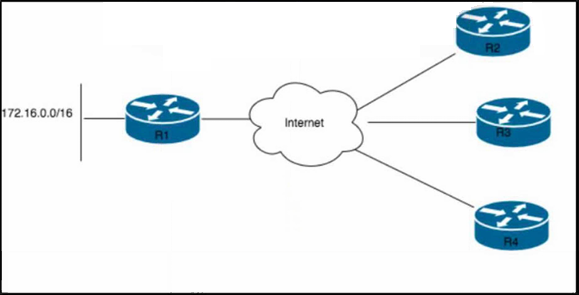
Refer to the exhibit. A company is expanding and decides to use a DMVPN solution to connect the branches. The network uses the EIGRP routing protocol. All remote branch routers must be configured with the normal EIGRP area. Auto-summary is not allowed on the routers in the network. Which solution must the company implement on R1 to achieve this goal?
Key Takeaways
The main trap is confusing split horizon (connectivity) with summarization (scalability); in expanding DMVPN/EIGRP designs, reducing route count via summarization is the priority.
This page explains why configuring a summary route is the correct solution for scaling EIGRP over a DMVPN hub router, addressing routing table bloat in expanding networks.
Common mistake: Candidates often choose 'Disable split horizon' because it enables spoke-to-spoke communication via the hub, but this fails to address the scalability requirement of reducing routing table entries as the network grows.
Expert Analysis
The DMVPN and EIGRP Scaling Constraint
The core challenge in this scenario is managing routing table size and convergence time in a growing DMVPN topology using EIGRP. In a standard Multipoint GRE (mGRE) setup, the hub router (R1) acts as a central point for all spoke-to-spoke traffic. By default, EIGRP enforces split horizon, which prevents a route learned on one interface from being advertised back out the same interface. However, on a multipoint interface like an mGRE tunnel, split horizon behavior can be tricky; typically, routes learned from one spoke are not sent to another spoke on the same multipoint interface if split horizon is enabled, but the primary issue here is the volume of specific subnets.
If the network expands with dozens of branches, each branch advertising multiple specific internal subnets, R1 would receive hundreds of distinct EIGRP updates. Without summarization, R1 would attempt to propagate these specific routes. Even with split horizon considerations, the sheer number of entries in the spokes' routing tables leads to scalability issues, increased memory usage, and slower convergence times during topology changes.
Why Summarization is the Correct Solution
Configuring a summary route (Option A) on R1's tunnel interface aggregates multiple specific subnets into a single, broader prefix. This drastically reduces the number of entries that R1 advertises to the spokes. Instead of receiving 50 specific /24 routes, a spoke might receive just one /16 summary route. This directly addresses the "network is expanding" concern by improving scalability and stability. It aligns with best practices for large-scale routing designs where stable, scalable routing is required.
Addressing Common Misconceptions
Many candidates might consider disabling split horizon (Option C). While disabling split horizon on a multipoint interface allows routes learned from one spoke to be advertised to others (enabling spoke-to-spoke communication via the hub), it does not solve the scaling problem. In fact, disabling it without summarization can lead to routing loops or excessive flooding of specific routes if not carefully managed. The question emphasizes the expansion and the need for a stable, scalable design, pointing toward summarization rather than just enabling basic connectivity features.
Other Options Analysis
- Disable stuck-in-active timer (Option B): This is a troubleshooting measure for EIGRP queries, not a design feature for scalability. It masks symptoms of poor design but doesn't fix the underlying routing table bloat.
- Configure a multipoint interface (Option D): DMVPN relies on mGRE interfaces by definition. Configuring it is a prerequisite, not a solution to the routing table expansion problem described. The interface type is already implied by the DMVPN solution choice.
Therefore, the critical implementation step on R1 to handle the growth and maintain scalability is to configure manual summary routes.
Exam Strategy
When a question mentions 'expanding', 'scaling', or 'many branches' in a routing context, prioritize solutions that reduce the number of routes (summarization) over those that simply enable forwarding (split horizon/timers). Always check if the protocol supports the feature natively on the interface type mentioned (e.g., EIGRP summaries on tunnel interfaces).
Frequently Asked Questions
Can you summarize EIGRP routes on a DMVPN hub interface?
Does disabling split horizon help with EIGRP scaling in DMVPN?
Community Votes
100% of anonymous learners picked answer A. Votes are pick records left by other test-takers — they are not the verified answer.
Discussion 1 contributions
Compiled from public community threads and reader submissions, lightly edited for clarity. Handles and vote tallies are shown as recorded, and comments reflect the views of individual contributors.
From public community threads 1
-
G_Singh12 👍 1 Answered A• If you only disable split horizon (Option C), the hub router (R1) will blindly repeat every single specific internal subnet down to every remote spoke router. As the network grows larger and adds dozens of branches, the spokes' routing tables will blow up with hundreds of entries. • By configuring a manual summary route (Option A) on R1's tunnel interface, you solve the scaling problem of the expanding network while obeying the "no auto-summary" rule.
Reader comments & corrections
No reader corrections yet — spotted an error or have a note? Share it below.
Related Analysis
Practice All 300-420 Questions
Access 150 questions with complete answers and detailed explanations.
View Full 300-420 Practice Test →