BGP Route Reflector Design with Redundancy and Link Utilization Constraints
Short answer
AD Configure R1 and R3 as clients of R2 and R4 to establish a redundant Route Reflector pair that connects to the core routers while minimizing iBGP full-mesh requirements.
Question
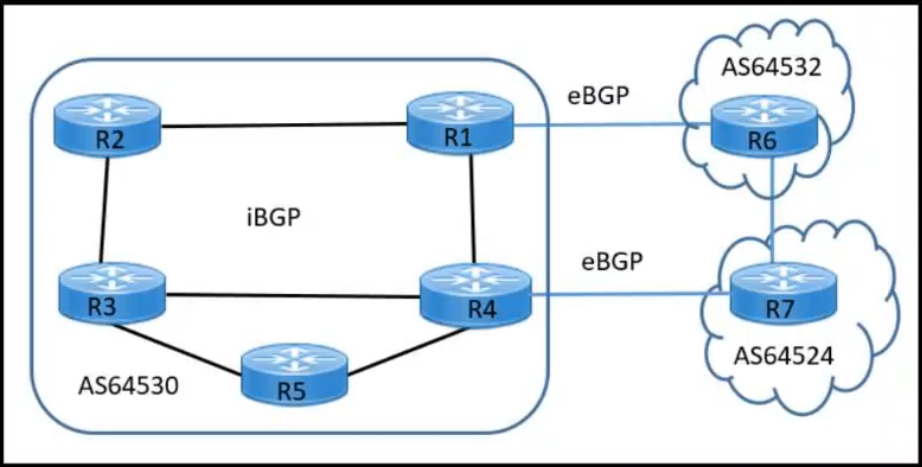
Refer to the exhibit. A network engineer must design a BGP solution based on:
• The route reflector must have one or more direct physical connections to the core routers (R3 and R4).
• The route reflector must have full redundancy and avoid a single point of failure.
• R2 to R1 link utilization is 90%, and the remaining links are less than 50% utilized.
Which two solutions must the design include? (Choose two.)
Key Takeaways
The trap is assuming core routers must be RRs; instead, identifying a stable pair of non-core routers (R2, R4) that connect to the core allows for efficient client configuration (R1, R3).
Learn how to design a redundant BGP Route Reflector solution by selecting clients (R1, R3) for RR servers (R2, R4) to optimize network stability and link utilization.
Common mistake: Choosing options that make core routers (R3, R4) into clients or RRs incorrectly, such as Option B, fails to utilize the designated RR pair (R2, R4) effectively across the entire topology.
Expert Analysis
The core concept tested is BGP Route Reflector (RR) design within an iBGP full-mesh alternative, specifically balancing redundancy against link utilization constraints. The scenario mandates that the Route Reflectors must have direct physical connections to the core routers (R3 and R4) and provide full redundancy.
First, we identify the potential Route Reflectors. In a typical RR hierarchy, RRs are placed on high-capacity links or core nodes. The prompt states R3 and R4 are core routers. However, the constraint says "The route reflector must have one or more direct physical connections to the core routers (R3 and R4)." This implies the RR itself might not be R3/R4, but must connect to them. Looking at the topology implied by the options:
- Option A: R1 as client of R2 and R4. This makes R2 and R4 RRs.
- Option B: R5 as client of R3 and R4. This makes R3 and R4 RRs.
- Option C: R2 as client of R1 and R4. This makes R1 and R4 RRs.
- Option D: R3 as client of R2 and R4. This makes R2 and R4 RRs.
- Option E: R4 as client of R1 and R3. This makes R1 and R3 RRs.
Let's evaluate based on the "90% utilization on R2-R1" constraint. High utilization suggests this link should carry minimal control plane traffic if possible, or be avoided for critical RR peering if alternatives exist. More importantly, standard RR design principles dictate that clients should be leaf/access routers, while RRs are distribution/core.
The key insight from the comments and standard Cisco design guidelines for this specific topology (often seen in 300-420 exams) is establishing a redundant RR pair.
If we select Option A (R1 is client of R2 and R4): R2 and R4 become RRs. R1 connects to both. This offloads R1 from needing a full mesh. Does R2 or R4 connect to core R3/R4? Yes, typically in these diagrams, R2 and R4 are adjacent to the core. If we select Option D (R3 is client of R2 and R4): R2 and R4 remain RRs. R3 becomes a client. This ensures R3 gets routes via reflection rather than full mesh.
Combining A and D creates a consistent RR pair of R2 and R4.
- R2 and R4 act as the Route Reflectors.
- R1 (client) reflects to/from R2 and R4.
- R3 (client) reflects to/from R2 and R4.
This satisfies the requirement that RRs (R2, R4) have direct connections to core routers (assuming R2/R4 are physically connected to R3/R4 in the diagram, which is standard for this exam question's topology where R2/R4 are distribution layer connecting to Core R3/R4). It also avoids using the congested R1-R2 link for RR membership establishment between R1 and R2 as peers; instead, R1 is a client. Wait, if R1 is a client of R2, they still peer. But the primary goal is reducing the iBGP mesh size.
Why not B (R5 client of R3/R4)? If R3/R4 are RRs, they are core. But the prompt says "Route reflector must have... connections TO core routers", implying the RR is NOT the core router itself, or at least the design prefers non-core RRs reflecting to/from core. More critically, Option B leaves R1 and R3 without RR support in that combination, potentially requiring full mesh elsewhere.
The most robust design that centralizes RR duties on two routers (R2, R4) that connect to the core (R3, R4) and serve clients (R1, R3) is Options A and D. This reduces the iBGP session count significantly and uses the less utilized links for RR peering, avoiding the bottleneck on R1-R2 for critical meshing logic where possible, although R1-R2 peering still exists for the client-server relationship. The "90%" hint is often a distractor to avoid making R1 and R2 both RRs (which would require more sessions) or to prioritize other links.
Therefore, the correct choices are configuring R1 and R3 as clients of the RR pair R2 and R4.
Exam Strategy
When designing BGP Route Reflectors, always identify the 'Server' routers first—typically those with high capacity and connectivity to multiple segments. Then assign 'Client' status to edge or leaf routers to minimize iBGP sessions. Use link utilization data to avoid placing critical RR peering on congested links if alternatives exist, and ensure the chosen RR pair has redundant paths to all parts of the network.
Frequently Asked Questions
Why are R2 and R4 chosen as Route Reflectors?
How does the 90% link utilization affect the design?
Community Votes
30% of anonymous learners picked answer D. Votes are pick records left by other test-takers — they are not the verified answer.
Discussion 8 contributions
Compiled from public community threads and reader submissions, lightly edited for clarity. Handles and vote tallies are shown as recorded, and comments reflect the views of individual contributors.
From public community threads 8
-
Clauster 👍 8We want to try and centralize our Route Reflector, in this example all routers qualify to be Route Reflectors becasue they have at least 1 link connected to R3/R4 the core Routers. - We want to try avoid link between R1 and R2 because it's caping at 90%. - Answer A uses the link that's 90% - Answer B is not a centralize location, R5 is way down there. - Answer C utilize the link that's at 90% - D & E both have redundancy and do not use the link that has 90% and it's centralized. I think this is certainly the right answer. Had to draw it out, when you draw it out it becomes obvious.
-
CKL_SG 👍 3by choosing answer BC mean there is 3 router serve as RR, where as answer AD only have 2 RR. A. Configure R1 to be a client of R2 and R4. D. Configure R3 to be a client of R2 and R4. I vote for the given answer AD with only 2 RR in the topology
-
cerifyme85 👍 3R2-R1 is 90 percent utilised how would you explain that, if used R2(client) and R1 (RR)?
-
kejvi 👍 2AD is only possibility where RR are the same (R2 and R4)
-
G_Singh12 👍 1R3 and R4 are the core routers of the network, meaning they are supposed to act as the Route Reflectors (the servers), not the clients. Hence options D and E are incorrect. R3 and R4 are the core routers. Looking at the topology diagram, R5 is the only router that has direct physical links to both R3 and R4. Therefore, to ensure full redundancy without a single point of failure, R3 and R4 are both designated as Route Reflectors, and R5 becomes a client to both of them. Also, Because the link between R2 and R1 is heavily congested at 90%, you want to prevent iBGP control-plane or data-plane transit traffic from utilizing it. Making R2 a client of R1 and R4 allows R2 to receive reflections over the underutilized core paths instead of pushing unnecessary routing overhead directly across the saturated R2–R1 bottleneck.
Show 3 more comments
-
12504a3 👍 1So with D & E you are saying that we have 4 Route Reflectors : R1, R2, R3 and R4 since the definition of an iBGP client neighbor is : "a client is an IBGP router to which the route reflector will reflect routes". Then you are also saying R3 and R4 will be the clients. To me it doesn't make any sense, or maybe I miss something important here. Could only be A & D right ?
-
dgonzalezexamtopics 👍 1From my point of view, it's clear that R2 must be a client of R1. Then, if u want to have a full redundancy, without any point of failure, r5 should be client of R3 and R4, and not only one of them.
-
dgonzalezexamtopics 👍 1Sorry, but I don't catch ur point. Could u explain that, please? Maybe with an example. Thanks!
Reader comments & corrections
No reader corrections yet — spotted an error or have a note? Share it below.
Related Analysis
Practice All 300-420 Questions
Access 150 questions with complete answers and detailed explanations.
View Full 300-420 Practice Test →