Balancing WAN Resiliency and Cost with Dynamic Routing
Short answer
C Implementing a dynamic routing protocol on the WAN connection increases resiliency through automatic path convergence while minimizing costs by avoiding expensive hardware redundancy.
Question
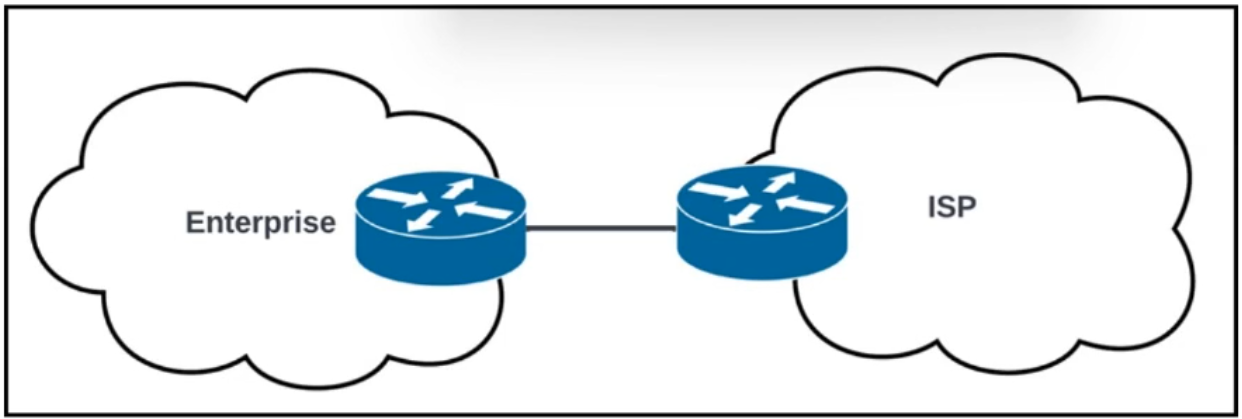
Refer to the exhibit. A company designed a new WAN connectivity plan and asked an engineer to review the design. The company wants to increase overall resiliency and minimize costs. Which configuration meets these requirements?
Key Takeaways
The exam tests the distinction between hardware redundancy (expensive, limited scope) and logical routing resilience (cost-effective, comprehensive). The trap is selecting hardware options when a software solution better meets both requirements.
This question explores how to design a cost-effective WAN strategy that maximizes resiliency. The correct approach leverages dynamic routing protocols to ensure automatic failover without requiring costly hardware investments.
Common mistake: Choosing D (router with dual power supplies) because it is perceived as a 'low-cost' hardware fix. However, this fails to address WAN link failures and is less effective for overall network resiliency compared to dynamic routing.
Expert Analysis
The scenario requires balancing two specific constraints: increasing resiliency and minimizing costs. To determine the correct configuration, we must evaluate how each option addresses these goals within the context of WAN connectivity.
Option C (dynamic routing protocol) is the superior choice because it provides logical resiliency at a minimal cost. By implementing protocols like BGP or OSPF on the WAN link, the network gains the ability to automatically detect peer failures and converge to alternative paths without manual intervention. This enhances availability through intelligent path selection. Crucially, this is a software-based feature that does not require expensive hardware upgrades, directly satisfying the 'minimize costs' requirement.
In contrast, Options B (dual supervisors) and D (dual power supplies) focus on hardware redundancy. While they improve device-level uptime, they are significantly more expensive than enabling a routing protocol. Furthermore, hardware redundancy alone does not protect against WAN link failures or routing loops; if the physical circuit goes down, dual components inside the router cannot restore connectivity. Option A (SNMPv3) is a monitoring tool for security and visibility, not a mechanism for automatic failover or resiliency.
Community comments reflect this trade-off. One comment correctly identifies that dynamic routing allows automatic adaptation to path changes and avoids proprietary hardware costs. Another suggests dual power supplies as a low-cost hardware solution, but this ignores the broader scope of WAN resiliency which primarily depends on path diversity and routing logic rather than just internal component duplication.
Exam Strategy
When questions ask for solutions that balance 'resiliency' and 'cost', prioritize software-based logical controls (like dynamic routing, VRRP, or HSRP) over hardware redundancies (like dual chassis or power supplies). Hardware fixes are often distractors because they increase capital expenditure significantly. Always look for the option that provides automatic recovery mechanisms without additional infrastructure costs.
Frequently Asked Questions
Why isn't SNMPv3 considered a resiliency solution?
Does dynamic routing really minimize costs?
Community Votes
50% of anonymous learners picked answer C. Votes are pick records left by other test-takers — they are not the verified answer.
Discussion 2 contributions
Compiled from public community threads and reader submissions, lightly edited for clarity. Handles and vote tallies are shown as recorded, and comments reflect the views of individual contributors.
From public community threads 2
-
G_Singh12 👍 1 Answered C• mplementing a dynamic routing protocol (such as BGP or OSPF) over the WAN link allows the network to dynamically adapt to path changes, detect routing or peer failures automatically, and switch to alternative paths without requiring manual intervention. Also, Dynamic routing is a software-level configuration and doesn't require purchasing additional high-end, proprietary hardware components.
-
drinu89 👍 1 Answered DD. Router with dual power supplies This is the lowest-cost hardware redundancy that actually improves availability by eliminating a common hardware failure point.
Reader comments & corrections
No reader corrections yet — spotted an error or have a note? Share it below.
Related Analysis
Practice All 300-420 Questions
Access 150 questions with complete answers and detailed explanations.
View Full 300-420 Practice Test →