SD-WAN TLOC Selection with SLA and Application-Aware Routing
Refer to the exhibit. A WAN Edge router is configured with SLAs. Which TLOC does the traffic take if the internet TLOC has latency 100 ms, loss 2%, jitter 50ms, and the MPLS TLOC has latency 50 ms, loss 1%, and jitter 150 ms? - 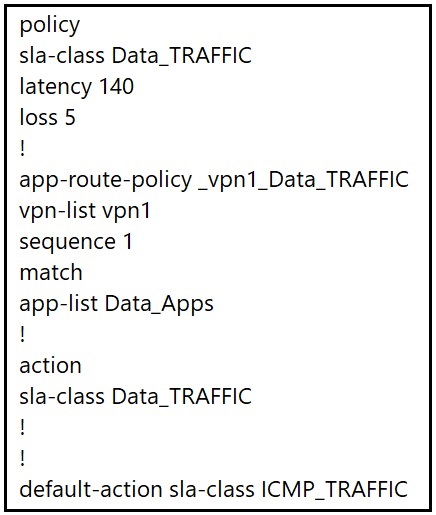
Community Votes
75% of anonymous learners picked answer A. Votes are pick records left by other test-takers — they are not the verified answer.
Community Insight
Tests the interaction between SLA compliance and metric-based selection when a specific preferred color is absent from the policy.
Determines the correct TLOC path when SLA thresholds are met by both options but no preferred color is configured, relying on application-aware routing metrics.
Choosing 'MPLS or internet' because both links meet the SLA requirements, ignoring that SD-WAN must select a single active path for forwarding based on best available metrics.
Community Discussion (3 comments)
Comments & Corrections
No comments yet — spotted an error or have a note? Share it below.
Expert Analysis
Why the Answer Is Correct
The traffic takes the MPLS TLOC because both interfaces satisfy the defined SLA thresholds (Latency <100ms, Loss <5%, Jitter <200ms). When an Application-Aware Routing (AAR) policy does not specify a 'preferred_color', the SD-WAN controller selects the best available path based on the lowest cost/metric among compliant paths. Since MPLS has superior latency (50ms vs 100ms) and significantly lower loss (1% vs 2%), it is selected as the primary path.Why the Other Options Are Wrong
Option B (Internet) is incorrect because while it meets the SLA, it has higher latency and loss compared to MPLS, making it the inferior choice when no preference is forced. Option C (MPLS or internet) is incorrect because SD-WAN forwards traffic over a single active TLOC per flow/session; it does not load balance across multiple underlay paths unless explicitly configured with ECMP policies, which is not indicated here. Option D (Drop) is incorrect because the traffic is compliant with the SLA class actions.Community Comment Notes
Commenter Traktark notes that MPLS is chosen because jitter constraints were not the deciding factor in this specific scenario, highlighting that all metrics matter. Another user argues for both paths being valid, citing Cisco Press documentation about configurations where no preferred color is set, implying equal treatment, but fails to account for the tie-breaking mechanism of underlying transport metrics. A third commenter correctly identifies that while SLA is relevant for eligibility, the final selection relies on the better metrics (latency/loss) when SLA is merely a pass/fail gate.Official Reference
Exam Strategy
Always check if a 'preferred_color' is specified in the AAR policy. If yes, that color wins regardless of metrics (as long as SLA is met). If no preferred color is specified, choose the link with the best transport metrics (lowest latency/loss/jitter) among those meeting SLA.
Frequently Asked Questions
Does SLA determine the path if both links meet it?
SLA acts as a filter. If both meet SLA and no preferred color is set, the path with the best underlying metrics (latency/loss) is chosen.
Why not load balance between MPLS and Internet?
Without explicit ECMP configuration, SD-WAN selects a single best active path based on policy and metrics, not load balancing.
Related Analysis
Practice All 300-415 Questions
Access 120 questions with complete answers and detailed explanations.
View Full 300-415 Practice Test →