Configuring OSPF Summary Routes to ASBR in SD-WAN
Refer to the exhibit. A network administrator is configuring OSPF advanced configuration parameters from a template using the vManager GUI for a branch WAN Edge router to calculate the summary routes to an ASBR. Which action achieves this configuration? - 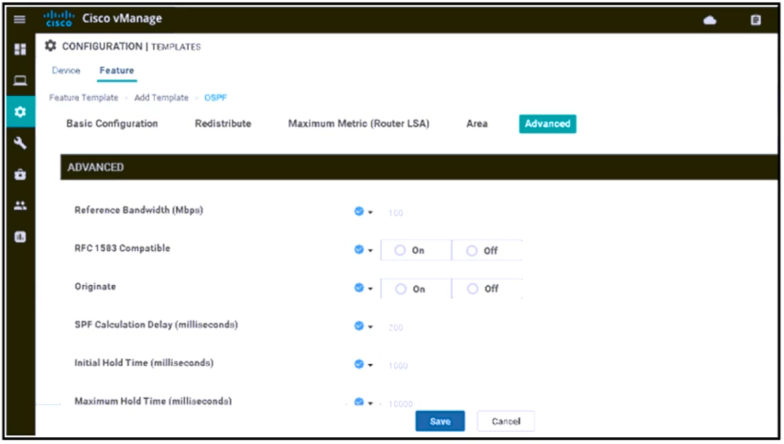
Community Votes
67% of anonymous learners picked answer D. Votes are pick records left by other test-takers — they are not the verified answer.
Community Insight
The core concept tested is the OSPF RFC compatibility setting for inter-area path cost calculation, with the common trap being confusion between RFC 1583 and non-RFC 1583 behaviors.
This question addresses configuring OSPF advanced parameters on Cisco Catalyst SD-WAN WAN Edge routers via vManager templates. It specifically focuses on the correct action to calculate summary route costs to an Autonomous System Boundary Router (ASBR).
Many users incorrectly select 'Disable RFC 1583 Compatible' or other options because they are unsure if the default behavior aligns with the requirement to use RFC 1583 standards.
Community Discussion (4 comments)
Comments & Corrections
No comments yet — spotted an error or have a note? Share it below.
Expert Analysis
Why the Answer Is Correct
To ensure that the branch WAN Edge router calculates summary route costs per the original OSPF standard defined in RFC 1583, you must enable the 'RFC 1583 Compatible' option. In Cisco IOS-XE (which underpins SD-WAN edge configurations), this is often achieved by ensuring the commandcompatible rfc1583 is active or not disabled. The default behavior in modern versions might be non-RFC 1583 (RFC 2328), so explicitly enabling compatibility ensures the correct cost calculation method for summary routes.Why the Other Options Are Wrong
Options A and C ('Originate') relate to generating summary LSAs, which is a different function than calculating the cost of those summaries. Option B ('Disable RFC 1583 Compatible') would switch the router to use the newer RFC 2328 cost calculation, which contradicts the goal of using the RFC 1583 method.Community Comment Notes
Community consensus strongly favors Option D. Users like Rosh8787 confirmed that restoring the RFC 1583 method requires the compatible setting, citing Cisco CLI documentation. While one user suggested disabling it, the majority and official logic support enabling compatibility to adhere to the older standard's cost metrics.Official Reference
Exam Strategy
When configuring OSPF on SD-WAN edges, always verify if the question specifies a particular RFC standard for cost calculation. If it mentions RFC 1583, look for settings that enforce compatibility with that version rather than the newer defaults.
Frequently Asked Questions
Why is Enable RFC 1583 Compatible required for ASBR summary routes?
It forces the router to use the older RFC 1583 metric calculation for inter-area paths, which differs from the newer RFC 2328 method.
What is the difference between Originate and RFC 1583 Compatible?
Originate controls whether the router generates summary LSAs, while RFC 1583 Compatible controls how the cost of those routes is computed.
Related Analysis
Practice All 300-415 Questions
Access 120 questions with complete answers and detailed explanations.
View Full 300-415 Practice Test →