Configuring EIGRP Peering on Service VPN in Cisco SD-WAN
Short answer
B Configuring EIGRP within VPN 1 (service VRF) with the correct network statement and redistributing OMP allows peering with local devices while keeping transport in VPN 0.
Question
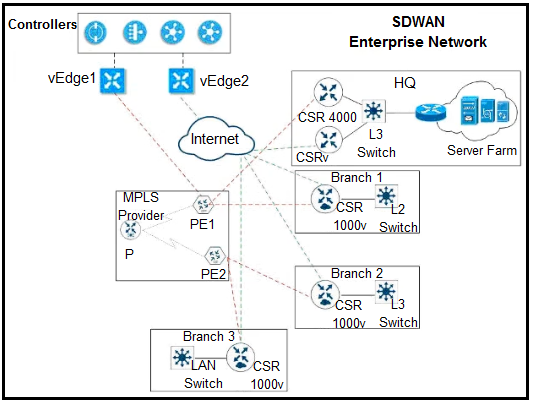
Refer to the exhibit. The network team must configure EIGRP peering at HQ with devices in the service VPN connected to WAN Edge CSRv. CSRv is currently configured with:
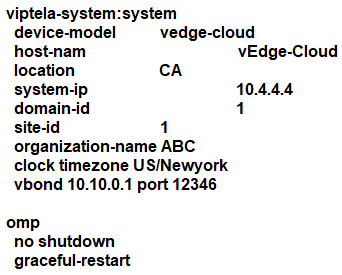
Which configuration on the WAN Edge meets the requirement?
Key Takeaways
The main trap is placing the EIGRP process in VPN 0; remember that transport interfaces and tunnels belong in VPN 0, while service-side peering and redistribution belong in the specific service VRF.
This question tests your ability to correctly segregate transport and service configurations in Cisco Catalyst SD-WAN. The correct solution places EIGRP in the service VRF (VPN 1) rather than the transport VRF (VPN 0).
Common mistake: Many candidates choose Option A or C because they incorrectly place the EIGRP configuration under VPN 0. This fails because the transport VRF does not have access to the service-side interface IP required for peering with the local branch router.
Expert Analysis
The core concept tested here is the separation of concerns in Cisco Catalyst SD-WAN (vManage) configuration: specifically, how to connect a traditional router via EIGRP on a Service VPN while maintaining proper transport segmentation.
Step 1: Identify the Transport vs. Service boundary. In SD-WAN architecture, the 'Transport' side (connecting to the underlay/internet) must reside in VRF 0 (VPN 0). The 'Service' side (connecting to customer devices/branch routers) resides in the specific service VRF (e.g., VPN 1). Comments frequently highlight this distinction, noting that options placing tunnel interfaces or public IPs in VPN 1 are architecturally incorrect because transport encapsulation happens at the VRF 0 level.
Step 2: Analyze Option A and C. Both place the router eigrp configuration inside the vpn 0 block. This is a critical error. EIGRP peering with local non-SD-WAN devices occurs on the service interface. If you configure EIGRP in VRF 0, it attempts to peer using the transport IP, which is not connected to the customer device. Therefore, any option binding EIGRP to VPN 0 is wrong.
Step 3: Analyze Option B. This option correctly places the EIGRP configuration within vpn 1 (the service VPN). It defines the network statement for the interface IP (10.0.0.1) and crucially includes redistribute omp. In SD-WAN, to exchange routes between the overlay (OMP) and an external routing protocol (EIGRP), redistribution is mandatory. Without redistribute omp, the branch router would not learn about overlay destinations, and vice versa.
Step 4: Addressing the missing Option D. While some commenters suggest a missing Option D, Option B is the only syntactically and architecturally valid choice among the provided images. It correctly isolates the service-side EIGRP process to VPN 1, uses the correct private IP address for the service link, and enables the necessary OMP redistribution. Options A and C fail due to VRF misplacement; Option B succeeds by adhering to the SD-WAN data plane segregation model.
Exam Strategy
When configuring SD-WAN edges, always mentally map your commands to their VRF context. Ask yourself: 'Is this connecting to the Internet/Underlay?' -> Go to VPN 0. 'Is this connecting to a Customer Device/Local Branch?' -> Go to the specific Service VRF. Never mix transport encapsulation (tunnel-interface) into a service VRF.
Frequently Asked Questions
Why can't I configure EIGRP in VPN 0?
What is the purpose of 'redistribute omp' in EIGRP config?
Community Votes
50% of anonymous learners picked answer B. Votes are pick records left by other test-takers — they are not the verified answer.
Discussion 18 contributions
Compiled from public community threads and reader submissions, lightly edited for clarity. Handles and vote tallies are shown as recorded, and comments reflect the views of individual contributors.
From public community threads 18
-
nbvolz 👍 4Again,,, Guessing? This adds value how?
-
BREC 👍 3Correct Answer is D. The option that is not appearing looks like: vpn 0 interface ge0/0 description " Internet Circuit " ip address 209.165.200.229/30 tunnel-interface encapsulation ipsec color public-internet allow-service all ! ! ! vpn 1 router eigrp address-family ipv4-unicast maximum-path paths 4 network 10.0.0.0/28 redistribute omp ! ! ! ! interface ge0/1 ip address 10.0.0.1/28 ! vpn 512 interface eth0 shutdown ! !
-
Seba_o_s 👍 3 Answered BThe network team must configure EIGRP peering at HQ with devices in the SERVICE VPN connected to WAN Edge CSRv. A and C peering in VPN 0, the only that peering with service VPN is the B (VPN1)
-
colipto 👍 3Missing data
-
RafaJohnston76 👍 2 Answered CA is wrong because Router EIGRP command should not be under VPN0, but in global configuration B is wrong because public IP will not be configured under VPN1 C is correct - Transport configured and EIGRP configured and redistributing OMP into service-side
Show 13 more comments
-
Outlaw_87 👍 2In cEdge configuration, first comes interface configs then router configs. I'll go with C.
-
incog 👍 2service VPN is 0? or it needs to be other that 0 like 1?
-
westh4m1234 👍 1 Answered BA, C, are configured on the VPN0 side it should be on the service side see below- To establish EIGRP peering from a Cisco SD-WAN edge router (Cisco IOS XE Catalyst SD-WAN device) with local branch or datacenter devices inside a service VPN, EIGRP must be bound directly to that specific service-side VRF and redistributed into OMP (Overlay Management Protocol) which means BREC is correct answer would be D
-
brian7857ffs45 👍 1 Answered CIn B, the tunnel-interface configurations are under VPN1 but any transport configs should be under VPN0. The question says we want to create a peering between the CSRv and the non-SDWAN devices on the Service VPN side (look at the diagram). Has to be C.
-
mikidvd51 👍 1wrong - C has eigrp configured in VPN0 with private IP. Overall, all these 3 options are incorrect. Is this cisco mistake or a public community thread mistake?
-
Myare 👍 1 Answered BThe correct answer is B, cause A, C and D, the eigrp router are all configured under VPN0 transport side, Only option B has VPN1 which is service side
-
PureInertiaCopy 👍 1This must be missing a D option because all of it is wrong.
-
Aldebeer 👍 1I dont get iot , is it vpn in vpn case ? never heard of it.
-
mikidvd51 👍 1I think here are incomplete options to answer
-
Seba_o_s 👍 1But EIGRP config also should not be in VPN 0.
-
RafaJohnston76 👍 1And it is not, it is configured globally
-
abvga 👍 1 Answered CVoting for C, Others seem messed.
-
colipto 👍 1A seems correct
Reader comments & corrections
No reader corrections yet — spotted an error or have a note? Share it below.
Related Analysis
Practice All 300-415 Questions
Access 120 questions with complete answers and detailed explanations.
View Full 300-415 Practice Test →