Configure IPSec over mGRE with ISAKMP and Transform Sets
SIMULATION
Guidelines
This is a lab item in which tasks will be performed on virtual devices.
• Refer to the Tasks tab to view the tasks for this lab item.
• Refer to the Topology tab to access the device console(s) and perform the tasks.
• Console access is available for all required devices by clicking the device icon or using the tab(s) above the console window.
• All necessary preconfigurations have been applied.
• Do not change the enable password or hostname for any device.
• Save your configurations to NVRAM before moving to the next item.
• Click Next at the bottom of the screen to submit this lab and move to the next question.
• When Next is clicked, the lab closes and cannot be reopened.
Topology
 Tasks
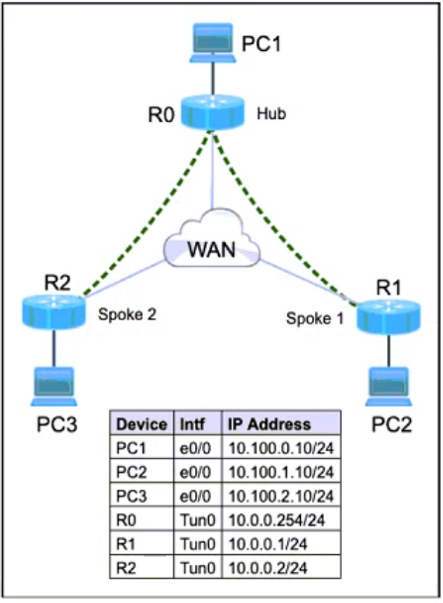
Configure IPSec security policy on tunnel interfaces to ensure data confidentiality and integrity where mGRE tunnels are up and running between HUB and SPOKE routers.
1. Configure the ISAKMP policy parameters with the following attributes:
• AES256
• SHA256
• Group2
• lifetime 86400
2. Ensure that GRE IP Header should be encrypted inside the IPSec packet. Verify IPSec security association and ISAKMP encrypted key. Use ISAKMP key "abc123".
3. Configure a flexible ISAKMP Policy on the HUB to add peers that have the dynamic IP addresses where SPOKES must add HUB IP static entry using an encrypted key. Use a single command to configure it. Use IPSec phase-2 transform-set name as T-SET and IPSec Profile name as ’IPSEC-PROFILE’.
Tasks
Configure IPSec security policy on tunnel interfaces to ensure data confidentiality and integrity where mGRE tunnels are up and running between HUB and SPOKE routers.
1. Configure the ISAKMP policy parameters with the following attributes:
• AES256
• SHA256
• Group2
• lifetime 86400
2. Ensure that GRE IP Header should be encrypted inside the IPSec packet. Verify IPSec security association and ISAKMP encrypted key. Use ISAKMP key "abc123".
3. Configure a flexible ISAKMP Policy on the HUB to add peers that have the dynamic IP addresses where SPOKES must add HUB IP static entry using an encrypted key. Use a single command to configure it. Use IPSec phase-2 transform-set name as T-SET and IPSec Profile name as ’IPSEC-PROFILE’.
Community Insight
The core challenge is correctly mapping the ISAKMP parameters to the hub/spoke topology while ensuring the IPSec transform set uses tunnel mode to encrypt the inner GRE headers.
This simulation requires configuring an IPSec security policy to encrypt GRE traffic in a Dynamic Multipoint VPN (DMVPN) scenario, specifically using AES-256, SHA-256, and Group 2 for the ISAKMP phase.
Learners often fail to explicitly configure 'mode tunnel' in the IPsec transform set or neglect the 'authentication pre-share' command within the ISAKMP policy, leading to failed security associations.
Community Discussion (20 comments)
Comments & Corrections
No comments yet — spotted an error or have a note? Share it below.
Expert Analysis
Why the Answer Is Correct
The solution requires three distinct configuration steps on both Hub and Spoke routers: defining the ISAKMP policy with specific crypto attributes (AES256, SHA256, Group2), setting up the static or dynamic ISAKMP keys, and applying the IPSec profile to the tunnel interface. The critical technical detail is that the IPSec transform set must support tunnel mode (default) to encapsulate the GRE packet, satisfying the requirement to encrypt the GRE IP header.Why Other Candidate Answers Are Wrong
Incorrect configurations often omit the 'pre-share' authentication method under the ISAKMP policy, causing negotiation failures. Additionally, some candidates incorrectly attempt to use transport mode or forget to apply the crypto map/profile to the tunnel interface, resulting in plaintext GRE or protocol down states. Confusing the ISAKMP key syntax for dynamic peers (0.0.0.0) vs static peers also leads to connectivity issues.Community Comment Notes
Community feedback highlights that 'mode tunnel' is the default behavior in modern IOS, so explicit entry is not always required but understanding it is vital for the exam logic. Several users noted that the 'authentication pre-share' command is mandatory under the ISAKMP policy sub-mode, a frequent omission point. Others pointed out that NHRP configuration is separate from this specific IPSec task, though both are needed for full DMVPN operation. One user confirmed that the tunnel protocol remains down if the crypto parameters do not match exactly between peers.Exam Strategy
When configuring IPSec policies in simulations, carefully check the order of commands and ensure all specified parameters (hash, encryption, group) match the prompt exactly. Remember that for mGRE/DMVPN, the tunnel interface itself does not have a destination; the destination is resolved dynamically via NHRP, but the IPSec profile must still be applied.
Frequently Asked Questions
Why is 'mode tunnel' important in the transform set?
It ensures the entire GRE packet (including its header) is encrypted as payload inside the IPSec packet, which is required for DMVPN functionality.
How do I configure ISAKMP keys for dynamic spokes?
Use the command 'crypto isakmp key abc123 address 0.0.0.0 mask 0.0.0.0' on the Hub to accept connections from any dynamic IP.
Related Analysis
Practice All 300-410 Questions
Access 159 questions with complete answers and detailed explanations.
View Full 300-410 Practice Test →