Which Command Enables IP SLA Responder on R201 for TCP Connect?
Short answer
B Ip sla responder enables R201 to accept the IP SLA control connection on UDP port 1967 and respond to R101's TCP Connect probe.
Question
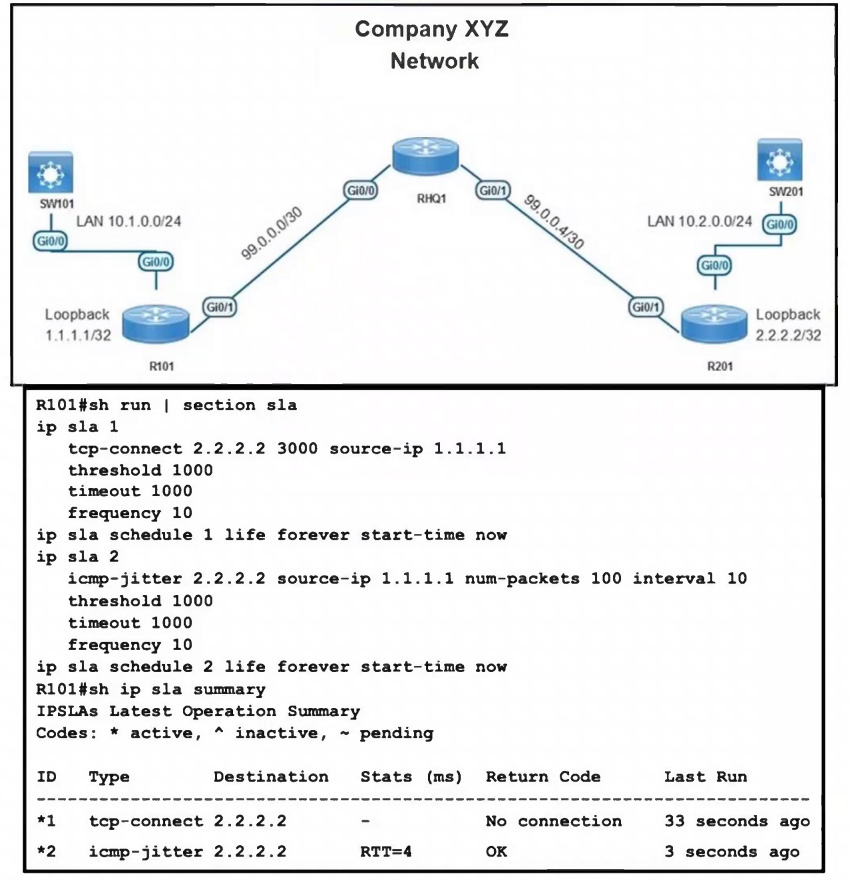
Key Takeaways
This question tests the default IP SLA control port (UDP 1967) and the command that enables the responder; the trap is selecting a tcp-connect or udp-echo responder command that wrongly changes the target address or port.
The IP SLA responder on R201 must accept control messages on UDP port 1967 to support a failed TCP Connect operation on port 3000. The correct command is the global 'ip sla responder', which enables the default control listener without overriding the target address or port.
Common mistake: Many candidates choose D, 'ip sla responder udp-echo ipaddress 1.1.1.1 port 1967', because they focus on the UDP 1967 control port but ignore that the operation is TCP Connect and the address should be R201's 2.2.2.2.
Expert Analysis
Why the Answer Is Correct
The command ip sla responder enables the IP SLA responder on R201, which listens for control messages on UDP port 1967 by default. Because the question explicitly mentions a control connection on UDP 1967, no additional parameters are needed to change the port. The TCP Connect operation on port 3000 is the data probe, but the responder's control channel is the default 1967, so the general responder command is sufficient. This matches the community consensus, as Horsefeathers noted that the "only valid responder commands" include plain ip sla responder. Multiple comments confirm that 1967 is the default listening port and does not need to be configured manually.
Why the Other Options Are Wrong
Option A specifies TCP Connect to 2.2.2.2 on port 3001, which would set up the responder for the wrong TCP port (the failed operation used 3000). Option C uses 1.1.1.1, which is R101's address rather than R201's local address, and would not make R201 listen correctly. Option D configures UDP echo to 1.1.1.1 on port 1967, mixing the wrong operation type with the wrong target IP; the question is about a TCP Connect failure, not UDP echo. As tsamoko pointed out, "originally tcp-connect control packets are to 1967" and the responder only needs the single command.
Community Comment Notes
Most voters chose B (62 votes) and comments reinforce the default-port reasoning. XBfoundX commented, "There is not any kind of reason to specify a default port," summarizing why the bare command wins. Pietjeplukgeluk noted "where the responder listens by default == 1967. so no need to change this default." A minority argued for D, but their reasoning conflates the control port with the operation type. The source key and community majority align with the technical analysis: B is correct.
Official Reference
https://www.cisco.com/c/en/us/td/docs/ios-xml/ios/ipsla/command/sla-cr-book.pdf
This link opens the official vendor documentation in a new tab.
Exam Strategy
When an IP SLA question mentions UDP port 1967, treat it as the default control channel and look for the simplest responder command. Eliminate options that alter the target IP or port unless the question explicitly asks to change defaults, and always match the operation type (TCP Connect vs. UDP echo).
Frequently Asked Questions
Why is 'ip sla responder udp-echo ipaddress 1.1.1.1 port 1967' wrong for this TCP Connect issue?
Doesn't the responder need to know the TCP port 3000 used by the failed probe?
Community Votes
64% of anonymous learners picked answer B. Votes are pick records left by other test-takers — they are not the verified answer.
Discussion 16 contributions
Compiled from public community threads and reader submissions, lightly edited for clarity. Handles and vote tallies are shown as recorded, and comments reflect the views of individual contributors.
From public community threads 16
-
Horsefeathers 👍 8 Answered BIt has to be B. The only valid responder commands are: ip sla responder ip sla responder udp-echo ipaddress (ip-address) port (port) vrf (vrf)
-
Commando1664 👍 6 Answered DIt's D. there are 2 IP SLA configured, one for TCP-Connect and one for Jitter. B would would work but this wants UDP on a specific port. So it is D
-
tsamoko 👍 2 Answered BIt's definitely B. First of all the tcp-connect failed not upd-echo. Second the ip sla responder is not the 1.1.1.1 is 2.2.2.2 of R201. And third and last , originally tcp-connect control packets are to 1967. So the responder need only 1 command "ip sla responder" . If the sender want to change the default behavior of responder and reply to different port then, then the sender and responder need to configure accordingly R101 : tcp-connect 2.2.2.2 80 ( for example) R201: ip sla responder tcp-connect ipaddress 2.2.2.2 port 80
-
[Removed] 👍 2 Answered BB is more acurate i think the whole purpose of this question is to test our knowladge about the port 1967 (which is the default one for listening)
-
Pietjeplukgeluk 👍 2 Answered Bwhere the responder listens by default == 1967. so no need to change this default.
Show 11 more comments
-
Testerchill 👍 1I think its B. Given they specifically said that control port is used. Implying no need to specify port and ip at destination. I.e the control port will notify the destination what socket to listen on. "IP SLAs use the control protocol to notify the IP SLAs Responder to enable the target port temporarily. This action allows the Responder to reply to the TCP Connect operation." - https://www.cisco.com/c/en/us/td/docs/ios-xml/ios/ipsla/configuration/xe-16/sla-xe-16-book/sla-tcp-conn.html
-
jdmpk 👍 1C is correct. To enable the Cisco IOS IP Service Level Agreements (SLAs) Responder for TCP Connect operations, use the ip sla responder tcp-connect ipaddress command in global configuration mode. see pg 272 in config guide: https://www.cisco.com/c/en/us/td/docs/ios-xml/ios/ipsla/command/sla-cr-book.pdf
-
XBfoundX 👍 1It's B There is not any kind of reason to specify a default port. Even if you activate the command in the C answer if you will block the UDP packets the ip sla responder will go down. By default it listen to the port 1967 so no need to specify it
-
XxnightwingxX 👍 1 Answered CC is correct. The shown R1 configuration SLA has no connection and is configured to hit destination address 2.2.2.2 on port 3000. R2 needs to be configured to respond to traffic sourced from 1.1.1.1 on port 3000.
-
bk989 👍 1In my lab environment both B and D works: ip sla 1 tcp-connect 1.1.1.2 30000 source-ip 1.1.1.1 threshold 1 timeout 1 frequency 3 ip sla schedule 1 life forever start-time now
-
kldoyle97 👍 1 Answered BThe responder must match what's configured on the ip sla operation. The responder must be configured with ip target address 2.2.2.2 eliminates C,D leaving B the best option
-
dapardo 👍 1 Answered DD its the right one to me, additionally in other sites its suggested that UDP setup suggested for the responder is the right one
-
d740f62 👍 1 Answered DThe answer is literally on the question itself.
-
Mohaned990_go 👍 1 Answered Dit's correct D
-
Br2 👍 1 Answered BB is correct
-
revul93 👍 1It is B
Reader comments & corrections
No reader corrections yet — spotted an error or have a note? Share it below.
Related Analysis
Practice All 300-410 Questions
Access 159 questions with complete answers and detailed explanations.
View Full 300-410 Practice Test →