MP-BGP IPv6 Route Exchange Troubleshooting
Refer to the exhibit. A network engineer configured routers R1 and R2 with MP-BGP. The engineer noticed that the routers cannot exchange any IPv6 routes; however, the IPv4 neighbor relationship is working fine. Which configuration must the engineer apply to router R2 to exchange IPv6 routes? - 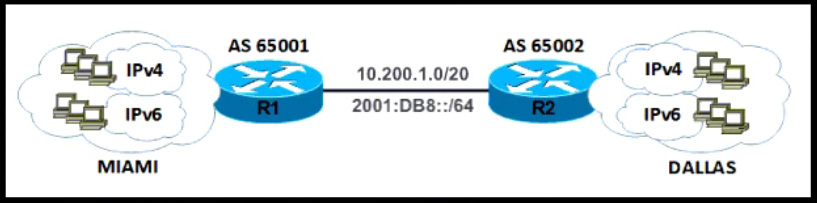
Community Votes
100% of anonymous learners picked answer C. Votes are pick records left by other test-takers — they are not the verified answer.
Community Insight
The question tests the distinction between global IPv6 routing enablement and BGP-specific address-family activation; the trap is overlooking the need for explicit neighbor activation within the IPv6 context.
This question examines MP-BGP configuration requirements for exchanging IPv6 routes, specifically identifying the necessary address-family and network commands. The correct solution involves enabling the IPv6 unicast address family on router R2.
Many candidates select 'ipv6 cef' (Option D) assuming it enables all IPv6 features, but CEF alone does not activate BGP address families or route exchange capabilities.
Community Discussion (3 comments)
Comments & Corrections
No comments yet — spotted an error or have a note? Share it below.
Expert Analysis
Why the Answer Is Correct
Router R2 has an established BGP neighbor with R1, but they are only exchanging IPv4 routes. To exchange IPv6 routes using MP-BGP, R2 must be configured to support the IPv6 unicast address family. Option C provides the complete necessary configuration: it enables IPv6 routing globally, ensures CEF is active for IPv6, enters the BGP configuration mode, defines the IPv6 unicast address family, advertises the specific IPv6 prefix via the 'network' command, and activates the neighbor for this address family. Without these steps, BGP will not process or advertise IPv6 routes.Why the Other Options Are Wrong
Options A and B appear identical in the text provided ('ipv6 unicast-routing'), which suggests a typo in the exam dump or that they represent partial configurations insufficient for BGP operation. Even if distinct, simply enabling 'ipv6 unicast-routing' is a prerequisite but does not configure BGP itself. Option D, 'ipv6 cef', enables Cisco Express Forwarding for IPv6, which is required for efficient packet switching but does not instruct BGP to enter the IPv6 address family or exchange routes. It is a supporting feature, not the primary mechanism for route exchange.Community Comment Notes
Community consensus strongly supports Option C. One user noted that Option C includes the critical 'address-family ipv6' block with neighbor activation, stating "And of course the other commands in option C are correct." Another comment confirmed this is a repeated question where C is the right answer, highlighting the importance of recognizing standard MP-BGP IPv6 templates.Exam Strategy
When troubleshooting MP-BGP, always check both the global IPv6 routing status and the specific BGP address-family configuration. Ensure that neighbors are explicitly activated within the relevant address-family context (e.g., 'neighbor x.x.x.x activate' under 'address-family ipv6 unicast').
Frequently Asked Questions
Why is 'ipv6 unicast-routing' alone not enough for BGP?
Global IPv6 routing enables the stack, but BGP requires the specific 'address-family ipv6 unicast' configuration to process and exchange IPv6 NLRI.
Does 'ipv6 cef' activate BGP IPv6 routes?
No, 'ipv6 cef' only enables hardware forwarding optimization for IPv6 packets; it does not trigger BGP route exchange logic.
Related Analysis
Practice All 300-410 Questions
Access 159 questions with complete answers and detailed explanations.
View Full 300-410 Practice Test →